Hanalei Bay Snorkeling: The Honest Guide to Kauai’s Famous Bay (2026)
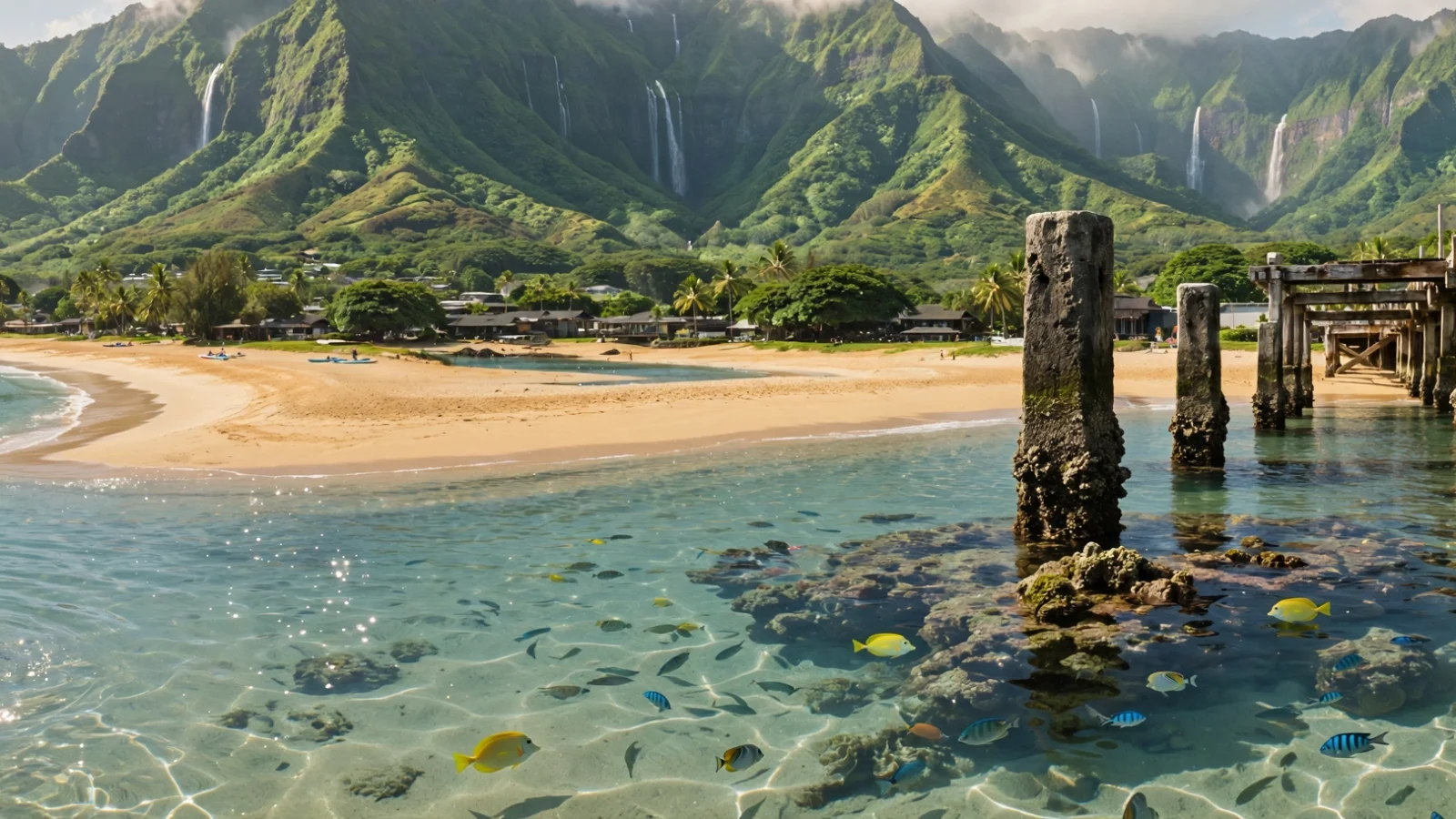
Hanalei Bay is the most beautiful two miles of sand on Kauai — a perfect crescent under green mountains, with a historic pier, a river mouth, and postcard water that turns glassy and blue all summer. It is also, honestly, not a snorkeling beach in the way Tunnels or Anini are snorkeling beaches. The bay floor is mostly sand, there is no reef garden waiting offshore, and in winter the same bay produces some of the most dangerous surf in Hawaii.
So why does this guide exist? Because thousands of people search for Hanalei Bay snorkeling every year, the internet answers them with a contradiction — one respected guide says there is no snorkeling here at all, a family blog ranks it the best snorkeling on Kauai, and tour companies sell a “Bay Reef Lagoon” — and nobody sorts it out. This guide sorts it out. There IS a small, real snorkel here, around the pier, on calm summer mornings. It is modest, it is conditional, and if you understand exactly what it is and is not, you will have a lovely morning — and you will know precisely when to drive ten minutes east or west to a real reef instead.
Hanalei Bay snorkeling at a glance
| Question | Answer |
|---|---|
| Where is it? | Hanalei, on Kauai’s North Shore — a two-mile crescent bay between the Hanalei River mouth (east) and the Waikokos reef (west), backed by Hanalei town |
| The honest verdict | A swim-first bay with one small snorkel: fish around the Hanalei Pier pilings and nearby structure, on calm summer days only. Not a coral reef destination |
| The reef | There is effectively no reef in the bay proper — the bottom is predominantly sand, which is why the fish concentrate on the only structure available: the pier |
| What you see | Small reef fish gathered around the pier pilings, occasional green sea turtles crossing the bay, and — from the sand — one of the great mountain backdrops in Hawaii |
| Best time | Summer, roughly May to September, early morning, after several dry days. That is the whole window |
| The hard rules | Never in winter surf. Never after heavy rain (the Hanalei River turns the bay brown). Never around the river mouth current |
| Lifeguards | Yes — lifeguard towers at Hanalei Beach Park / Pavilion and Pine Trees, daytime hours posted at the towers |
| Parking | Free but limited: the small Black Pot / pier lot (roughly 40 cars) and Wai’oli Beach Park; both fill early in summer |
| Facilities | Restrooms, showers and picnic areas at Black Pot Beach Park and Wai’oli Beach Park; gear rental and food in Hanalei town |
| Who it suits | Families already based in Hanalei who want a gentle pier-side look at fish — not snorkelers making a special trip |
Start with the island picture in our Kauai snorkeling hub, because on the North Shore the skill is choosing the right beach for the day — and Hanalei is one option in a line of very different ones.
The contradiction, resolved: can you snorkel Hanalei Bay or not?
Three claims circulate about this bay, and each holds a piece of the truth:
- “There is no snorkeling at Hanalei Bay.” One long-standing Kauai beach guide says exactly this — and then, in the same breath, notes that fish live under the pier. What it means is: there is no reef snorkeling here. On the question of a coral garden offshore, it is simply correct.
- “Hanalei is great family snorkeling.” Family and roundup blogs rank the bay highly because the summer water by the pier is shallow, calm and sandy-bottomed — wonderful for a child’s first mask-and-snorkel splash. What they are rating is the swimming, and the small fish around the pier are a bonus, not a reef.
- “Snorkel the Bay Reef Lagoon on a tour.” The kayak-and-snorkel tours that paddle the Hanalei River and finish in the bay describe their snorkel stop in glowing terms. The stop is real — guides take guests to the bay’s most structured water — but calibrate your expectations to a sandy bay with patches of life, not to the coral gardens the phrase suggests.
The synthesis, which the rest of this guide is built on: Hanalei Bay offers one conditional micro-snorkel — the pier area, in summer, on a calm morning — inside an otherwise swim, surf and scenery bay. Plan it that way and it will not disappoint you. Plan it as a reef trip and it will.
The one snorkel: around Hanalei Pier
The pier is the east end of the bay, at Black Pot Beach Park, where the beach is at its most sheltered. Built in the late nineteenth century to load rice and sugar, made famous by the film of South Pacific, and rebuilt after the record 2018 floods, it is now the bay’s gathering place — fishing from the deck, kids jumping at high tide, and, underneath, the bay’s only real fish habitat.
Here is how the snorkel works:
- Enter from the sand beside the pier, not from the pier itself. Jumping is for the end of the deck into deep water and is a local ritual, not a snorkel entry — wade in from the beach on the pier’s sheltered side and swim out to the pilings.
- Work the pilings slowly. Structure is everything in a sandy bay. The pier’s pilings and their shade hold the small reef fish that have nowhere else to gather — the same reason fish stack up on any isolated structure. Move slowly, look into the shadow lines, and check the bottom around the base for resting life.
- Expect scale honestly. This is a look-at-fish snorkel measured in tens of minutes, not a reef expedition measured in hours. Green sea turtles cross the bay and are seen near the pier area — enjoy one at the legal 10-foot distance set out in our snorkeling with turtles guide if you are lucky, but do not come counting on it.
- Mind the shared water. The pier is fished from above — lines and hooks are a real consideration, so give the deck’s fishing side a wide berth and stay visible. Swimmers, jumpers, beginner surf lessons and kayaks launching for the river all share this corner; it is the bay’s busiest water on a summer morning.
- The river is right there — stay out of its lane. The Hanalei River reaches the sea just east of Black Pot. Its outflow carries current and, after rain, mud. Snorkel west of the pier, never in the river mouth itself, and treat brown water anywhere in the bay as a cancelled session.
That is the whole snorkel, described without inflation. On a glassy July morning, with the mountains reflected and the pilings alive, it is genuinely charming. It is also the ceiling of what this bay offers — everything beyond it lies at other beaches, covered below.
The bay in four zones — and what each means for a snorkeler
Hanalei’s two miles are not one beach but a sequence, east to west:
| Zone | Where | Character | For a snorkeler |
|---|---|---|---|
| Black Pot / Hanalei Pier | East end, by the river mouth | The sheltered corner; beach park, pier, kayak launching | The only snorkel — pier pilings, summer mornings. Watch fishing lines and the river lane |
| Hanalei Pavilion / Beach Park | ~600 yards west of the pier | Lifeguard tower, restrooms, showers, the main family beach | Swimming beach. Sand bottom, nothing to snorkel over — but the safest family base on the bay |
| Pine Trees / Wai’oli Beach Park | Mid-bay | Grass park, parking, the first surf break surfers check in winter | A surf zone in season, a swim in flat summer. No snorkel structure |
| Waikokos | West end | The bay’s exposed end, reef-fringed surf breaks offshore | Surf, not snorkeling — the offshore reef here is a wave machine, not a lagoon. Do not swim out to it |
Reading the bay this way explains the mixed reviews online: a visitor who based at the Pavilion in August and poked around the pier remembers gentle family snorkeling; a visitor who walked the mid-bay in January remembers a magnificent, empty, dangerous surf beach. Both visited Hanalei Bay.
Seasons: the summer-only rule
No section of this guide matters more than this one. Kauai’s North Shore faces the open Pacific, and its year divides in two:
- Summer (roughly May to September) is the snorkeling window — and really the only one. The bay turns placid, often lake-flat for days, the pier snorkel works, and the whole North Shore reef system, from Anini to Ke’e, comes alive. This is also when every other visitor has the same idea: arrive early.
- Winter (roughly October to April, peaking November to March) rewrites the bay completely. North Pacific swells arrive as powerful surf — the breaks off Pine Trees and Waikokos are serious waves — with strong currents and shorebreak along the sand. Swimming itself becomes dangerous on big days, and snorkeling is simply off the table anywhere in the bay, pier included on the worst days. Winter Hanalei is for watching surf from the sand, and it is spectacular at exactly that.
- The shoulder weeks are decided day by day. In April and October the bay can be flat or firing within the same week. The lifeguards’ call is the call — if the tower says no, the answer is no, whatever the forecast app said at breakfast.
Our best time to snorkel in Hawaii guide sets out the island-by-island version of this pattern; on Kauai it is at its most extreme, because the north and south shores trade seasons almost perfectly — which is why the winter alternative at the end of this guide is a drive south, not a different north beach.
The brown-water rule: rain, the river, and visibility
Hanalei is one of the wettest inhabited valleys in Hawaii, and the Hanalei River delivers that rain straight into the bay’s east end. Two consequences govern snorkeling here more than surf forecasts do:
- After heavy rain, the bay goes brown. River runoff carries sediment and everything the valley washes down, visibility collapses to nothing, and the standard public-health advice applies: do not enter brown water. Local guides note that runoff interferes with swimming at Hanalei more often than surf does. Wait for the water to clear — in summer that is usually a day or two after the rain stops, and the waterfalls on the mountains behind town are the consolation prize in the meantime.
- The river mouth always carries current. Even on clear days, the outflow lane beside Black Pot is moving water with a seaward set. It is a kayak route and a fish lane, not a swim zone. Keep the pier snorkel west of the pier and well clear of it.
A practical morning check follows from both rules: stand on the sand and look at the colour before you look at the waves. Blue-green and clear to the bottom in the shallows means go. Tea-coloured, murky, or debris-streaked means the bay is a beach walk today — and a reef trip elsewhere only if that coast has had no rain either.
Safety at Hanalei Bay
Hanalei is a lifeguarded, family-loved bay that still demands respect, because its hazards are seasonal and easy to underestimate on a pretty day:
- Swim at the towers. Lifeguards staff the Hanalei Beach Park / Pavilion area and Pine Trees in the daytime. Base a family day — and any pier snorkel — within reach of a tower, and ask about the day’s currents before entering; conditions here change with the tide and the swell, not the calendar.
- Winter surf is a spectator sport. If sets are breaking across the bay, nobody snorkels and only expert surfers swim. Shorebreak on this sand can injure adults, not just children — watch from well up the beach.
- The pier is shared infrastructure. Fishing lines and hooks from the deck, jumpers at its end, and boat and kayak traffic launching at Black Pot all concentrate where you want to snorkel. Stay close to the pilings on the sheltered side, stay shallow, and keep a buddy’s eyes on the surface traffic — the full habit set is in our snorkeling safety guide.
- No lifeguard covers the far west end. Waikokos and the outer reef are expert water year-round. The snorkel in this guide never goes there, and neither should a swim.
Beginners are welcome at the pier snorkel in summer — it is shallow, sandy and supervised — provided the day is calm and clear. Our beginner’s guide to snorkeling in Hawaii covers the first-session skills; practise them in the shallows here before you ever point yourself at a real reef.
Parking, access and facilities
Hanalei town is small, the road in is two lanes over a one-lane bridge, and the bay’s parking is the sum of a few small lots — plan accordingly:
- Black Pot Beach Park (pier end): the lot for the snorkel — small, roughly 40 cars, free, and full early on summer days. Restrooms, showers and picnic space are in the park. If it is full, do not invent a space on the roadside by the river; use the town or Wai’oli options and walk.
- Wai’oli Beach Park (Pine Trees): the mid-bay option, grass, shade, facilities and its own parking — a longer walk back east to the pier, along a very beautiful beach.
- Hanalei town: a short walk from the pier end, and the practical base — snorkel gear rental shops, food, coffee and shave ice are all here. There is no rental stand on the beach itself, so collect gear in town before you head to the water, and check it fits — the gear checklist takes two minutes.
- No fee, no reservation applies to the beach itself: Hanalei Bay is a public county beach park. What does book out is everything around it — summer parking by mid-morning, kayak-and-snorkel tours, and the Ha’ena State Park reservations required further west for Ke’e Beach, which are covered in that guide.
Driving in from the south, allow the better part of an hour from Lihue in summer traffic, yield at the one-lane Hanalei Bridge, and treat the drive as part of the day: it is one of the great coastal approaches in Hawaii.
Where to actually snorkel near Hanalei (the decision table)
This is the section the roundups never write. You are based in or near Hanalei with a mask in the car. Where should you point it, by day type?
| Your day | Go here | Why |
|---|---|---|
| Glassy summer morning, you’re already in town, kids in tow | Hanalei Pier (this guide) | Zero drive, lifeguards, a gentle pier-pilings look at fish, then breakfast in town |
| Calm summer day, you want a real reef | Tunnels Beach — ~15 min west | Kauai’s great shore reef: lava tubes, turtles, the full cast. Parking is the battle, not the snorkeling |
| Calm day, beginners or a nervous swimmer | Anini Beach — ~10 min east | The North Shore’s calm lagoon: reef-protected, shallow, the forgiving first reef |
| Summer, booked ahead, end-of-the-road scenery | Ke’e Beach — ~20 min west | A postcard lagoon inside Ha’ena State Park — advance reservations required, plan days ahead |
| Summer, staying in Princeville, short on time | Hideaways Beach — ~10 min | A proper little reef below the cliff, if the steep trail and summer-only calm align |
| Any winter day, or after heavy rain anywhere north | Poipu Beach — ~75 min south | The south shore’s season is the north’s off-season: Poipu is Kauai’s reliable winter snorkel |
The pattern to remember: Hanalei Bay is the view, the swim and the pier-side taster. The North Shore’s reefs begin a few minutes either side of it — and knowing that before you drive north is worth more than any single tip in this guide.
Things to do in Hanalei beyond snorkeling
Hanalei Bay’s snorkeling is a footnote — this guide has said so from the start — but Hanalei itself is a full day, and a good one. The same bay that gives you a small pier snorkel on a calm summer morning gives you beginner surf, a river to paddle, a ridge to climb, taro fields to look over, and a small town that feeds you well afterwards. The plan below is the day that works: water in the morning, land in the afternoon, the pier again at sunset. If you are planning the wider island, start with our things to do in Kauai guide — this section is the Hanalei chapter of it, with the snorkeling detail the general guides skip.
Walk the bay and the pier at sunset
The pier is Hanalei’s gathering place twice a day: the snorkel spot in the morning, the sunset spot in the evening. Walk out to the end of the deck as the light drops, watch the surfers on the inside breaks, and look back at the mountains streaked with waterfalls after rain. It costs nothing, needs no reservation, and it is the single best free thing in Hanalei. The same pier is where the morning snorkel happens — fish around the pilings, entered from the sand on the sheltered side, on calm summer days only — so one structure carries both halves of the day. Fishing lines come off the deck, so give the fishing side room even at sunset.
Learn to surf in the bay
Hanalei Bay is one of the easier places in Hawaii to learn to surf. The curve of the bay blocks much of the swell, so the inside breaks near the pier stay small and forgiving for beginners, while the outer breaks give experienced surfers something to work with. Several shops in town run lessons and rent boards — Love Big Island’s Hanalei guide recommends Hawaiian Surfing Adventures — and a lesson here is a gentler first session than almost anywhere else on the North Shore. The same seasonal rule as the snorkel applies in reverse: in winter the bay is a spectator sport, with powerful surf and shorebreak, and nobody learns to surf in it. Summer mornings are the window, and the lifeguard towers at Hanalei Beach Park and Pine Trees are the place to ask about the day’s conditions before you paddle out.
Kayak the Hanalei River
The Hanalei River reaches the sea just east of Black Pot, and paddling it is the quietest way to see the valley. The river runs right through the Hanalei National Wildlife Refuge — 917 acres of wetland and taro fields managed as habitat for endangered native waterbirds — so the paddle is green walls, taro, and birdsong rather than open ocean. Beginners can book a guided trip with Kayak Hanalei and drift downstream on the river into the bay, or rent a kayak in town and poke around the bay on your own. Stronger paddlers head out of the bay and along the base of the Nāpali cliffs; Kayak Kauai and Nāpali Kayak guide those long-distance trips from spring through fall, and Nāpali Kayak’s overnight camping trip needs a separate DLNR camping permit. Stay out of the river mouth itself when you swim or snorkel — its outflow carries current and, after rain, mud — but from a kayak it is the route, not the hazard.
Hike the ʻŌkolehao Trail
The ʻŌkolehao Trail starts close to Hanalei and climbs the ridge behind the refuge, with views over Hanalei, Princeville, the Kīlauea Lighthouse, and the taro fields below. It is short but often muddy, so wear shoes you do not mind trashing, and go after a dry spell if you can — the same rain that turns the bay brown turns this trail to slick clay. The payoff is the view back over the whole bay: the two-mile crescent, the pier, and the mountains behind town in a single frame. It is the best short hike in Hanalei, and the one that explains why the town sits where it does.
Look over the taro fields at Hanalei Valley Lookout
Drive out of Hanalei toward Princeville and pull over at the Hanalei Valley Lookout on Kūhiō Highway, the roadside overlook above the refuge and its taro fields. This is the view every Hanalei postcard is taken from: green patchwork, the river winding through it, and the mountains behind. The refuge itself stays mostly closed to the public for restoration, so the lookout — and the river paddle, and the ʻŌkolehao Trail above — are how you actually see it. To get closer to the crop itself, book a taro farm tour: the family behind the Hanalei Taro & Juice food truck farms taro in the valleys behind town and runs farm and historic rice-mill tours, including the Haraguchi Rice Mill, the only one left in all of Hawaii, farmed by the same family for six generations since 1924.
Tour Limahuli Garden and Preserve
Just west of Hanalei, Limahuli Garden and Preserve is a botanical garden and nature preserve in a steep valley, run by the National Tropical Botanical Garden. A self-guided loop trail winds past native plants and old Hawaiian agricultural terraces, with the valley walls and the ocean behind them. It is open Tuesday through Friday and closed on weekends; reserve online to hold a parking spot, and book ahead if you want a guided tour rather than the self-guided walk. It is the quietest hour in Hanalei — no surf, no crowds, just the valley — and the best answer to the question of what the North Shore looked like before the road arrived.
Eat your way through Hanalei town
Hanalei has the North Shore’s best cluster of places to eat for a town its size. Start with the food trucks: Hanalei Taro & Juice and Fresh Bite Kauaʻi for a quick lunch, Holey Grail for taro donuts, and Wishing Well Shave Ice, which the family guides rate the best on the island. For sit-down dinner, the town classics are Postcards, Kalypso Island Bar & Grill, Tahiti Nui, and the Hanalei Dolphin for sushi and seafood on the river; Hanalei Bread Co does breakfast. Between meals, walk the town itself: the little green Waiʻoli Huiʻia Church and the Waiʻoli Mission House, now a museum, are the historic heart of Hanalei, and the shops and galleries along the main road are the place to buy the thing you will actually keep. Gear rental, food, coffee and shave ice are all here — there is no rental stand on the beach itself, so collect everything in town before you walk to the water.
See Lumahai Beach — from the sand
About a mile and a half west of Hanalei, Lumahai Beach is the golden crescent made famous by the film South Pacific, and it is the most beautiful beach on this stretch of coast — and the one to admire without getting in the water. Lumahai has no protective reef, so waves break directly onto steep sand with a heavy shorebreak, strong rip currents and powerful backwash; there is no lifeguard and no facilities, and people have drowned here, which is why locals grimly call it “Luma-die.” The eastern end, Kahalahala, can be calm enough on dead-calm summer days, and the freshwater river pools are calmer in summer, but the honest rule for visitors is the one every Kauai guide gives: stay on the sand, take the photos, wade ankle-deep at most, stay off the wet lava rocks at either end, and never swim near the river mouth, where rip currents are common. If the waves are too rough here, the answer is not a braver entry — it is the drive back to the lifeguarded water at Hanalei Pier.
Day-trip the Nāpali Coast by boat or on foot
Hanalei is the last town before the road ends at the Nāpali Coast, which makes it the natural base for the coast itself. Boat and raft tours leave from Hanalei for the cliffs and sea caves, with snorkel stops along the way — departures, seasons, and raft versus catamaran options are in our Na Pali Coast snorkeling guide. On foot, the Kalalau Trail starts at Keʻe Beach, about twenty minutes west inside Hāʻena State Park: the first two miles along the coast reach Hanakāpīʻai Beach, and two more miles up the valley reach Hanakāpīʻai Falls, about eight miles round trip. The valley stretch is unmaintained and rated for experienced hikers only, the stream floods fast, and Hanakāpīʻai Beach itself has strong currents and no safe swimming. Hiking the full eleven-mile Kalalau Trail and camping overnight needs a DLNR permit, released ninety days out, and Hāʻena State Park caps daily entry, so you need an advance parking or shuttle reservation before you go. The same end of the road holds the reefs this guide points you to — Tunnels Beach, Anini Beach and Keʻe Beach — so the Nāpali day and the snorkel day are the same drive, planned once.
Frequently asked questions
Can you snorkel at Hanalei Bay?
Yes, in one small and conditional way: around the Hanalei Pier pilings at Black Pot Beach Park, on calm summer days, where small reef fish gather on the bay’s only structure. There is no reef or coral garden in the bay itself — the bottom is predominantly sand — so if you want a true reef snorkel, nearby Tunnels Beach and Anini Beach are the real answers, a short drive away.
Is Hanalei Bay good for snorkeling?
It is good for a gentle first look at fish and poor as a destination reef — both halves matter. Families based in Hanalei in summer will enjoy the shallow, lifeguarded pier area. A snorkeler travelling to Kauai for the snorkeling should base reef days at Tunnels, Anini or Ke’e in summer, and at Poipu in winter, and treat Hanalei as the beautiful swim-and-scenery day between them.
Where is the best snorkeling spot in Hanalei Bay?
At the pier. The pilings at Black Pot, at the bay’s sheltered east end, hold the fish because they are the only structure in a sandy bay. Enter from the sand on the pier’s sheltered side, work the pilings slowly, stay clear of fishing lines from the deck above, and stay west of the Hanalei River mouth — its current and runoff are never part of the snorkel.
When is the best time to snorkel Hanalei Bay?
Summer, roughly May to September, in the early morning, after a run of dry days. That combination gives you the flat water the pier snorkel needs and the clear water the river allows. In winter (roughly October to April) north swells make the bay dangerous and snorkeling is off the table; after heavy rain in any season, wait until the water is no longer brown.
Is Hanalei Bay safe for swimming and kids?
In summer, at the lifeguarded sections by Hanalei Beach Park and Pine Trees, it is one of Kauai’s favourite family swims — shallow, sandy and supervised in the daytime. In winter it is not a swimming beach on surf days at all: powerful surf and currents take over the whole bay. In every season, ask the lifeguards, keep children in the tower zones, and stay out of brown water after rain.
Are there turtles at Hanalei Bay?
Green sea turtles cross the bay and are seen around the pier area, but there is no cleaning station or resident reef population here as there is at Tunnels — a turtle at Hanalei is a pleasant chance encounter, not an expectation. Keep the standard 10-foot distance, never chase or touch one, and head to Tunnels or Anini if turtles are the point of the day.
Where do you park for Hanalei Bay?
At the small free lot at Black Pot Beach Park by the pier (roughly 40 cars, full early in summer), at Wai’oli Beach Park mid-bay, or in Hanalei town a short walk away. There is no beach fee and no reservation for the beach itself. On a summer morning, assume the pier lot is gone by mid-morning and plan the town-and-walk option from the start.
Can you snorkel Hanalei Bay in winter?
No. From roughly October to April the North Shore receives large Pacific swells, and Hanalei Bay becomes a serious surf beach with strong currents and shorebreak — conditions for expert surfers and for watching from the sand, not for entering the water with a mask. Kauai’s winter snorkeling is on the south shore, at Poipu Beach and Lawai Beach, where the season is reversed.
What else is there to do in Hanalei besides snorkeling?
Plenty — the snorkel is the smallest part of a Hanalei day. Learn to surf in the bay, kayak the Hanalei River through the wildlife refuge, hike the ʻŌkolehao Trail, look over the taro fields from Hanalei Valley Lookout, tour Limahuli Garden, eat through the food trucks and restaurants in town, photograph Lumahai Beach from the sand, and day-trip the Nāpali Coast by boat or on the Kalalau Trail. The bay itself is the swim and the sunset; the reefs are ten minutes east or west at Tunnels and Anini.
Is Hanalei worth a full day?
Yes. A good Hanalei day runs: early morning at the pier for the calm water and the small snorkel, breakfast in town, a kayak trip or the ʻŌkolehao Trail before lunch, the Valley Lookout and Limahuli Garden in the afternoon, and the pier again at sunset. Give it two or three days and you add a Nāpali boat tour, a full reef day at Tunnels Beach, and Keʻe Beach at the end of the road. What Hanalei is not worth is a special trip for the snorkeling alone — base the reef days at Tunnels, Anini or Keʻe in summer, and at Poipu in winter, and let Hanalei be the beautiful swim-and-scenery day between them.
What are the best free things to do in Hanalei?
The beach itself is free — there is no beach fee and no reservation for Hanalei Bay — and the best of it costs nothing: walking the two-mile crescent, the pier at sunset, the Hanalei Valley Lookout on Kūhiō Highway, the ʻŌkolehao Trail, and the green Waiʻoli Huiʻia Church and the town’s shopfronts. Parking is free too, at the small Black Pot lot by the pier, at Waiʻoli Beach Park mid-bay, and in town — though all three fill early on summer days, so the free day starts early. What does cost money is everything around the beach: kayak and surf lessons, the Limahuli Garden reservation, the Nāpali boat tours, and the Haʻena State Park parking or shuttle for Keʻe Beach.
The verdict
Hanalei Bay does not need to be a great snorkeling beach, because it is already a great everything-else beach — the swim, the pier at sunset, the mountains after rain, the town behind it. Its snorkeling is a footnote, and this guide has written the footnote accurately: a pier, a calm summer morning, a little gathering of fish in the shade of the pilings, and the good sense to know that the reefs start ten minutes down the road. Come for the bay. Bring the mask for the pier. Then drive to Tunnels with your expectations exactly where the last two miles of sand set them — high, and pointed at the right beach.
For boat-only Na Pali snorkeling, see our Na Pali Coast snorkeling guide for departures, seasons, and raft versus catamaran options.