Kaimana Beach Snorkeling: Waikiki’s Quiet Reef at Sans Souci (2026)
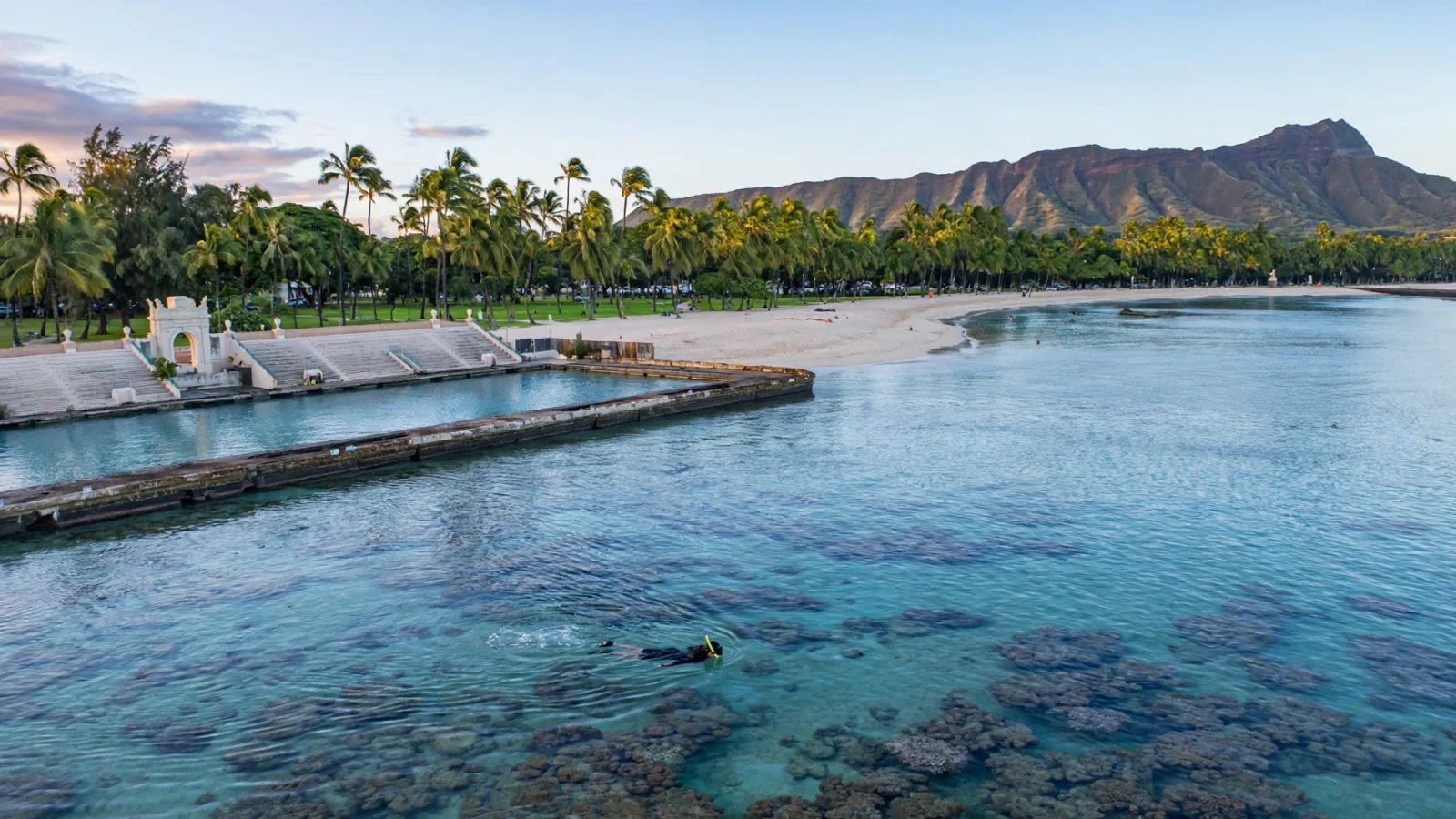
Waikiki has a loud end and a quiet end, and the snorkeling belongs to the quiet one. At the Diamond Head edge of the strip, past the Aquarium and the shuttered War Memorial Natatorium, Kaimana Beach — the old Sans Souci Beach — fronts a shallow, protected reef flat where the fish are protected by law, the water is calm enough for a first-ever snorkel, and most of the crowd is still a fifteen-minute walk away eating breakfast. It is the best snorkeling you can reach on foot from a Waikiki hotel, and this guide treats it that way: where the reef actually is, the one channel you must never drift into, and the morning hour that decides whether the water is clear or milky.
Honesty first, as always. This is a small urban reef, not Hanauma Bay and not a boat-trip reef — the coral is patchy, the flat is shallow enough to stand on (do not), and a stirred-up afternoon here can look green and empty. What Kaimana offers instead is unbeatable in its own category: a living reef flat inside Waikiki’s protected waters, turtles cruising through most mornings, a lifeguard tower on the sand, and zero logistics — no reservation, no parking hunt if you walk, no boat. Come early, stay inside the reef, and it delivers exactly what it promises.
Kaimana Beach snorkeling at a glance
| Question | Answer |
|---|---|
| Where is it? | The Diamond Head (east) end of Waikiki, Oahu — beside the Waikiki War Memorial Natatorium and the Waikiki Aquarium, fronting Kapiolani Park and the Kaimana Beach Hotel on Kalakaua Avenue |
| The draw | The best walk-in snorkeling in Waikiki — a shallow protected reef flat a short swim off a quiet, local-leaning beach |
| The reef | A shallow reef flat just offshore, generally only a few feet deep, inside the protected Waikiki shoreline waters — fish here are used to people |
| What you see | Unicornfish, yellow tang, parrotfish, triggerfish including the humuhumunukunukuapua’a, moray eels in the structure, and green sea turtles most calm mornings; Hawaiian monk seals haul out on the sand |
| Best time | Early morning — before feet and wind stir the sediment bottom and visibility drops |
| The hard rule | Stay inside the reef flat. The Kapua Channel is the surfers’ and swimmers’ access corridor through the reef — it carries current, and the outer reef edge is dangerous when south swell is running |
| Lifeguards | Yes — Honolulu Ocean Safety Tower 2H on the beach (daytime hours, posted at the tower) |
| Parking | No beach lot — metered street parking on Kalakaua Avenue and around Kapiolani Park; most visitors staying in Waikiki should walk |
| Facilities | Restrooms and showers by the Natatorium / beach park, grass and shade in Kapiolani Park behind the beach |
| Who it suits | Beginners, families and anyone staying in Waikiki who wants a real reef snorkel with no car, no tour and no reservation |
Start with the island picture in our Oahu snorkeling hub, and if this is a first snorkel, skim our beginner’s guide to snorkeling in Hawaii on the walk over — this flat, calm reef is precisely the water it was written for.
Two names, one beach: Kaimana and Sans Souci
You will see both names on maps, signs and guides, and they mean the same stretch of sand. Sans Souci — French for “without a care” — is the old name, from the Sans Souci Hotel that stood here in the 1890s; Robert Louis Stevenson stayed in 1893 and praised the clear sea water and heavenly sunsets. Kaimana, the name locals use today, is the Hawaiian word for “diamond”, a nod to Diamond Head rising at the end of the road. The beach itself is one small, wide crescent between the Natatorium wall and the Gold Coast condominiums, with Kapiolani Park’s grass and ironwood shade directly behind it.
One naming wrinkle worth knowing: the paved promenade running west from the Natatorium toward Queen’s Beach is also called Sans Souci by some guides, and at high tide that stretch is mostly seawall with little sand. The swimmable, snorkelable beach — the one this guide is about — is the sand in front of the Kaimana Beach Hotel, east of the Natatorium. If you are standing on sand with a lifeguard tower in view, you are in the right place.
The reef: where it is and how to snorkel it
Kaimana’s snorkeling is a reef-flat snorkel, and understanding the flat is the whole game:
- The entry is as gentle as Waikiki offers — walk in over sand anywhere along the crescent. The bottom shelves gradually; there is no shore break to time on a calm day and no rock ledge to cross.
- The reef flat begins a short swim offshore, where the pale sand gives way to darker reef structure. The flat is shallow — generally only a few feet deep at the inside edge — and the life concentrates where rock and coral structure meets open sand. Work slowly along those edges rather than crossing the middle of the flat: fish hold on structure, feed along its margins, and shelter in its holes.
- The residents are the classic Waikiki reef cast, and because this shoreline sits within Waikiki’s protected marine-life district waters, they are notably unbothered by snorkelers: unicornfish and yellow tang grazing the reef, parrotfish crunching coral, triggerfish — including Hawaii’s state fish, the humuhumunukunukuapua’a — patrolling their patches, and moray eels tucked into the structure (look, never reach). Green sea turtles cruise the flat and the channel edges, most reliably in the calm of the morning; give them the 10-foot distance our snorkeling with turtles guide sets out.
- Stand on sand, never on reef. The flat is shallow enough that standing is tempting — and standing on coral kills the very thing you came to see, as well as risking cuts and urchin spines. If you need to rest or adjust a mask, swim back to the sandy patches inside the flat and stand there.
Rate it honestly: a living, fishy, beginner-perfect flat — not a coral garden to rival the outer reefs. For Waikiki’s bigger turtle show, the boat-only Turtle Canyon reef sits offshore of the main strip; for the island’s flagship walk-in reef, Hanauma Bay is the half-day trip east. Kaimana is the reef you can do before breakfast, in the middle of a city stay, and that is its own kind of best.
The Kapua Channel rule — the safety centrepiece
Every Waikiki reef has one feature that matters more than all the fish in it, and here it is the Kapua Channel: the deeper corridor cut through the reef off Kaimana that swimmers, kayakers and surfers use to reach the open ocean and the Old Man’s surf break beyond. Lap swimmers train in it, which tells you what it is — a channel, with moving water in it.
The rules that follow from that:
- Snorkel the flat, not the channel. The channel is a transit corridor with current that can pull seaward, especially on a falling tide or when surf is pumping outside. It is not a snorkel route and it is not a shortcut to deeper water.
- The outer reef edge is the danger line. Where the flat ends and the ocean begins, breaking south swell exposes sections of reef and pushes water across it. On any day with real south swell running — most common in summer — the outer edge is for watching from inside, not exploring. Local guidance is blunt on this and so is this guide.
- Stay oriented. The Natatorium, the lifeguard tower and Diamond Head are your landmarks. Check your position against them every few minutes; a slow drift along the flat toward the channel is easy not to notice in a mask.
- Use the lifeguard. Tower 2H staffs this beach in the daytime. If you are unsure where the channel runs today or how the flat looks, ask before you get wet — that is what the tower is for. Our snorkeling safety guide covers the full habit set.
None of this should scare a beginner off the inner flat on a calm morning — it is one of the most forgiving snorkels on Oahu. It should keep everyone, beginner and expert alike, inside the reef and out of the channel.
Protected water: the Waikiki MLCD and what it means for you
The reef fronting this end of Waikiki lies within and beside the Waikiki Marine Life Conservation District — 76 acres of protected reef established in 1988, running along the shoreline from the Kapahulu groin past the Aquarium toward the Natatorium. Kaimana sits at the district’s Diamond Head edge, and the practical effect is the same whichever side of the survey line a given patch of reef falls on: in the MLCD, taking marine life is prohibited — no fishing, no collecting, no feeding — and decades of that protection are why the fish here hold still for snorkelers instead of scattering.
For a visiting snorkeler the rules are simple and worth stating plainly: look at everything, take nothing, touch nothing, feed nothing. The full etiquette — for this reef and every Hawaiian reef — is in our Hawaii coral reef snorkeling guide.
Conditions: the morning clock, seasons and when to skip
Kaimana snorkels year-round, but it does not snorkel all day. Three patterns decide your session:
- The visibility clock. The bottom in and around the flat is sediment and fine sand, and every foot, fin and shore-break ripple stirs it. First thing in the morning — before the beach fills and before the trade winds texture the surface — the water is at its clearest and the turtles are at their most active. By midday on a busy day the same reef can look milky green. This is a pre-breakfast snorkel by design; our best time to snorkel in Hawaii guide generalises the rule, and nowhere in Waikiki is it truer than here.
- Summer south swell. The south shore’s surf season is summer, and a strong south swell is Kaimana’s one real condition hazard: surf breaking on the outer reef, water pushing across the flat, and an energised channel. Inside-flat snorkeling can still work on smaller swell days, but the outer edge is off limits and the channel is to be given a wide berth. In winter, when the North Shore takes the big swells, this coast is at its calmest.
- After heavy rain. Waikiki’s water quality is ruled by runoff, and Kaimana holds one structural advantage: it sits at the far eastern end of the strip, the greatest distance from the Ala Wai Canal’s outflow at the western end. After storms the east end clears first — but “first” is not “immediately”. After heavy rain, give any urban beach a day or two, and never snorkel brown water.
- Jellyfish and limu. Occasional jellyfish and stinging limu (seaweed) are reported on this shoreline, more in summer. A quick look at the sand line and a word with the lifeguard covers it; a rash guard covers the rest — see the snorkel gear checklist.
Skip the session entirely when: the outside surf is breaking heavily across the reef, the water is brown or murky to the bottom, or the lifeguard advises against it. Diamond Head, the Aquarium and the park make an excellent dry plan B, five minutes apart.
Monk seals on the sand
Hawaiian monk seals — critically endangered, federally protected, and completely unbothered by beach schedules — regularly haul out to rest on Kaimana’s sand, and mothers have nursed pups in these calm shallows, most often noted in spring. If you find a seal on the beach, or a roped-off section of sand, that is the system working: stay at least 50 feet away (further for a mother and pup), keep voices down, never approach for a photo, and let the roped perimeter do its job. Response volunteers are often nearby and happy to answer questions. A seal sighting from a respectful distance is a privilege of this beach, not an obstacle to it — the reef is still there, a few metres along the sand.
Parking, access and facilities
If you are staying anywhere in Waikiki, walk. Kaimana is a flat, shaded fifteen-minute stroll along Kalakaua Avenue from the centre of the strip — past the zoo and the Aquarium — and walking deletes this beach’s only real friction, which is parking.
Arriving by car, set expectations: there is no dedicated beach lot. Parking is metered street parking on Kalakaua Avenue and around Kapiolani Park, plus limited side-street parking in the Gold Coast neighbourhood; it fills on weekends and event days in the park. Read the meter and signage rules carefully — this is central Honolulu, and enforcement is real.
Facilities are genuinely good for a city beach: a staffed lifeguard tower (Tower 2H), restrooms and outdoor showers by the Natatorium end of the beach park, and Kapiolani Park directly behind the sand with grass, shade trees, picnic space and drinking fountains. What there is not: gear rental or vendors on this beach. If you need a mask and fins, rent from any Waikiki rental shop on your walk over — do not arrive expecting a beach shack, because arriving gearless with no plan is the one way to waste Kaimana’s morning window. Food is the Hau Tree restaurant at the Kaimana Beach Hotel on the sand and the cafes of Kapahulu Avenue a block inland — both easy, neither cheap, so a picnic from the park side is the local play.
The landmarks in the waterline: Natatorium and aquarium
No other Waikiki snorkel comes with this much built history at its edge. The long concrete facade beside the beach is the Waikiki War Memorial Natatorium — a saltwater swimming stadium opened in 1927 as a living memorial to Hawaii’s World War I servicemen, where Duke Kahanamoku-era swimmers trained and raced. It has been closed for decades, and its future is debated to this day; from the water it is simply the unmistakable landmark that tells you where you are. A block west, the Waikiki Aquarium (founded in 1904, one of the oldest in the United States) displays the very reef system you just snorkeled — the single best post-snorkel hour in Waikiki is mask off, then twenty minutes in front of its reef tanks putting names to what you saw. And the trivia that ties the beach to sporting history: the original Ironman triathlon started its swim here in 1978, before the race grew up and moved to Kona — where, fittingly, you can now snorkel the calm cove at Kamakahonu Beach in the middle of that town too.
Kaimana vs Waikiki’s other snorkels
| Kaimana / Sans Souci | Queen’s Beach | Central Waikiki | Turtle Canyon | Ala Moana (Magic Island) | |
|---|---|---|---|---|---|
| Access | Walk-in off the sand | Walk-in off the sand | Walk-in off the sand | Boat only | Walk-in off the sand |
| The snorkeling | Protected reef flat — fish, eels, turtles | MLCD reef — Waikiki’s other walk-in reef | Sand more than reef — a swim, not a snorkel | Coral heads + turtle cleaning station | Sheltered lagoon edges, turtles |
| Crowds | Quietest in Waikiki | Moderate | The busiest water in Hawaii | Tour groups | Local-family busy |
| Lifeguard | Yes — Tower 2H | Yes | Yes | Tour crew | Yes |
| Reservation / cost | None — just walk up | None | None | Paid tour | None |
| Beginners | Yes — the inner flat is ideal | Yes, smaller area | Splashing only | Yes, with a tour’s flotation | Yes, in the lagoon |
| Best pick when | You’re staying in Waikiki and want a real reef before breakfast | You’re at the park/zoo end and want the closest reef | You want to swim, not snorkel | You want the guaranteed turtle show | You’re west of the strip with kids |
The Waikiki ladder, honestly climbed: splash in the centre, snorkel the flat here or at Queen’s, and boat out to Turtle Canyon for the turtle finale — the full strip surveyed in our Waikiki snorkeling guide.
Frequently asked questions
Is Kaimana Beach good for snorkeling?
Yes — it is the best walk-in snorkeling in Waikiki. The shallow reef flat just offshore sits in protected marine-life district waters, so the fish (unicornfish, yellow tang, parrotfish, triggerfish, moray eels) are plentiful and calm around snorkelers, and turtles cruise through most calm mornings. It is a small urban reef, not a destination reef — come for a convenient, genuine reef snorkel, ideally early, and it delivers.
Is Sans Souci Beach the same as Kaimana Beach?
Yes — one beach, two names. Sans Souci (“without a care” in French) is the historic name, from the 1890s Sans Souci Hotel where Robert Louis Stevenson stayed in 1893. Kaimana — Hawaiian for “diamond”, for Diamond Head — is the name in common use today, from the Kaimana Beach Hotel behind the sand. Maps and older guides use both interchangeably.
Is Kaimana Beach safe for beginners and kids?
It is one of Oahu’s better beginner beaches: a gentle sand entry, a shallow protected flat, calm water on most mornings, and a staffed lifeguard tower (2H). Two rules make it safe rather than merely calm: stay inside the reef flat, and stay out of the Kapua Channel, the deeper corridor through the reef where current runs and surfers pass to the breaks outside. Beginners belong on the inner flat, with an adult, in the morning.
Where exactly is the reef at Kaimana Beach?
A short swim straight off the sand — the pale entry bottom gives way to darker reef structure, and the snorkeling runs along that structure, where rock and coral meet open sand. The flat is shallow, only a few feet deep on its inside edge. Work the edges slowly, stand only on sand patches when you need to rest, and use the Natatorium and lifeguard tower as landmarks to check you are not drifting toward the channel.
When is the best time to snorkel Kaimana Beach?
Early morning, before the beach fills. The bottom here is sediment that stirs easily — by midday, feet and wind can turn the water milky, while the first hours are clear and the turtles most active. Seasonally, winter is this coast’s calmest; in summer, south swell can roughen the outer reef and energise the channel even when the inner flat stays swimmable.
Where do you park for Kaimana Beach?
There is no beach parking lot. Parking is metered on Kalakaua Avenue and around Kapiolani Park, with limited side-street parking in the Gold Coast area — all of it fills on weekends. If you are staying in Waikiki, walk: the beach is a flat fifteen-minute stroll from the centre of the strip, and walking is what most snorkelers here do.
Can you rent snorkel gear at Kaimana Beach?
Not on the beach itself — there are no vendors or rental stands at Kaimana. Rent from any of the Waikiki rental shops on your walk over (Kalakaua and Kapahulu Avenues are lined with them), and rent early enough to keep the calm morning window. Bringing your own mask that fits is better still.
What should you do if a monk seal is on the beach?
Admire it from at least 50 feet away — further if it is a mother with a pup — and stay outside any roped-off area. Hawaiian monk seals are critically endangered and federally protected; hauling out to rest on this sand is normal behaviour, and volunteers often rope a perimeter and answer questions. Never approach, touch or crowd a seal for a photo.
The verdict
Kaimana is not the best reef on Oahu, and this guide has not pretended otherwise. It is something rarer: a real, protected, turtle-visited reef flat that a visitor can reach in flip-flops from a hotel bed, snorkel before breakfast under a lifeguard’s eye, and follow with an aquarium visit and a park picnic — no car, no booking, no boat, no fare. In a neighbourhood famous for crowds and commerce, Sans Souci kept the “without a care” promise of its old name. Get there early, stay inside the reef, keep out of the channel, and let Waikiki’s quiet end do the rest.
For the quieter morning alternative around the point, see our Diamond Head Beach Park snorkeling guide.