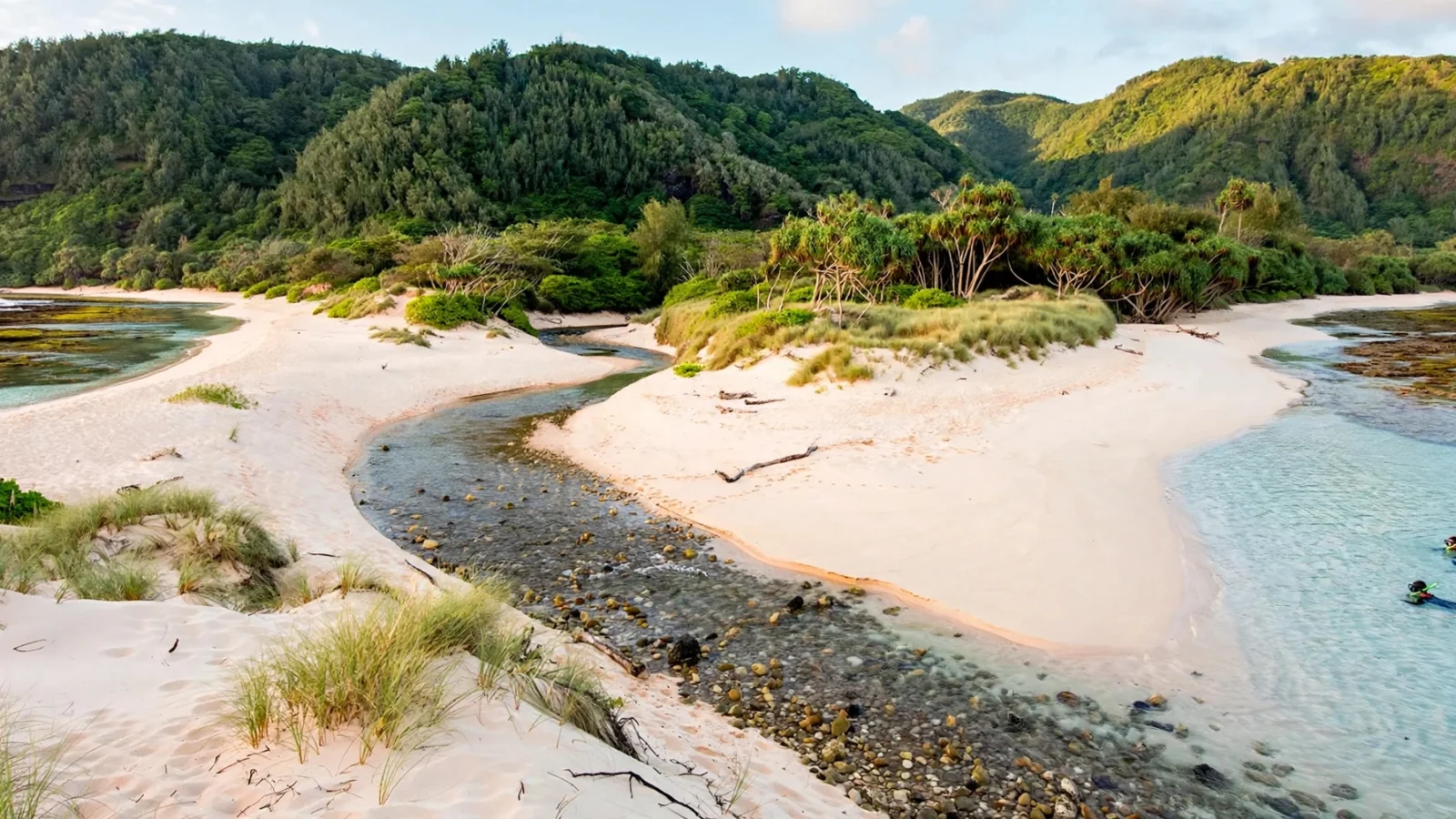
Most Kauai snorkel guides will never send you to Moloa’a Bay — and on most days, they are right not to. This is a small, unguarded, facility-free crescent in a residential neighbourhood on the northeast shore, where the snorkeling lives only at the two ends of the bay, the centre is drained by currents that run out to sea, and the whole outing hinges on picking a calm morning. But on that calm morning — light wind, small surf, no recent rain — the reef barriers at either end of Moloa’a offer something the famous spots cannot: a genuine locals’ snorkel, over living coral, with the beach almost to yourself.
This guide is built around the one rule that makes Moloa’a work, because it is the rule the short beach guides bury in a single sentence: snorkel the ends, never the centre. Both the east and west ends of the bay are lined with protective reef, and both hold small but good snorkeling. The middle of the bay is a different ocean — even when the surface looks placid, strong currents form there and flow out past the reef edge. Every section below — the zones, the conditions checklist, the season — flows from that split. Get it right and Moloa’a is one of Kauai’s most rewarding quiet swims. Get it wrong and it is one of its most deceptive.
Moloa’a Bay snorkeling at a glance
| Question | Answer |
|---|---|
| Where is it? | Moloa’a Bay, northeast Kauai between Anahola and Kilauea — Highway 56 past Anahola, near mile marker 20, then Koolau Road to Moloaa Road; roughly 35 minutes north of Lihue Airport |
| The draw | A secluded horseshoe crescent with reef snorkeling at BOTH ends — and almost nobody there on a weekday |
| The zones | The east (southeast) reef end and the west reef end — small, sheltered, coral-covered. The CENTRE of the bay is never a snorkel zone |
| What you see | Reef fish over the coral-and-rock ends of the bay; an honest, modest reef — not a Poipu or Tunnels rival |
| Best time | Calm, light-wind mornings, best in the drier months (roughly April to October); winter is a no-go |
| Parking | Very limited — a small lot and roadside space in a residential area; a handful of cars, weekends worst |
| Lifeguards | None — no lifeguard, ever |
| Facilities | None — no restrooms, no showers, nothing. Bring everything, take everything home |
| Who it suits | Confident snorkelers who read conditions and want quiet; NOT a first snorkel and not an unsupervised kids’ spot |
New to Kauai’s north and east shores? Our Anini Beach guide covers the sheltered lagoon snorkel further north, and our best time to snorkel in Hawaii guide explains the calm-morning, dry-season logic this bay runs on.
The one rule: ends only, never the centre
Say it once more, because everything depends on it. Moloa’a Bay is split by its own geography into three waters:
- The two ends — east and west — where reef barriers break the ocean’s energy and the water inside stays workable on calm days. This is the snorkeling.
- The centre — the open middle of the crescent — where currents gather and run OUT of the bay, past the edge of the reef, toward open ocean. Local guidance is blunt: do not swim across the bay, and do not swim in the centre of the bay.
The trap is that the centre often looks like the calmest water in summer — a smooth, inviting sheet between the two reef ends. That smoothness is the current, not shelter. Snorkelers get into trouble at Moloa’a by drifting centre-ward without noticing, or by trying to swim from one end to the other. Pick ONE end, stay inside its reef, stay close to shore, and walk the sand — past the shallow stream crossing — when you want the other end. Our snorkeling safety guide covers the rip-and-channel pattern this bay is a textbook example of.
The snorkel zones: east end and west end
The east (southeast) end — start here
The right-hand, southeast side of the bay is where general beach guidance sends swimmers first, and it is the natural first snorkel at Moloa’a: the reef barrier takes the edge off the swell, the entry is over sand that gives way to coral and rock, and the fish hold over the structure inside the reef. Work slowly along the inside of the reef line, close to shore, and let the bay’s shape set your limits — the moment the bottom drops toward the open centre or the water starts moving sideways with purpose, you have found the edge of the zone. Turn back along the reef the way you came.
The west end — the second reef
The west end mirrors the east: its own reef barrier, its own patch of sheltered coral water, reached by walking the crescent — including the ankle-deep ford where Moloa’a Stream meets the sea. Visitors who only snorkel one end usually snorkel the east; the west end rewards the walk with even fewer people and the rocky outcrop and reef area at the bay’s edge. The same discipline applies, doubled: the west end sits closer to the bay’s exit water, so hold your line inside the reef and never round the point. Beyond the two points of the bay is open-ocean pull — no source recommends it, and neither do we.
| Zone | Best for | The water | The limit |
|---|---|---|---|
| East (southeast) reef end | First Moloa’a snorkel, calm mornings | Reef-sheltered, sand entry turning to coral and rock | Stay inside the reef, close to shore; drift toward centre = turn back |
| West reef end | A quieter second snorkel | Reef-sheltered, fewer people, rocky outcrop at the edge | Never round the point; exit water sits just beyond |
| Centre of the bay | Nobody — not a swim zone | Looks placid, runs OUT to sea past the reef edge | Hard no, in every season, at every skill level |
A practical note on the bottom: coral reef covers much of the bay floor at both ends. Enter in reef shoes or your fins, float as soon as you can, and never stand on the coral — it protects your feet and the reef at once (our Hawaii coral reef snorkeling guide explains what you are floating over).
The stream rule: Moloa’a after rain
Moloa’a Stream empties into the bay at its north end, fed from the forest reserve in the hills behind the beach — the reserve that also gave the bay its name-country character. On dry weeks the stream is a pleasant ankle-deep crossing that splits the crescent into its two halves. After heavy rain it becomes the second reason to skip the snorkel:
- Runoff browns the water near the stream side first, and visibility across the bay suffers.
- The forest sends down wood debris after big rains, which can linger in the bay for a day or so.
- Stream mouths after rain are where bacteria advisories happen — if the water looks brown or smells off, stay out, full stop.
The honest counterweight: this stretch of coast is known as one of the drier corners of Kauai’s north shore — when rain is threatening the beaches further north, Moloa’a is the local fallback, provided the wind stays light. Dry for two days, calm on the morning, clear water at the ends: that is the full green-light combination.
What you will see
Set expectations the way the bay deserves: this is a small, living, neighbourhood reef, not a greatest-hits site. Over the coral and rock at the two ends expect the working cast of a Kauai shallows — reef fish grazing and holding over the structure, colour in the coral heads, and the quiet itself as half the experience. Visibility is conditions-dependent in the extreme: genuinely clear on a calm morning after dry weather, and poor after rain or wind.
Two inflations to ignore in other write-ups. First, Moloa’a is sometimes described online as a protected marine sanctuary and a snorkeler’s paradise — it is neither a designated sanctuary nor a paradise reef, and you will enjoy it more for knowing that. Second, turtles: honu pass along this coast and are occasionally spotted from the cliffs and the water, but this is not a turtle spot — for reliable turtle snorkeling on Kauai, go to Poipu Beach instead, and wherever you meet one, keep the 10-foot distance our snorkeling with turtles guide sets out.
What the bay does give you, on its day, is rarer than fish lists: a Gilligan’s Island cove (the pilot and early episodes were filmed here — the castaway crescent is instantly recognisable), backed by green dunes and cliffs, with a fruit-tree coast path wandering off toward Larsen’s Beach. Plenty of visitors come for exactly that and never get wet — which is also the right call on any day the conditions say no.
Conditions: the go / no-go checklist
Moloa’a has no lifeguard to make this call for you. Make it yourself, from the sand, every time:
- Surf and swell. Small and calm, or do not enter. In high surf the currents strengthen and the shallow reefs become a pounding hazard — strong swimmers included.
- Wind. The bay is exposed; a windy day is a poor day here even without swell. Light-wind mornings are the window.
- The centre test. Stand and watch for a few minutes before entering — local advice, and good advice anywhere. If you can see water moving out through the middle, the ends are on borrowed time too.
- Rain history. Heavy rain in the last day or two = brown water, debris, and a stream to avoid. Wait it out.
- Season. Winter (roughly November to March) brings the strong ocean pull this coast is known for — the bay recorded some of Kauai’s largest tsunami runups in 1946, a reminder of how much energy this shoreline can receive. Winter Moloa’a is a walk-and-look beach. The snorkel season is the calm, drier stretch, roughly April to October.
GO on a calm, light-wind morning after dry days, at one reef end, with a buddy. GO SLOWLY — short, close-to-shore, east end only — when there is light texture but no swell. NO-GO in surf, wind, brown water, or winter. First-timers: this is not your learning beach — start with our beginner’s guide to snorkeling in Hawaii, and bring every item on the snorkel gear checklist — there is nowhere here to rent or buy anything.
Parking, access and being a good guest
Moloa’a is a neighbourhood first and a beach second, and its logistics enforce the point. Access runs off Highway 56 past Anahola: near mile marker 20, Koolau Road leads seaward to Moloaa Road and the rural residential streets above the bay. Parking is the bay’s famous bottleneck — a small lot near the beach (visitors describe just a handful of spaces) plus limited roadside room. On weekends it fills and turns people away; on weekdays the beach is often near-empty. Two entries reach the sand — one by a gate near the last houses, one on a marked path between homes — and crossing between the bay’s halves means fording the shallow stream.
Because the parking sits inside a small residential community, the etiquette matters more here than at a state park:
- Park only where it is clearly allowed; never block a driveway, gate, or the road itself.
- Keep voices down on the access paths — you are walking past people’s homes.
- Pack out everything. There are no bins staff, no restrooms, no showers, and no lifeguard: everything you need, you carry in; everything you brought, you carry out.
- Stay on the coastal trail where it is marked — the path toward Larsen’s Beach crosses private land, and its future depends on walkers respecting it.
Facilities score, in full: none. The nearest real beach-park infrastructure is back toward Anahola and Kapa’a. Plan Moloa’a as a self-sufficient morning, not a basecamp.
Moloa’a vs Kauai’s other snorkels
| Moloa’a Bay | Anini Beach | Poipu Beach | Tunnels Beach | |
|---|---|---|---|---|
| The draw | Secluded crescent, reef at both ends, Gilligan’s Island cove | Kauai’s longest sheltered lagoon reef | Reliable turtles, facilities, lifeguards | Kauai’s flagship summer reef |
| Snorkeling quality | Small but good, at the ends only | Good, broad and calm | Good, consistent | Excellent in summer calm |
| Entry | Sand to coral — reef shoes | Sand, lagoon-calm | Sand | Sand to reef channels |
| Lifeguards | No | No | Yes | No |
| Facilities | None at all | Restrooms, parking area | Full beach park | Minimal, Haena side |
| Parking | Very limited, residential | Easier | Large park lots | Haena State Park rules apply |
| Beginners | No — confident snorkelers | Yes, in the lagoon | Yes | Confident, summer only |
| Best pick when | You want quiet and can read conditions | You want calm and space | You want turtles + easy logistics | You want the big reef day |
The Kauai snorkeling hub maps the full island, including Ke’e Beach at the end of the road, the Lydgate ponds for first-timers, Hideaways Beach below Princeville, and Tunnels Beach for the flagship reef. Moloa’a’s place in that set is specific: the quiet east-meets-north shore snorkel for people who have already done the famous ones — or who simply prefer a cove to a crowd.
Frequently asked questions
Is Moloa’a Bay good for snorkeling?
Yes — conditionally, and only at the ends. Both the east and west ends of the crescent are lined with protective reef and hold small but good snorkeling on calm, light-wind days. The centre of the bay is never safe to swim: currents there flow out to sea past the reef edge, even when the surface looks placid. Treat Moloa’a as a calm-morning snorkel for confident swimmers, not an everyday beach.
Where exactly do you snorkel at Moloa’a Bay?
At the two reef ends of the bay — start at the east (southeast) end, where swimming is generally rated best, and walk the sand to the west end for the second reef. Enter over sand, float over the coral, and stay inside the reef line, close to shore. Never snorkel the centre, never swim from one end to the other through the middle, and never go past the bay’s points.
Is Moloa’a Bay safe for beginners and kids?
It is not a beginner beach. There is no lifeguard, no facilities, and a current pattern that punishes drifting — the centre and the water past the reef edge are dangerous even for decent swimmers on the wrong day. Families do enjoy the sand, the shade and the stream-side shallows on calm days, but a first snorkel belongs somewhere guarded and sheltered, like Poipu or Lydgate. Confident, buddy-paired snorkelers who pick a calm morning are who the ends are for.
When is the best time to snorkel Moloa’a Bay?
On a calm morning in the drier months, roughly April to October, after at least a day or two without heavy rain. Mornings bring the lightest wind — the bay is exposed, and wind alone can spoil it. Winter (roughly November to March) is a no-go: swells and the strong ocean pull make the bay dangerous, and it is better enjoyed as a scenic walk.
Are there lifeguards or facilities at Moloa’a Bay?
No — none of either. There is no lifeguard, no restrooms and no showers at Moloa’a Bay. Bring all your water, food, shade and gear, and pack everything out. That absence is exactly why the beach stays quiet — and why your own conditions check, from the sand, before entering, is the only safety system the bay has.
How is parking at Moloa’a Bay?
Very limited — the bay’s biggest drawback. A small lot near the beach holds only a handful of cars, with limited roadside space beyond it, all inside a residential neighbourhood. Weekends fill first; weekdays are far easier. Park only where clearly allowed, never block driveways or gates, and be ready to walk a little. If the lot is full, take it as the bay’s capacity signal rather than squeezing onto a verge.
Why is Moloa’a Bay famous?
Television: the pilot and early episodes of Gilligan’s Island were filmed on this crescent in the 1960s, and the castaway look — white sand, green cliffs, not a building in the shot — is still the beach you arrive at. Its name is older: Moloa’a comes from molo a’a, “matted roots,” for the paper mulberry trees that once grew thickly here. The bay also recorded some of Kauai’s largest runups in the 1946 tsunami — history that underlines how seriously to take its ocean.
What is the Moloa’a Trail?
A coastal path of roughly a mile round trip that leaves the bay and wanders along the shore toward Larsen’s Beach — part of an ancient island-circling footpath network. It passes fruit trees, viewpoints over the crescent and the rocky outcrop at the bay’s end, and it crosses private land, so stay on the marked line and leave gates as you find them. Wear real footwear: the route includes the ankle-deep stream ford and flat, sometimes slippery rock.
The verdict
Moloa’a Bay will never top a Kauai snorkeling list, and this guide has not tried to put it there. What it offers, on the right morning, is the thing the top of the list cannot: a reef at the end of a castaway crescent, in a neighbourhood that keeps the crowds away by having nowhere to put them. Respect the split that defines it — reef ends in, centre out, stream after rain, winter off — pick your calm morning honestly, and Moloa’a gives you one of the most peaceful snorkels on the island. Pick the wrong day, and the correct snorkel is the walk, the shade, and the view. Either way, you will have the cove almost to yourself.