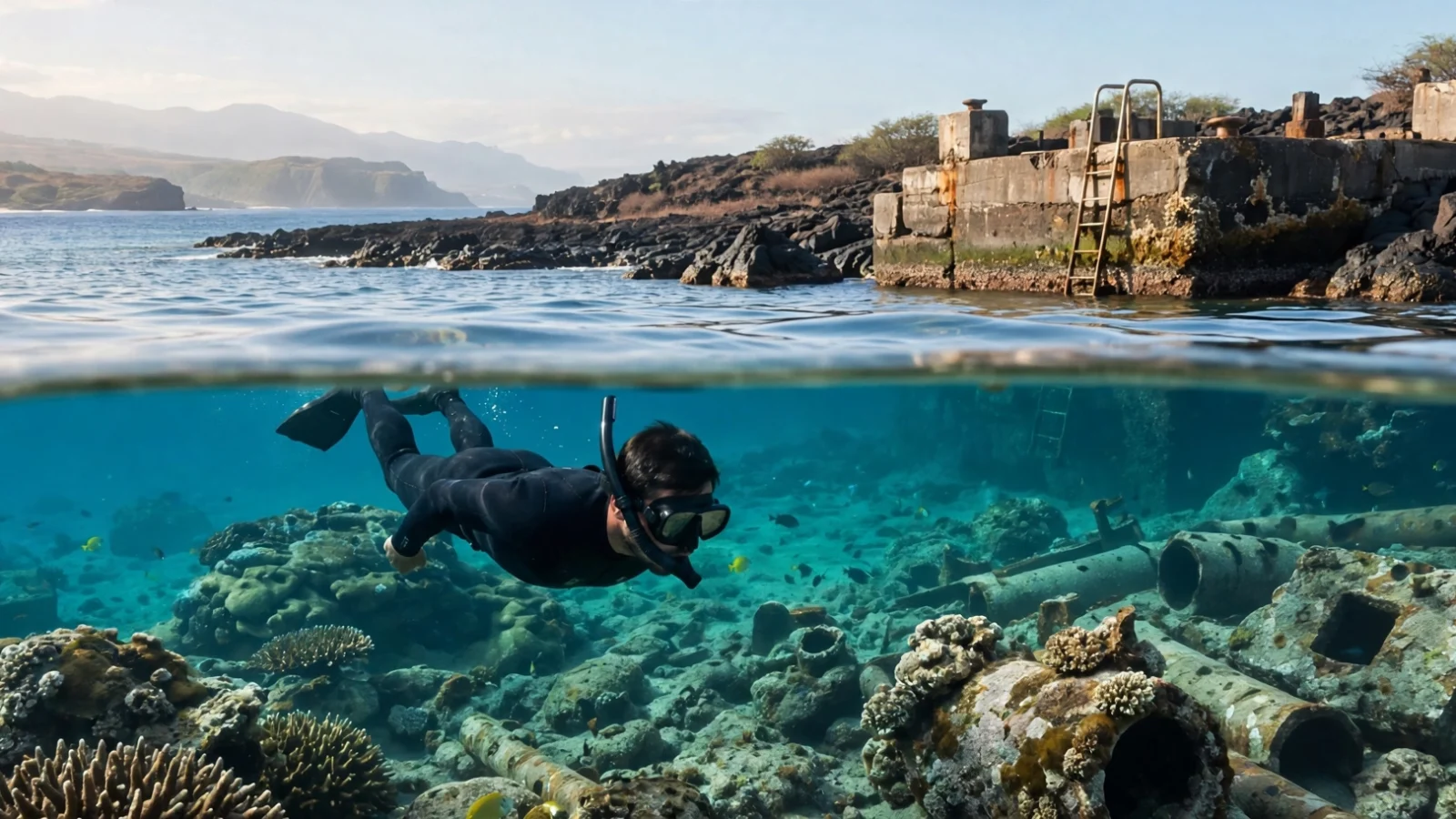
Mahukona is not a beach, and that is exactly why snorkelers love it. Mahukona Beach Park in North Kohala is an abandoned sugar-shipping harbor — concrete docks, a rusting crane, old railway buildings — where you climb down a steel ladder straight into clear water and snorkel over a debris field of mill machinery, a massive anchor chain, and the reported remains of a wrecked freighter, all mixed in with living coral.
This guide is honest about the trade-offs. On a calm summer morning Mahukona is one of the easiest, clearest shore snorkels on the Big Island. On a winter day with north swell rolling in, the same ladder becomes a genuinely dangerous place, and the right move is to stay out, watch for whales from shore, and snorkel somewhere sheltered instead. Here is how to tell the difference, and how to snorkel the harbor properly when conditions say yes.
Mahukona snorkeling at a glance
| Question | Answer |
|---|---|
| Where is it? | Mahukona Beach Park, North Kohala, Big Island — off Akoni Pule Highway (Hwy 270), north of Kawaihae |
| What is it? | A former Kohala Sugar Company harbor (closed in 1956), not a sandy beach |
| Entry | Steel ladder and concrete steps at the harbor dock (right fork of the park road) |
| Entry fee / reservation | No entrance fee for day use; camping is by Hawaii County permit only |
| Park hours | 6:00 AM–10:00 PM daily (county listing) |
| Parking | Two park lots — right fork for the harbor/snorkeling, left fork for the picnic area; free |
| Lifeguards | None — no lifeguard is stationed at Mahukona |
| Facilities | Picnic pavilions and tables, BBQ pits; restrooms can be unreliable (portable units reported); no running water currently — bring your own drinking water |
| Best window | Calm mornings, roughly May to September; winter swell often closes it in practice |
| Who it suits | Comfortable swimmers and snorkelers who can handle a ladder entry; not a first-ever snorkel for weak swimmers |
If ladder entries and open-coast water are new to you, build up first at a protected sandy spot from our beginner’s guide to snorkeling in Hawaii, then come back to Mahukona on a flat morning.
Why there is a harbor here: the sugar story in one minute
Mahukona was the port of the Kohala Sugar Company. Sugar grown across North Kohala was brought down by rail, loaded onto ships anchored off this harbor, and shipped out — the old Hawaii Railway Co. building by the parking area, dated 1930, is part of that operation, and rusted machinery, rails and dock hardware still litter the shoreline. The harbor closed in 1956, the shipping moved elsewhere, and the port quietly became a county beach park.
That history is not just background — it is the snorkeling. Unlike every sandy beach on this coast, Mahukona’s underwater landscape is half reef, half industrial archaeology. Coral has grown over concrete pilings and iron for nearly seventy years, and the fish treat the whole debris field as structure. You are snorkeling a working waterfront that the ocean took back.
The two snorkel zones at Mahukona
| Zone 1: The harbor and debris field | Zone 2: The north shoreline swim | |
|---|---|---|
| Where | Inside and just outside the old harbor, around the dock, rock wall and pilings | North along the rocky shoreline from the harbor |
| Entry | Ladder/steps at the dock | Same ladder entry, then a longer surface swim |
| Depth feel | Gently sloping bottom, roughly 40 ft at its deepest | Shallow coral shoreline, deepening gradually |
| What you see | Mill machinery, anchor chain, wreck remains reported further out, coral on pilings, morays and octopus in the rubble | More continuous coral and reef fish, generally clearer water away from the harbor |
| Best for | Most snorkelers — the main Mahukona experience | Confident swimmers on calm days who want a longer, quieter swim |
| Main risk | Slippery ladder, surge at the entry when swell runs | Distance from your exit point, current reported outside the harbor |
Zone 1: The harbor, the chain and the debris field
Enter by the ladder (see the entry walkthrough below), then work slowly. The snorkeling starts immediately: coral outcrops and old concrete pilings in the shallows, rusted machine parts scattered across the bottom, and a very large anchor chain that divers and snorkelers use as a navigation line — follow it outward and the bottom deepens gradually, with more substantial wreck remains reported in roughly 35 feet of water along that line. Treat the wreck as “reported by divers” rather than a guaranteed sighting: visibility, surge and your own comfort decide how far out you should go, and there is plenty to see without chasing the deepest structure.
Move slowly around the rubble. Moray eels live in the gaps, octopus hide in the debris, and frogfish and pufferfish turn up around the pilings. Look, do not touch: rusted metal is sharp, coral is alive, and both will punish careless hands and fins.
Zone 2: The north shoreline swim
For a second, different snorkel, exit the harbor area and swim north along the shoreline. The character changes from archaeology to reef — more continuous coral formations and reef fish, and on calm days very clear water. The honest costs: it is a longer swim from your only exit (the ladder), there is no sandy rest beach along the way, and current is reported outside the harbor on some days. Go north only when the harbor itself is calm, keep enough energy for the swim back, and turn around early rather than late.
Do not build your plan around swimming south. The coast toward Lapakahi State Historical Park is a Marine Life Conservation District (MLCD), where taking any marine life is prohibited and rules are stricter — check the DLNR signs and boundaries on the day, stay legal, and treat the harbor and north shoreline as your snorkel area.
How to enter: the ladder, step by step
- Read the water first. Stand on the dock and watch for a few minutes. If waves are breaking against the harbor wall or washing over the entry area, do not get in — the ladder in surge is how people get hurt here.
- Gear up on the dock, not in the water. Mask, snorkel and fins sorted before you climb down; keep one hand for the ladder.
- Climb down facing the ladder, slowly. The rungs and steps can be slippery with algae, and rusted edges are sharp — water shoes or sturdy sandals for the walk across the concrete and rock are a good idea.
- Once in, move away from the wall before you settle into snorkeling, so you are clear of any surge zone at the entry.
- Exit the same way, and time it: watch the surge pattern, commit on a calm moment, and climb steadily. If conditions have built while you were out, wait for a lull rather than fighting the ladder.
Divers also step off the northwest wall in calm conditions, but for snorkelers the ladder is the controlled, repeatable entry — use it.
What you will see
Mahukona’s species list is a reef list with an industrial twist:
- Reef fish: yellow tang, parrotfish, pufferfish and frogfish are all reported regularly, along with the usual Kohala coast reef community.
- In the rubble: moray eels in the debris gaps, octopus, crabs, sea urchins — and seahorses have been reported here, which is a rare Hawaii sighting worth a slow, patient look around the pilings.
- Bigger visitors: Hawaiian green sea turtles pass through occasionally, and manta rays have been reported feeding over the structure — neither is a promise. If a turtle shows up, give it space and never touch or chase it; our guide to snorkeling with turtles in Hawaii covers the distance rules.
- From shore in winter: humpback whales are often visible offshore during the winter migration. That is a surface show, not a snorkeling plan — winter is exactly when the ladder is most likely to be off-limits.
Access, parking and facilities — the reality check
The park sits at the end of a paved road off Akoni Pule Highway (270) in North Kohala, north of Kawaihae. At the fork inside the park, go right for the harbor, dock and snorkeling, and left for the large picnic area with pavilions and tables.
- Parking: two park lots, free; the harbor-side lot is the one you want for snorkeling.
- Hours: the county lists the park at 6:00 AM–10:00 PM daily.
- Fees: no entrance fee for day use.
- Camping: allowed only with a Hawaii County camping permit (book through the county system; do not just pitch a tent).
- Facilities: picnic pavilions, tables and BBQ pits. Restrooms can be unreliable — recent sources report portable units — and there is no running water currently provided, so bring all the drinking water you need. Do not count on showers.
- Lifeguards: none. There is no guarded swim area at Mahukona.
- Gear: bring everything — there is no rental shop at the park. Our Hawaii snorkeling gear checklist covers what to pack for a no-services spot like this.
Best time for Mahukona snorkeling
Season: summer (roughly May to September) brings the calm northerly conditions this exposed harbor needs. Winter (roughly December to March) sends north swells straight at this coast — the harbor can look inviting from the parking lot and still surge dangerously at the ladder. Our best time to snorkel in Hawaii guide explains the seasonal pattern island by island.
Time of day: mornings, before the wind builds. Mahukona is at its clearest and calmest early, and the ladder is at its easiest.
Tide: divers here favour slack tide for the clearest, easiest water; as a snorkeler, simply avoid the roughest surge moments and never force an exit in building surf.
The honest rule: Mahukona is a conditions-first spot. If you arrive to whitecaps, breaking waves on the wall, or surge at the ladder, the snorkel is cancelled for the day — enjoy the shore, look for whales in season, and use the backup plan below.
Is Mahukona good for beginners and kids?
For the right beginner, on the right day, yes — the harbor water is protected and the snorkeling starts in shallow water right off the ladder, which is why locals bring learners here in summer. But be honest about the prerequisites:
- There is no sand beach — no wading in, no sandy rest spot, and kids cannot play at the water’s edge.
- The ladder entry requires climbing down (and back up) with gear on; every swimmer must be able to do it unassisted.
- There is no lifeguard, and winter or windy-day conditions remove the “protected harbor” feeling entirely.
Confident kids who already snorkel will love the machinery-and-eels treasure hunt on a flat summer morning. First-timers and weak swimmers are better served by the sandy, guarded shallows at Spencer Beach Park just south of here, or Hapuna Beach on its calm days.
Safety at Mahukona
- No lifeguard. You are your own safety plan: snorkel with a buddy, use flotation if you are not a strong swimmer, and tell someone your plan.
- Surge is the main hazard, especially at the ladder. Watch the water before entering and before exiting, and never turn your back on a building swell.
- Winter swell = no-go. This coast faces north; heavy surf days are for shore sightseeing only. The statewide rule applies: if in doubt, don’t go out. Our Hawaii snorkeling safety guide goes deeper.
- Sharp stuff everywhere. Rusted metal, broken concrete and lava rock cut bare feet and hands — water shoes to the ladder, and never grab structure in the water.
- Current outside the harbor is reported by divers; the further you follow the chain or the shoreline, the more conservative your turnaround point should be.
- Sun and water: there is little shade at the harbor and no drinking water on site — bring more water than you think you need.
Mahukona vs Spencer Beach vs Hapuna: which North Kohala snorkel?
| Mahukona Beach Park | Spencer Beach Park | Hapuna Beach | |
|---|---|---|---|
| Character | Old sugar harbor, ladder entry, relics + reef | Calm sandy park beach, family basecamp | Big white-sand beach, snorkel at the ends on calm days |
| Entry | Steel ladder at the dock | Easy sand entry | Sand entry; snorkel zones at the rocky points |
| Sand beach | No | Yes | Yes |
| Best for | Snorkelers who want something different; history + reef in one swim | Beginners, kids, mixed groups | Beach day first, snorkel second |
| Conditions risk | Winter swell and ladder surge | Sheltered more often; still check surf | Shorebreak can shut the snorkeling down |
| Guide | This page | Spencer Beach snorkeling guide | Hapuna Beach snorkeling guide |
Staying further south? The Kohala coast keeps going: turtles and lava shoreline at Puako Bay, the resort-front reef at Waikoloa Beach, the hike-in lagoon at Kiholo Bay, and the gated white-sand snorkel at 49 Black Sand Beach. The full coast is mapped on our Big Island snorkeling hub.
Frequently asked questions
Can you snorkel at Mahukona Beach Park?
Yes — Mahukona is one of the Big Island’s most distinctive shore snorkels. You enter by a steel ladder at the old sugar harbor dock and snorkel over mill machinery, an anchor chain and coral-covered pilings — but only when the ocean is calm. In winter swell, stay out.
Is Mahukona a real beach?
No. Despite the name, there is no sandy beach — the shoreline is an old commercial harbor with concrete docks, ladders and lava rock. Bring water shoes, and do not come expecting to wade in from sand.
How do you get into the water at Mahukona?
Via the steel ladder and concrete steps at the harbor (take the right fork inside the park). Gear up on the dock, climb down facing the ladder, and move away from the wall once you are in. If waves are washing the entry area, do not get in.
What will I see snorkeling at Mahukona?
Reef fish such as yellow tang and parrotfish, moray eels and octopus in the underwater debris field, coral growing over old machinery and pilings, and a large anchor chain leading toward wreck remains reported in about 35 feet of water. Turtles and even manta rays are occasional visitors, never guarantees.
Is Mahukona good for beginners?
On a calm summer morning, comfortable beginners who can climb a ladder with gear on can enjoy the protected harbor water. Weak swimmers, first-timers and young kids do better at sandy, lifeguarded Spencer Beach Park nearby — there is no lifeguard and no sand at Mahukona.
When is the best time to snorkel Mahukona?
Calm mornings in the summer months (roughly May to September). Winter brings north swells that surge at the ladder and make entry dangerous, even though whales may be visible from shore in that season.
Is there parking and camping at Mahukona?
Yes — two free park lots (right fork for snorkeling, left for picnics), pavilions and tables. Camping is allowed only with a Hawaii County permit. Bring your own drinking water: no running water is currently provided, and restrooms may be portable units.
Are there lifeguards at Mahukona?
No. There is no lifeguard stationed at Mahukona Beach Park. Snorkel with a buddy, check conditions before entering, and follow the rule: if in doubt, don’t go out.
The bottom line
Mahukona rewards snorkelers who like their reefs with a story attached: a ladder down into a drowned sugar port, an anchor chain for a guide rope, eels in the machinery and tang over the pilings. Pick a calm summer morning, respect the ladder, bring your own water — and if the swell is up, enjoy one of the Big Island’s most atmospheric shorelines from dry land and snorkel it next time. Plan the rest of the coast with our Big Island snorkeling hub.