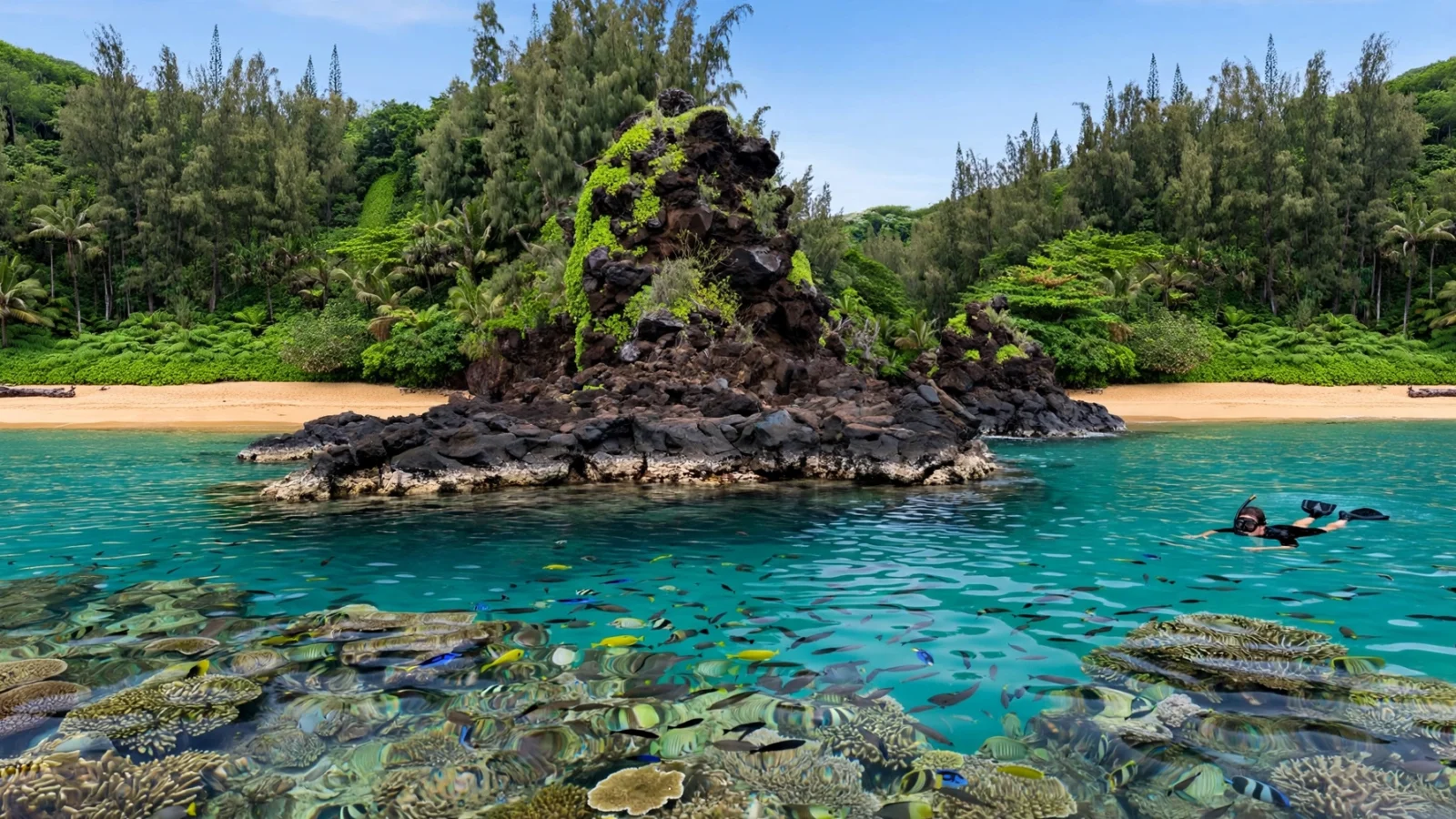
Hideaways Beach is the North Shore snorkel you have to earn. There is no sign on the highway, the car park holds nine or ten cars, and the beach itself sits at the bottom of a cliff in Princeville, down a trail steep enough that most visitors to Kauai never attempt it. The people who do make the descent on a calm summer morning find two small golden coves, a spur-and-groove reef that starts almost at the waterline, and some of the fishiest snorkeling on the island — often with the beach nearly to themselves.
That trade — real effort and real limits in exchange for a genuinely uncrowded reef — is the whole story of this spot, and this guide does not hide either side of it. The trail is steep and was closed for rehabilitation for much of summer 2026. The snorkeling is a summer-only proposition; in winter this is a surf beach. There are no facilities and no lifeguard. What follows is the full picture: how to get down, exactly where the reef runs, what you will see, when to go, and how Hideaways compares with Tunnels Beach, Anini Beach and Ke’e Beach so you can decide whether the climb is worth it for you. For the rest of your time on the North Shore, see our guide to Things to Do in Princeville.
Quick facts
| Also known as | Pali Ke Kua Beach (see the name note below — the two coves have separate access) |
| Entry fee / reservation | None — public beach access, free parking lot, no reservation |
| Lifeguard | None — ever. You are on your own here |
| Facilities | None at all: no restrooms, showers, rentals or food. Shade from shoreline trees |
| Parking | Free public lot of about 9–10 tight spaces at the end of Ka Haku Road; arrive by about 8am |
| Trail | Kaumumene Trail, roughly 0.15–0.25 mile, very steep — stairs, then a roped dirt slope; about 10–15 minutes down |
| Trail status | Closed for County rehabilitation from late June 2026; reopened late September 2026 — check current Kaua’i County notices before you go |
| Best snorkeling | The spur-and-groove reef directly in front of the beach and around the dividing rocky outcrop |
| Depth | Mostly shallow — about 10 feet or less over the front reef; around 15 feet in front of the rocky point |
| Best season | Late spring to early autumn on calm days (roughly May–September); mornings before the trade winds |
| Not suitable for | Beginners, young children, anyone with knee or mobility problems — see the honest verdict below |
Quick answer: is Hideaways Beach good for snorkeling?
Yes — in summer, for confident snorkelers, it is excellent, and it is the least crowded good snorkel on Kauai’s North Shore. The reef comes right up to the beach, the fish variety is outstanding, and turtles are regular visitors. But it comes with three honest qualifiers. First, the season is short: from about November to March, North Shore surf turns Hideaways into a surf break and snorkeling is off the table. Second, the access filters people hard — a nine-space car park and a steep, roped cliff trail that is genuinely unsuitable for young children or anyone unsteady on their feet. Third, set your coral expectations correctly: the reef structure and fish life are the show here, not lush live coral, which is patchy. If those qualifiers sound like a price worth paying, Hideaways will likely be your favourite North Shore snorkel. If they do not, Anini and Ke’e give you North Shore reef with far easier access — the comparison table below lays it out.
Hideaways or Pali Ke Kua? Untangling the names
You will see this beach listed both ways, sometimes as if they were identical, sometimes as neighbours — and the distinction actually matters for access. The Princeville bluff drops to two small coves separated by a lava-rock outcropping:
- The western cove is Hideaways Beach, reached by the public Kaumumene Trail described in this guide.
- The eastern cove is Pali Ke Kua Beach, reached by a separate paved path that comes down through the Pali Ke Kua condominium complex. That path is for the complex’s guests and residents — it is not a public access, and it is not a shortcut if the trail puts you off.
Because the two coves sit side by side under the same cliffs, guidebooks and review sites use the names loosely, and “Pali Ke Kua (Hideaways)” appears as a single listing in several places. For snorkeling purposes the reef system fronts both coves, and the best water — around the dividing outcrop — is reached from the Hideaways side. Every direction in this guide uses the public Hideaways access.
Where Hideaways Beach is
Hideaways sits below the cliffs of Princeville, on Kauai’s North Shore, roughly a ten-minute drive west of Hanalei. From Highway 56 (Kuhio Highway), turn toward the ocean on Ka Haku Road and follow it to its end, where the road reaches the gatehouse of the 1 Hotel Hanalei Bay. The small public parking lot is on your right just before that gatehouse, and the trailhead is beside the Pu’u Poa condominium tennis courts, tucked between fences at the edge of the lot.
Princeville is a resort and residential community, which shapes the whole visit: there is no beach infrastructure here because the beach was never developed as a public park. Everything you need — water, food, reef-safe sunscreen, your gear — comes down the cliff with you, in a backpack, because you will want both hands free on the trail. The nearest restrooms are back out on the highway at the Princeville Shopping Center.
Parking: nine spaces and an 8am rule
Parking is the first filter, and it is unforgiving:
| Option | How it works |
|---|---|
| Public beach-access lot (free) | About 9–10 tight spaces at the end of Ka Haku Road, shared by visitors to Hideaways and neighbouring Pu’u Poa Beach. On a calm summer day it is typically full by about 8am |
| Walk or cycle in | If you are staying in Princeville, walking to the trailhead is the stress-free option — much of the beach’s regular crowd arrives this way |
| 1 Hotel Hanalei Bay (paid) | Visitors report using the hotel’s paid valet parking and walking past the gatehouse to the trailhead. Availability and rates are the hotel’s to set and change — treat this as a sometimes-option, never a plan A |
| Roadside / condo parking | Do not improvise. Roadside parking here draws tickets, and parking in nearby vacation-rental or condo complexes risks being towed |
The practical routine used by regulars: aim to be parked by 7:30–8am, which conveniently also puts you in the water during the calmest, clearest part of the day. If the lot is full at 9am on a perfect summer Saturday, that is not bad luck — it is the system working as it always does. Go to Anini instead and try Hideaways on a weekday.
The Kaumumene Trail: steep, short, and recently rebuilt
The trail is the second filter, and the one to respect most. From the trailhead beside the tennis courts:
- A short, fairly flat section along the fence line to the top of the bluff.
- A steep set of stairs dropping over the edge.
- A very steep dirt slope for the rest of the descent, with fixed ropes and handrails to hold — you will use them, in both directions.
The whole descent is only about 10–15 minutes, but it is closer to a controlled scramble than a walk. The dirt becomes extremely slippery after rain — and Princeville gets plenty — and the climb back up, in the heat, with wet gear, is the harder half. Wear sturdy closed shoes or hiking sandals for the trail and change at the beach; flip-flops are how people get hurt here. Keep both hands free: everything goes in a backpack.
2026 trail update — read this before you plan around older reviews. Almost everything written about this trail before 2026 describes rusted, broken handrails and a slope that had deteriorated badly. That deterioration is why Kaua’i County closed the Kaumumene Trail in late June 2026 for a rehabilitation project that kept it shut for roughly eight weeks, through the heart of the summer season. The County confirmed the trail reopened after the rehabilitation was completed in late September 2026. The rehabilitation improves the route; it does not flatten it — this is still a steep cliff descent that demands sure footing, and it still turns slippery when wet. Trail conditions and any temporary closures change, so check the current Kaua’i County notices before you go, and if the trail is signed closed on the day, believe the sign.
Who should not attempt it: young children (there is no safe way to carry a small child down this slope), anyone with knee, ankle or balance problems, and anyone who would struggle to climb several flights of uneven stairs while holding a rope. There is no shame in that call — Kauai’s easiest good snorkels, Lydgate and Poipu, exist precisely for the days and the people this trail excludes.
Getting in the water
The beach is a crescent of coarse golden sand backed by shade trees, with the reef visible from the trail on the way down — on a calm day you can pick out the reef grooves through the turquoise water before you reach the sand.
Enter from the sandy centre of the cove. The sand extends a short way out, then the bottom transitions to reef that comes very close to shore. Reef spurs reach toward the beach, so pick a sandy channel to walk out through, put your fins on once you are floating, and never stand on the reef — both for the coral’s sake and your feet’s, since rock-boring urchins sit in the crevices. Watch for small drop-offs in the sand as you enter and, especially, as you exit: the beach face here can be steep.
There are no rentals anywhere near this beach. Bring your own gear or rent in Hanalei or Princeville before you come — our Hawaii snorkeling gear checklist covers what is worth carrying down a trail like this (the short version: mask, snorkel, fins, reef-safe sunscreen, water — and nothing you cannot carry hands-free).
The snorkel route: grooves in front, deeper water at the point
Hideaways’ reef is a classic spur-and-groove system: fingers of reef running perpendicular to the shore, separated by sandy grooves, starting almost at the waterline. It makes for a simple, satisfying route:
- Start in the grooves directly in front of the beach. Snorkel in and out of the sandy channels between the reef spurs. The water over this front reef is shallow — about 10 feet or less — and the best of Hideaways is close to shore. There is little reason to swim far out: the fish density drops and the interest drops with it.
- Work toward the dividing outcrop. The rocky point separating Hideaways from Pali Ke Kua Beach holds the richest structure: more developed reef, more nooks, and consistently the best fish action reported here. This is the zone to spend your time in.
- The deeper section in front of the point reaches roughly 15 feet. It is rewarding on a flat day — and it is the first place to feel current and lose visibility when any swell is running. If the water in front of the point is murky or pushing, stay in the front grooves.
- The far cove is not an upgrade. The snorkeling in front of the neighbouring beach is noticeably less interesting than the Hideaways side — fewer fish, less structure. Enjoy the view of it; snorkel your own side.
On coral, honestly: live coral cover here is patchy and limited — small patches rather than coral gardens. What Hideaways offers instead is topography and fish: grooves to explore, reef fish in real variety and density, and clear summer water to see them in. If coral gardens are your priority on the North Shore, Ke’e’s reef flat will suit you better; if fish and solitude are, this is your beach. More on how Hawaii’s reefs differ is in our coral reef snorkeling guide.
What you will see
The fish list recorded at Hideaways is one of the longest for any Kauai shore snorkel:
- Butterflyfish in variety — bluestripe, fourspot, longnose, teardrop and threadfin butterflyfish all recorded here
- Surgeonfish and tangs — bluelined and orangeband surgeonfish, convict tangs in their striped schools, lavender tangs
- Wrasses — including the small, busy Hawaiian cleaner wrasse working its cleaning station, plus saddle and bird wrasses
- Goatfish, parrotfish and triggerfish — including the humuhumunukunukuapua’a, Hawaii’s state fish
- The occasional hunters — bluefin trevally passing through, peacock grouper in the structure, a whitemouth moray in a crevice if you look slowly
- On the reef floor — sea cucumbers in the grooves, pale rock-boring urchins in the rock (look, never touch)
Turtles are regulars rather than a lucky bonus: green sea turtles (honu) feed and rest around this reef, and because the beach is quiet, they also occasionally come ashore to rest on the sand — as, very occasionally, does a Hawaiian monk seal. Both are protected species. In the water, stay at least 10 feet from turtles and never chase, touch or block one; on the beach, give a resting turtle the same space and a monk seal at least 50 feet. Our snorkeling with turtles guide covers the etiquette in full. The quiet of this beach is exactly why animals use it — keep it that way.
Best time to snorkel Hideaways
Hideaways is the most seasonal snorkel in this guide series, and the season is set by North Shore surf:
| Period | What to expect |
|---|---|
| May–September | The window. Calm seas, clear water, the reef fully snorkelable on most mornings |
| April & October | Shoulder months — snorkelable on calm spells, surf possible. Check the surf forecast day by day and have a South Shore backup |
| November–March | Winter surf season. Hideaways becomes a surf beach — a break sits roughly 100 metres out — and waves can wash over the reef at high tide. Do not snorkel here in winter surf |
Within a good day, morning is the snorkel: arrive for the parking, stay for the conditions. The water is calmest and clearest early, before the trade winds build their afternoon chop and stir the shallows. By mid-afternoon on a breezy day, visibility in the front grooves can be a fraction of the morning’s.
Two conditions checks before you commit to the trail: the North Shore surf forecast (any meaningful north swell ends the plan — head south to Poipu or Lawai instead), and recent rain, which makes the trail treacherous even when the ocean is calm. Our best time to snorkel in Hawaii guide explains the island-wide seasonal pattern this beach follows so strictly.
Safety: the honest list
- No lifeguard, no facilities, difficult exit. Help here is a steep trail and a phone call away. Snorkel with a buddy, tell someone your plan, and be conservative. The full site briefing is our Hawaii snorkeling safety guide — this beach is exactly the kind it is written for
- Currents live at the points. The area in front of the rocky outcrop and beyond the reef can pull, especially with any swell running. Stay inside the reef grooves if you feel movement you do not like
- High tide plus surf sends waves over the reef. Even in the shoulder months, a rising tide over a building swell changes this beach quickly. If whitewater is crossing the reef, stay out
- The trail injures more people than the ocean does. Slippery after rain, steep always. Sturdy footwear, both hands free, no rushing the descent with your arms full of beach gear
- Urchins and reef cuts. Enter through sand channels, keep off the reef, and treat any cut promptly — reef cuts infect easily
- Everything in, everything out. There are no bins and no services. What you carry down — including all rubbish — comes back up with you
Beginners and kids: the honest verdict
Hideaways appears on some family lists, and the sheltered sandy patch at the centre of the cove — a few feet deep, with small reef fish at its edges — can indeed give a confident older child a lovely short snorkel on a flat summer morning. But as a recommendation, this guide’s verdict is no for beginners and young children, and the reason is only partly the water. It is the combination: a trail that demands two free hands and sure feet, no lifeguard, no facilities, no easy exit, and reef at the shoreline rather than a protected lagoon. A beginner’s first snorkel should be somewhere the day stays easy when something goes wrong — Anini’s long calm lagoon or Lydgate’s walled ponds. Our beginners’ guide to snorkeling in Hawaii ranks the island’s genuinely beginner-grade options. Hideaways is where those same snorkelers should come in year two — it rewards experience, which is precisely its appeal.
Hideaways vs Tunnels vs Anini vs Ke’e
The North Shore gives you four serious shore snorkels within about fifteen minutes of each other. They are not interchangeable:
| Hideaways | Tunnels | Anini | Ke’e | |
|---|---|---|---|---|
| Access | Steep roped trail; 9–10 parking spaces | Roadside/Haena parking pressure; walk-in entry | Easy roadside parking, lawn and facilities | Haena State Park reservation required |
| Crowds | Lowest of the four | Busy | Moderate | Capped by reservations |
| Reef | Spur-and-groove, fish-rich, coral patchy | Big lagoon + outer reef, the North Shore’s largest system | Long fringing reef, calm lagoon | Reef flat and lagoon, strong coral interest |
| Season | Summer only | Summer only (outer reef) | Widest window of the four | Summer best; lagoon usable more of the year |
| Best for | Confident snorkelers wanting solitude | The fullest reef experience | Beginners, families, long easy swims | Coral + scenery, booked-ahead trips |
For the full island picture, start from our Kauai snorkeling hub — and if you are building a North Shore day, Hideaways pairs naturally with an Anini afternoon: the hard, quiet snorkel in the morning calm, the easy lagoon when the trades arrive.
What to bring (the trail edits your list for you)
- Mask, snorkel and fins — there are no rentals nearby
- Reef-safe sunscreen, applied before the trail (your hands will be busy on the ropes)
- More water than you think — there is none at the beach, and the climb out is hot work
- Sturdy trail shoes or hiking sandals, plus water shoes if your feet are tender on reef-adjacent entries
- A backpack — everything rides on your back, hands free
- A dry bag for keys and phone
- Snacks and shade plans: tree shade exists at the back of the beach, but do not count on claiming it
Frequently asked questions
Is Hideaways Beach good for snorkeling?
Yes — on calm summer days it is one of Kauai’s best shore snorkels: a spur-and-groove reef starting right at the shoreline, outstanding fish variety, regular turtles and very few people. It is poor to impossible in winter surf, and the steep access keeps it unsuitable for beginners.
When is the best time to snorkel Hideaways Beach?
Late spring through early autumn — roughly May to September — on mornings with little or no north swell. Mornings beat afternoons year-round here because the trade winds chop the surface and cloud the shallows as the day goes on.
How do you get to Hideaways Beach?
Drive Ka Haku Road in Princeville to its end, park in the small free public lot just before the 1 Hotel Hanalei Bay gatehouse, and take the Kaumumene Trail beside the Pu’u Poa tennis courts: a short flat section, steep stairs, then a steep roped dirt slope down to the sand — about 10–15 minutes, hands free.
Is the Hideaways Beach trail open?
The Kaumumene Trail was closed for a County rehabilitation project from late June 2026 and reopened after the work was completed in late September 2026. It remains a steep trail, and temporary closures can happen at any time — check current Kaua’i County notices before you go and obey any closure signs on the day.
Where do you park for Hideaways Beach, and what if the lot is full?
The free public lot at the end of Ka Haku Road holds about 9–10 cars and is usually full by about 8am on good summer days. If it is full, do not park on the roadside or in condo complexes — you risk a ticket or a tow. Walk in if you are staying in Princeville, or switch to Anini Beach and try Hideaways early on a weekday.
Are there lifeguards or facilities at Hideaways Beach?
No — none of either. No lifeguard, no restrooms, no showers, no rentals and no food. Bring everything you need in a backpack, and plan the Princeville Shopping Center on the highway as your nearest restroom stop.
Can beginners or kids snorkel at Hideaways Beach?
We do not recommend it. The combination of a steep roped trail, no lifeguard, no facilities and reef right at the shoreline makes this a confident snorkeler’s spot. Anini Beach and Lydgate Beach Park are Kauai’s genuinely beginner- and family-grade snorkels.
What is the difference between Hideaways Beach and Pali Ke Kua Beach?
They are two coves side by side below the Princeville cliffs, split by a rocky outcrop. Hideaways, the western cove, is reached by the public Kaumumene Trail. Pali Ke Kua, the eastern cove, is reached by a private paved path through the Pali Ke Kua condos for its guests and residents. Listings often use the names interchangeably, which is why they are so often confused.
The verdict
Hideaways is the North Shore snorkel for people who plan: an early alarm, a small backpack, sturdy shoes, a summer morning with no north swell in the forecast. Give it those inputs and it returns what almost no other Kauai beach can — a fish-rich reef, turtles in clear water, and a cove you might share with five people instead of fifty. Ask it to be something else — a winter snorkel, a toddler beach, a spontaneous midday stop — and it will refuse, sometimes sharply. Check the County trail notices, check the surf, be at the lot by eight, and let this earned little beach be the highlight of your North Shore trip. For more under-the-radar reefs like it, our guide to shore snorkeling in Hawaii is the natural next read.