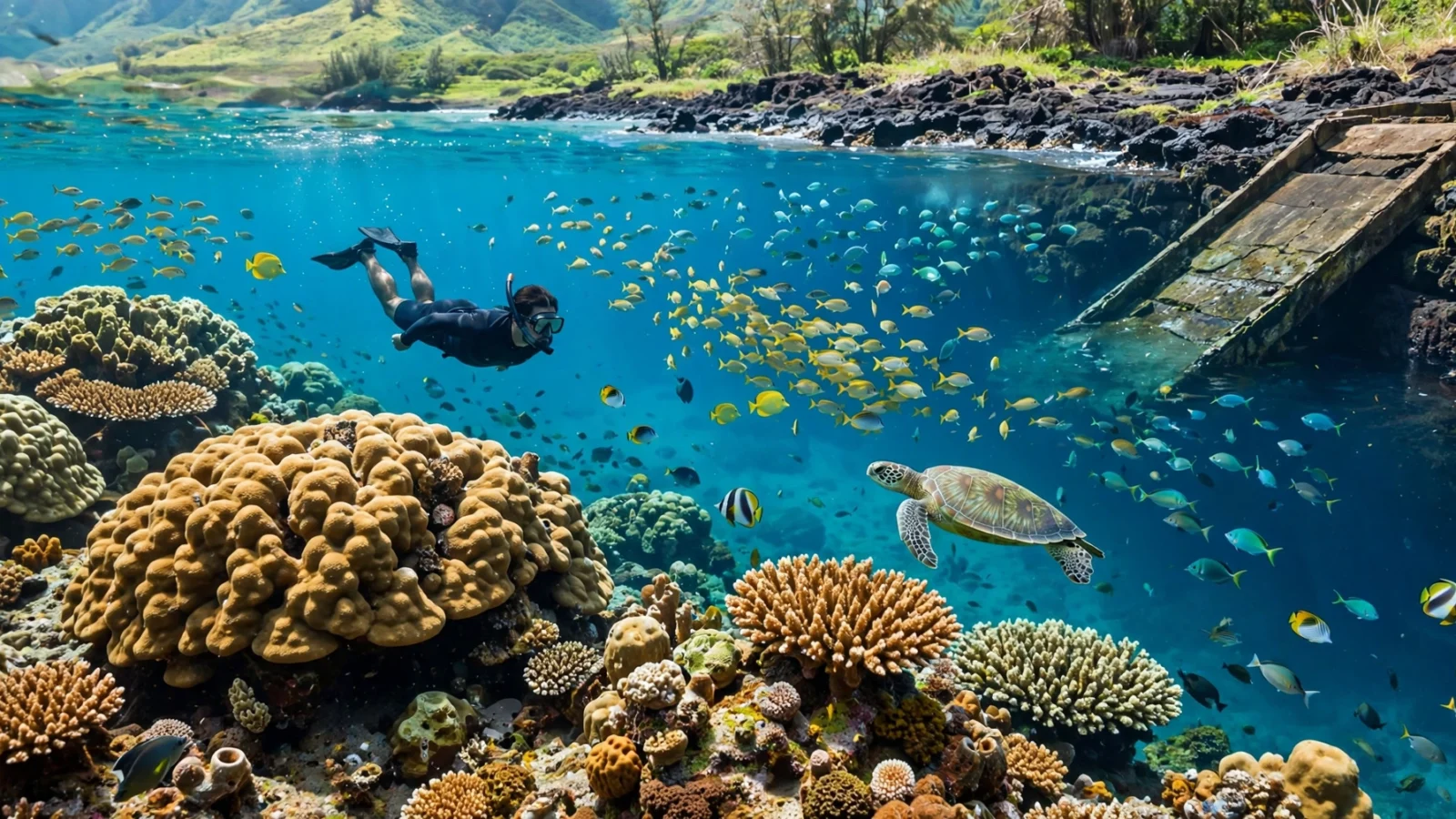
Koloa Landing is the snorkel spot that does not look like one. There is no beach, no sand, no palm-shaded lawn — just an old concrete boat ramp at the end of a dirt road, a rocky shoreline, and water that turns deep blue within a few fin kicks. People drive past it on their way to Poipu’s famous beaches every day. The snorkelers and divers who stop here know something the drivers do not: below that unglamorous ramp is one of the healthiest reefs on Kauai, with large coral heads that are genuinely rare on this island, turtles on almost every visit, and walls that drop into proper blue water.
This is not a beginner’s cove, and this guide will not pretend otherwise. Koloa Landing gets deep quickly, there is no lifeguard, and the entry is a slippery ramp rather than a sandy slope. What it offers in return is the best coral-and-fish snorkeling on the south shore for confident swimmers. This guide covers exactly how it works: the ramp entry, the two very different walls, the rain rule that decides visibility, and when to choose Koloa over its gentler neighbours Lawai and Poipu.
Quick facts
| Entry fee | None — public access, no reservation system |
| Lifeguard | None |
| Entry | Old concrete boat ramp — slippery; reef shoes on, fins on once floating |
| Depths | 5–15 ft in the shallows near the ramp, dropping steeply to 30 ft+ along the walls |
| Restrooms / showers | No permanent restrooms or showers; portable toilets have been reported at the lower parking area — do not count on them |
| Rentals / food | None at the landing; dive and snorkel shops in Koloa and Poipu |
| Best conditions | Calm winter mornings (south shore’s calm season, roughly Nov–Apr); never right after heavy rain |
| Parking | Free dirt parking above the ramp and a small lower area by the water — fills on calm weekends |
| Also known as | Hanaka’ape Bay; the historic wharf below Whalers Cove |
Quick answer: is Koloa Landing good for snorkeling?
Yes — for strong, confident snorkelers it is arguably the best shore snorkel on Kauai’s south shore, because of the coral. Most Kauai reefs are low, scattered growth on lava; Koloa Landing has big, healthy coral heads rising off the walls, and local dive operators have run trips here for decades (it was named one of the Best Shore Dives in the Pacific by Scuba Diving magazine). Turtles are close to guaranteed, the fish list is the longest of any south-shore shore entry, and spotted eagle rays cruise the drop-off. The honest catches: no beach, no lifeguard, a slippery ramp entry, water that deepens fast, and visibility that collapses after rain. Beginners and nervous swimmers should start at Poipu or Lawai and come here once deep water feels boring.
Where Koloa Landing is — and what it is not
Koloa Landing sits in Hanaka’ape Bay on Kauai’s south shore, at the end of Ho’onani Road below the Whalers Cove condominiums, a few minutes west of Poipu Beach Park. From Poipu Road, take the roundabout exit onto Lawai Road, turn left almost immediately onto Ho’onani Road, and follow the short dirt road down to the water.
One confusion to clear up first: this is not the beach of the Koloa Landing Resort. The resort — despite the shared name — has no beachfront and no snorkel entry; the landing is the separate, historic waterfront down the road. The name is literal: this was a working landing. In the whaling era it was the third-largest whaling port in Hawaii and Kauai’s only port of entry, and sugar ships loaded here into the early 1900s. The old ramp is no longer used for motorboat launching — Hawaiian outrigger canoes use it now — which is part of why the reef below has stayed in such good shape.
The entry: down the ramp, fins on in the water
There is exactly one way in, and every regular does it the same way:
- Gear up at your car — mask, snorkel, and reef shoes or booties on; fins carried, never worn on the ramp.
- Walk down the concrete ramp slowly. It is uneven and slick with algae, like every working ramp in Hawaii. Shuffle, do not stride.
- Once you can float, stop and put your fins on in the water. The shallows beside the ramp run about 5–15 feet deep, so you will be floating within a few steps of the waterline.
- Pick a wall — left or right — and commit to it (below). Do not surface-swim the middle of the bay looking for the reef; it is not there.
- Exit the way you came: fins off at the ramp shallows, reef shoes on, slow walk up. Watch for outrigger canoes using the ramp — give them the whole lane, every time.
If the ramp is greasy, the surge is pushing up it, or you cannot clearly see the bottom in the shallows, that is the day’s answer: visibility and grip only get worse further out. Our how to snorkel guide covers entry technique generally; Koloa is where it matters most on the south shore.
Where to snorkel: two walls and a boring middle
The bay is a horseshoe, and the snorkeling lives on its edges. The proven pattern is out along one wall and back the way you came — the area is compact enough that strong snorkelers can do both walls in one long session, but nobody needs to.
The left (west) wall
Head left from the ramp and the wall runs out for roughly 800 feet before the rocky point. This side is widely reported to hold the biggest coral heads — large, healthy formations that are rare anywhere on Kauai — with the bottom sloping from the shallows down to 30 feet and beyond. Fish stack up along the coral: schools of snapper and tangs over the heads, eels in the structure, turtles resting and feeding along the wall. The further out you go, the more exposed it gets — wind, surge and current all build past the point, so turn around while the swim back still feels easy.
The right (east) wall
The right side runs roughly 500 feet and stays shallower for longer — much of it in that 5–15 foot band near the shoreline — which makes it the better first-visit choice and the side to pick when conditions are marginal. Some local guides rate this side’s coral as the best of the two; others give that to the left. Honestly, both walls hold serious coral and fish, and which looks better on the day depends on light, surge and where the schools are sitting. One right-side caveat: the stream that enters the bay near this side is the visibility villain of the whole spot (see Best time, below) — after rain, this wall clouds first.
The middle: skip it
Because this was a boat channel, the centre of the bay drops quickly to a deep, sandy bottom with very little life on it. Crossing it is a long, dull swim — and boat-channel habits die hard, so keep a lookout for any vessel movement near the ramp regardless. Spend your air and energy on the walls, out and back, and let the middle be the view, not the route.
What you will see
Koloa Landing’s wildlife list is why divers and snorkelers share this ramp happily:
- Green sea turtles — reported on essentially every visit, resting on the bottom and cruising the walls
- Large coral heads — antler, cauliflower, finger, lobe, mound and rice corals, unusually big and healthy for Kauai
- Spotted eagle rays cruising the drop-off on calm days
- Moray eels, including dragon and stout morays, in the wall structure
- Schools — bluestripe snappers and bigeye scad moving along the walls
- Tangs of every kind — yellow, convict, Achilles, sailfin and lavender among them
- Butterflyfish in variety — raccoon, fourspot, ornate, lined, teardrop and more
- Trumpetfish, Moorish idols, parrotfish and triggerfish, including the humuhumunukunukuapua’a
- Red slate pencil urchins in the rocks — beautiful, and one more reason to watch your hands and feet
As always, the protected species set the terms: at least 10 feet from turtles, no touching coral or anything else, and no chasing rays. Our snorkeling with turtles guide covers the etiquette and the law.
Best time to snorkel Koloa Landing
Season: winter, like the rest of the south shore. Koloa Landing is generally best from about November through April, when the south shore is calm. In summer, south swells roll straight into Hanaka’ape Bay and can make the landing dangerous — if surfers are working the south shore breaks, snorkelers should not be on this ramp. Our best time to snorkel in Hawaii guide explains the island-wide pattern.
The rain rule matters more here than almost anywhere. A stream enters the bay just beside the ramp, and after heavy rain it carries runoff that can drop visibility from 40–50 feet to almost nothing — and the water near the stream mouth is best avoided entirely on those days. Simple rule: if it has rained hard in the past day or two, snorkel somewhere else (Lawai and Poipu clear faster) and save Koloa for a dry morning.
Time of day: morning. Calm before the trade winds, best light on the walls, and the viz holds up — dive reviews consistently report visibility collapsing when afternoon chop and surge stir the bay. Arrive early, snorkel the walls, and be done before the wind.
Parking, access and facilities
Parking is free dirt parking — an upper area where the dirt road bends, and a small lower area by the ramp. Both are informal and fill on calm weekend mornings; the lower area is shared with divers and canoe crews, so park considerately and keep the ramp lane clear. There is no entry fee and no reservation. There is no lifeguard, no rental stand, and no food at the landing. Facilities are minimal: there are no permanent restrooms or showers (portable toilets have been reported at the lower lot, but treat that as a bonus, not a plan) — the nearest full facilities are at Poipu Beach Park, minutes east. Rent gear in Koloa or Poipu before you come; everything you need is on our snorkel gear checklist, with solid reef shoes at the top for this ramp.
Is Koloa Landing good for beginners?
Honest answer: no — and that is a compliment to the spot, not a warning to everyone. Koloa Landing asks for three things beginners do not yet have: comfort in water that drops to 30 feet, a slippery ramp entry in possible surge, and the judgement to read current and exposure as the walls run out toward the points. There is no lifeguard and no shallow lagoon to retreat to. Confident, experienced snorkelers will rank it among the best shore snorkels in Hawaii; first-timers will have a much better day at lifeguarded Poipu Beach Park or in Lawai’s sheltered side after our beginners’ guide. If deep water over big coral is exactly what you came to Kauai for, though, this is your spot — with a buddy, on a calm dry morning, per our snorkeling safety guide.
Koloa Landing vs Lawai vs Poipu
The three south-shore shore snorkels sit within ten minutes of each other and suit different people:
| Koloa Landing | Lawai Beach | Poipu Beach Park | |
|---|---|---|---|
| Setting | No beach — boat-ramp entry into a horseshoe bay | Tiny cove, fringing reef | Lifeguarded beach park, twin bays |
| Coral | Best of the three — large healthy coral heads | Good fringing reef | Modest |
| Fish life | Excellent along both walls; biggest species list | Best of the three on a calm day in the shallows | Good, especially the tombolo sides |
| Entry | Slippery concrete ramp, deep quickly | Rocky, slippery lava — reef shoes essential | Easy sand |
| Lifeguard | No | No | Yes |
| Best for | Strong swimmers and divers chasing coral | Confident snorkelers chasing fish density | Families, beginners, beach days |
| Watch out for | Depth, exposure past the points, murk after rain | Rip current on the far side; beach vanishes at high tide | Crowds |
For the full island picture, including the summer north-shore flagships, see our Kauai snorkeling hub.
Nearby spots
Koloa Landing pairs with its two neighbours into one clean south-shore rotation: Koloa on a calm, dry winter morning for the coral; Lawai when you want fish density in the shallows; Poipu for the lifeguarded beach day with the family. In summer, when the south shore takes the swell, the island flips — Tunnels Beach and Ke’e Beach become the flagships, with sheltered Anini Beach as the calm-water option.
FAQ
Can you snorkel at Koloa Landing?
Yes — it is one of the best shore snorkels on Kauai, entered from an old boat ramp in Hanaka’ape Bay near Poipu. There is no beach: you walk down the ramp in reef shoes, put your fins on once you are floating, and snorkel the coral walls on either side of the bay.
Is Koloa Landing good for beginners?
No. The water drops to 30 feet or more along the walls, the ramp entry is slippery, and there is no lifeguard or shallow lagoon. It is a spot for strong, confident snorkelers; beginners are far better served by lifeguarded Poipu Beach Park or sheltered Lawai Beach.
When is the best time to snorkel Koloa Landing?
On a calm winter morning (roughly November to April, the south shore’s calm season), after at least a day or two without heavy rain. Summer south swells can make it dangerous, and afternoon trade-wind chop cuts visibility.
Why is the water sometimes murky at Koloa Landing?
A stream enters the bay beside the ramp. After heavy rain it carries runoff that clouds the whole bay, especially the right-hand wall — visibility can fall from 40–50 feet to almost nothing. Skip Koloa for a day or two after heavy rain.
Where do you park for Koloa Landing?
On the free dirt parking areas at the end of Ho’onani Road — an upper area at the bend and a small lower area by the ramp. Both fill on calm weekends. There is no entry fee and no reservation.
Is there a lifeguard at Koloa Landing?
No. There is no lifeguard, no rental stand and no permanent restrooms or showers at the landing. Snorkel with a buddy, stay on the walls, and turn back before the rocky points if wind or current builds.
What will I see snorkeling at Koloa Landing?
Large healthy coral heads that are rare for Kauai, green sea turtles on most visits, spotted eagle rays, moray eels, schools of snapper and tangs, many butterflyfish species, trumpetfish, Moorish idols and red slate pencil urchins along the walls.
Is Koloa Landing the same as Koloa Landing Resort?
No. The snorkel spot is the historic landing at the end of Ho’onani Road below Whalers Cove — a public boat-ramp entry with no beach. The Koloa Landing Resort shares the name and the neighbourhood but has no beachfront or snorkel entry of its own.
Facts checked against local Kauai dive and snorkeling guides and beach references, October 2026. Conditions change daily — always check the surf report and posted signs before entering the water, and if the ramp looks rough, it is.