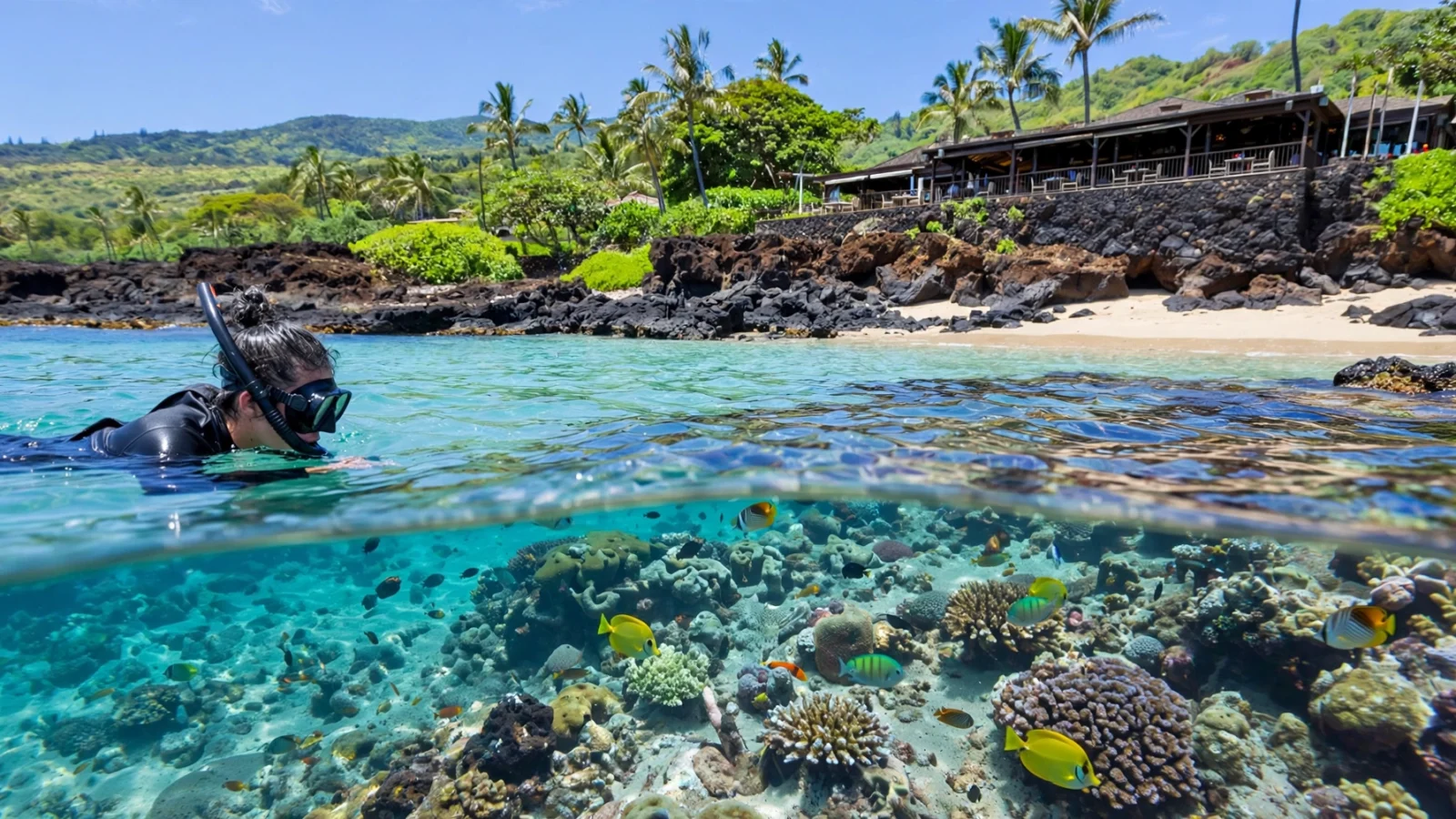
Ask a Poipu local where the best shore snorkeling on the south shore is, and a good number of them will not say Poipu Beach Park. They will point west, to a tiny strip of sand in front of a condominium resort, next to a famous sunset restaurant: Lawai Beach. The “beach” is so small it can vanish completely at high tide. The entry is over slippery lava rock. There is no lifeguard. And the reef inside the little cove is, on a calm morning, more alive than beaches ten times its size — schools of yellow tangs, eels in the rocks, turtles cruising through, and healthier coral than its famous neighbour keeps.
Lawai rewards people who read the conditions and pick their side of the cove. It punishes people who treat it like a swimming beach. This guide covers Lawai purely as a snorkeling spot: which side to snorkel, exactly how to get in over the rocks without falling, when the south shore season makes it sing (winter, not summer), and when to walk away and drive to Poipu instead.
Quick facts
| Entry fee | None — public beach, no reservation system |
| Lifeguard | None — nearest lifeguarded beach is Poipu Beach Park |
| Restrooms / showers | Restrooms and an outdoor shower across Lawai Road |
| Rentals / food | No rentals at the beach; rental shops in Poipu/Koloa nearby; Beach House Restaurant and a shave-ice stand across the street |
| Reef | Shallow fringing reef inside a small cove; reef flat a couple of hundred feet offshore |
| Best conditions | Calm winter mornings (Nov–Apr is the south shore’s calm season); early, before wind and crowds |
| Parking | Roadside on Lawai Road across from the beach, plus a small lot nearby — fills fast |
| Also called | Beach House Beach, Prince Kuhio Beach |
Quick answer: is Lawai Beach good for snorkeling?
Yes — for confident snorkelers, it is one of the best shore snorkels on Kauai’s south shore, and regulars rate its fish life above Poipu’s. The cove’s fringing reef holds more fish, in more variety, than the bigger beaches nearby, and turtles are routine rather than lucky. The honest catches are the entry (rocky and slippery — this is the spot’s whole reputation), the total absence of a lifeguard, a rip current on one side of the cove that you must stay away from, and a beach that disappears at high tide, so there is nowhere comfortable to set up between swims. Go to Lawai to snorkel, not to spend a beach day.
Where Lawai Beach is
Lawai Beach sits on Lawai Road on Kauai’s south shore, at the western end of the Poipu resort strip — directly in front of the Lawai Beach Resort condominiums and immediately beside the Beach House Restaurant, which is why many people know it as Beach House Beach. It is also called Prince Kuhio Beach, after the nearby Prince Kuhio birthplace and park. From Poipu, follow Poipu Road west to the roundabout and take Lawai Road toward the ocean; the beach is a few minutes along, on your left, with Spouting Horn blowhole a short drive further west — an easy pairing after your snorkel.
There is no signposted grand entrance, because there is barely a beach to enter: a narrow strip of sand and rock between the road and the reef. You park, cross the road, and you are at the water. That five-minute park-to-snorkel reality is part of the appeal — and part of why it gets busy with locals early.
The cove: two sides, two very different snorkels
A fringing reef barrier runs across the mouth of the cove and takes the force out of most incoming waves, which is why the inside stays snorkelable on days when exposed south-shore spots are rough. Inside that barrier, Lawai splits into two zones that could not be more different.
The sheltered side (by the Beach House)
The end of the cove beneath the low lava cliff the Beach House Restaurant sits on gets extra protection from both the reef and the point. The water here is the calmest in the cove, the reef fish are dense from the moment you put your face in, and this is where less experienced snorkelers — and everyone on a first Lawai visit — should stay. Work along the rocks at this end: eels hold in the lava structure, and the fish schools feed over the reef flat in the shallows.
The far side (the rip side — stay out)
The other side of the cove is known locally for treacherous rip currents that pull out through the reef, and it is the side that gets visitors into trouble. There is nothing over there that the sheltered side does not also have. Treat the far side as a hard boundary: if you feel a steady pull carrying you along or out, you have drifted too far — turn back toward the restaurant end immediately, parallel to shore, rather than fighting straight against it. Our snorkeling safety guide covers rip escapes in full.
The outer reef
A couple of hundred feet offshore, the reef flat proper carries the fullest coral and the biggest fish schools, and waves break on the barrier beyond it. On genuinely flat mornings, confident snorkelers work out along it; beginners should stay closer to shore, where the rocks and shallows hold plenty. Watch for sea urchins throughout — the reef here is full of them, in the rock holes and along the entry, which is one more reason the entry technique below matters.
The entry: how to get in without falling
Lawai’s entry is the whole game, and it is where most of the spot’s bad reviews are written. There is no wide sandy ramp. Expect a rock-littered shoreline with slippery lava, a few sandier patches, and a bottom that turns rocky within steps. Locals who snorkel here weekly do it the same way:
- Wear real reef shoes or booties with grip — not cheap mesh water shoes. The lava is slick with algae, and this is not the place to learn that barefoot.
- Gear up fully on shore — mask on, snorkel in, fins carried — and pick your entry line before you get wet, aiming for the sandier patches between rocks on the sheltered side.
- Walk in slowly in your reef shoes, shuffling rather than stepping, hands free for balance, never turning your back on incoming water.
- Once you are waist-deep, sit back and put your fins on in the water, then float out over the shallows — do not try to walk in fins over the rocks.
- Exit the way you came in: fins off in waist-deep water, reef shoes on, slow shuffle back, watching for urchins in the rock holes.
If the rocks look greasy, the shorebreak is thumping, or you cannot see a calm line in — those are the day’s answer. Lawai on a rough day is a sunset viewpoint, not a snorkel. For the general technique refresher, see our how to snorkel guide.
What you will see
The reef is the reason people put up with the entry. Commonly reported at Lawai:
- Schools of yellow tangs and convict tangs over the reef flat
- Butterflyfish — raccoon, fourspot and threadfin among them
- Moorish idols, parrotfish and triggerfish along the rocks
- Needlefish near the surface and wrasses everywhere, including yellowtail coris
- Moray eels tucked into the lava structure — look slowly at the sheltered end
- Day octopus, if you are lucky and patient around the rocks
- Green sea turtles cruising through the cove, and the occasional Hawaiian monk seal resting on the sand
Nothing is guaranteed, and the protected species set the terms: keep at least 10 feet from turtles and much further from any monk seal, and never touch or follow either. Our snorkeling with turtles guide covers the etiquette and the law.
Best time to snorkel Lawai Beach
Season: this is a winter spot. Kauai’s south shore is at its calmest from about November through April, when the north shore takes the big swells and the south stays sheltered. Summer flips the pattern — south swells roll in, waves can break over the reef barrier, and the cove gets rough and murky. The three surf breaks offshore (Acid Drop, PK’s and Centers) work on exactly those summer swells: if surfers are out in force, snorkelers should not be.
Time of day: early morning. Visibility is best and the water calmest before the trade winds texture the surface and before the local crowd arrives — regulars aim to be in before 8am. Our best time to snorkel in Hawaii guide explains the island-by-island seasonal pattern.
Tide: plan around high tide. The sandy strip disappears completely at high tide — there may be literally no beach to stand on — while low tide opens the sand up and calms the shallows. A morning visit on a falling or low tide is the comfortable combination; at high tide, come only to snorkel from the rocks and skip the beach expectations entirely.
Parking, access and facilities
Parking is roadside on Lawai Road, across from the beach, with a small free lot nearby; both fill quickly on calm mornings and again around sunset, when the Beach House crowd arrives. There is no entry fee and no reservation — it is a public beach. Restrooms and an outdoor shower sit across Lawai Road; there are no facilities on the sand itself. There is no lifeguard, ever, and no rental stand — rent gear in Poipu or Koloa (Boss Frog’s and others) before you come, and bring water; the shave-ice stand and the Beach House Restaurant across the street cover food. Everything you need fits on our snorkel gear checklist — reef shoes sit at the top of the list for this beach specifically.
Is Lawai Beach good for beginners?
Honest answer: it is a second-or-third-snorkel spot, not a first one. Confident beginners who are steady swimmers do fine on the sheltered side on a calm winter morning, in reef shoes, with a buddy — the fish are close to shore and the water inside the reef is gentle. But the entry is genuinely awkward, there is no lifeguard, and a beginner who slips on the lava starts their snorkel shaken. Nervous first-timers and families with small kids are better served by the lifeguarded ponds at Poipu Beach Park ten minutes east, or the rock-walled lagoons at Lydgate, after working through our beginners’ guide. Come to Lawai once the basics are boring.
Lawai vs Poipu vs Koloa Landing
The three south-shore shore snorkels sit within ten minutes of each other and suit different people:
| Lawai Beach | Poipu Beach Park | Koloa Landing | |
|---|---|---|---|
| Setting | Tiny cove, fringing reef | Lifeguarded beach park, twin bays | No beach — boat-ramp entry into a horseshoe bay |
| Fish life | Best of the three on a calm day | Good, especially the tombolo sides | Excellent along the rock walls |
| Entry | Rocky, slippery lava — reef shoes essential | Easy sand | Rocky ramp, deep quickly |
| Lifeguard | No | Yes | No |
| Best for | Confident snorkelers chasing fish density | Families, beginners, beach days | Strong swimmers and divers |
| Watch out for | Rip current on the far side; beach vanishes at high tide | Crowds; modest coral | Depth, boat channel, currents |
For the full island picture — north shore summer spots included, and Koloa Landing’s deep-water entry covered in the roundup — see our Kauai snorkeling hub.
Nearby spots
Lawai pairs naturally with a Poipu day: snorkel Lawai early while it is calm and empty, then move to Poipu Beach Park for the lifeguarded beach day, or continue west to Spouting Horn and the National Tropical Botanical Garden. In summer, when the south shore is rough, the north shore takes over — Tunnels Beach and Ke’e Beach are the summer flagships, with Anini Beach as the sheltered north option.
FAQ
Can you snorkel at Lawai Beach?
Yes — it is one of the best shore snorkels on Kauai’s south shore, inside a fringing-reef cove beside the Beach House Restaurant. Snorkeling is best on the sheltered side of the cove, on calm mornings, in reef shoes for the rocky entry.
Is Lawai Beach good for beginners?
For confident beginners, yes, on the sheltered side in calm winter conditions. It is not a first-ever snorkel spot: the lava entry is slippery, there is no lifeguard, and one side of the cove has a rip current. Beginners are better starting at lifeguarded Poipu Beach Park.
When is the best time to snorkel Lawai Beach?
Winter (roughly November to April), when Kauai’s south shore is calmest, on an early morning before the wind builds — and ideally not at high tide, when the small sandy beach disappears entirely. Summer south swells can make the cove rough and murky.
Where do you park for Lawai Beach?
Roadside on Lawai Road, directly across from the beach, with a small free lot nearby. Both fill fast on calm mornings and again at sunset. There is no entry fee and no reservation system.
Is there a lifeguard at Lawai Beach?
No. Lawai has no lifeguard, no rental stand and no facilities on the sand; restrooms and a shower are across Lawai Road. Snorkel with a buddy and be conservative — the nearest lifeguarded beach is Poipu Beach Park.
What will I see snorkeling at Lawai Beach?
Schools of yellow and convict tangs, butterflyfish, Moorish idols, parrotfish, triggerfish, needlefish and wrasses, moray eels in the rocks, turtles cruising through, and — with luck — a day octopus. Sea urchins are plentiful in the reef, so watch where you put your feet and fins.
Why does Lawai Beach disappear at high tide?
The beach is only a narrow strip of sand between Lawai Road and the reef. At high tide the water covers it completely, leaving just the rocky shoreline — one more reason to time a visit for the morning and a lower tide.
Is Lawai Beach the same as Prince Kuhio Beach?
Yes — the same cove is also called Prince Kuhio Beach (for the nearby prince’s birthplace park) and Beach House Beach (for the restaurant on the point beside it). All three names mean the small beach in front of the Lawai Beach Resort.
Facts checked against local Kauai guides and beach references, October 2026. Conditions change daily — always check the surf report and posted signs before entering the water, and if the entry looks rough, it is.