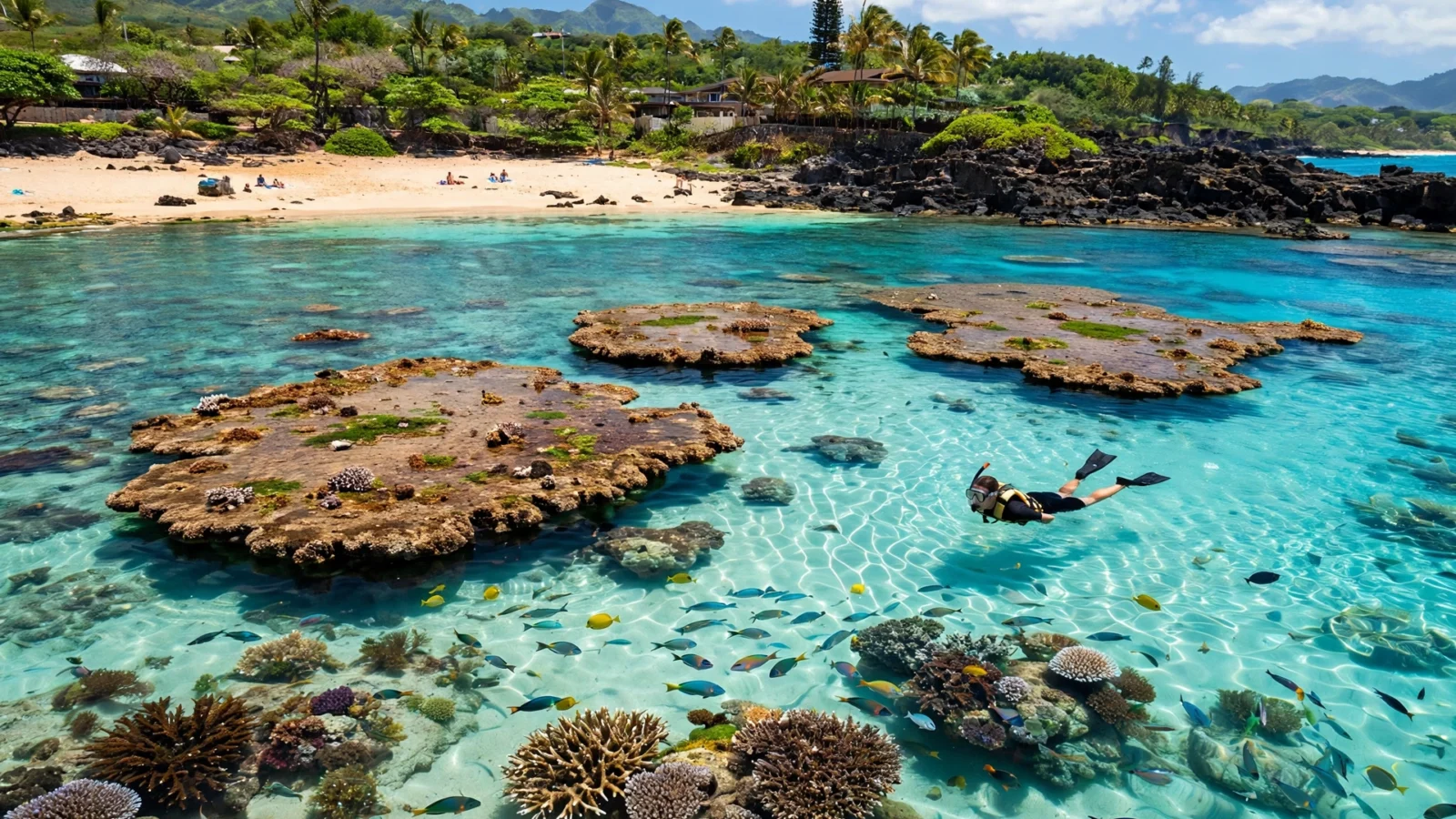
Most visitors to Pupukea Beach Park snorkel one spot and leave: Shark’s Cove, the famous lava cove at the north end of the park. A few minutes’ walk south along the same shoreline sits its quieter neighbour — Three Tables, named for three flat-topped reef tables that break the surface at low tide. The reef here is broader, the water over it is deeper, the fish list is longer, and on a calm summer morning you may share it with a handful of people instead of a crowd.
This guide covers Three Tables purely as a snorkeling spot: how the reef is laid out, exactly how to enter, what lives on the tables, the Marine Life Conservation District rules that apply to every fin kick, and the one thing that decides everything here — the season. Three Tables is a summer spot. Get that right and it is one of the best shore snorkels on the North Shore; get it wrong and it is a surf break you should only watch from the sand.
Quick facts
| Entry fee | None — public beach park, no reservation system |
| Protected status | Pupukea Marine Life Conservation District (MLCD) — nothing may be taken from the water |
| Lifeguard | None at Three Tables itself — the park’s lifeguard towers cover the Shark’s Cove end; check on the day |
| Restrooms / showers | Yes — restrooms and outdoor showers at Pupukea Beach Park |
| Rentals / food | No rental stand at the tables; rental shops and food trucks sit across Kamehameha Highway near Shark’s Cove |
| Reef depth | ~15 ft inside the reef; outer ledges drop to 35–45 ft (experienced snorkelers and divers) |
| Best conditions | Flat summer mornings, May to October |
| Parking | Free public lot at Pupukea Beach Park, shared with Shark’s Cove (fills early in summer) |
Quick answer: is Three Tables good for snorkeling?
Yes — in summer, and it is genuinely underrated. Inside the reef tables you get a protected lagoon about 15 feet deep with real coral, a long fish list and turtles, in the same park as Shark’s Cove but with a fraction of the people. The honest catches are three: there is no lifeguard stationed at this end of the park, the snorkeling sits a little farther from shore than the cove, and from roughly November to April the North Shore’s winter surf closes the spot completely. If you are visiting in the calm season and you already planned a Shark’s Cove morning, Three Tables is the better second snorkel of the day — or the better first one.
Where Three Tables is, and how the reef works
Three Tables is at the south end of Pupukea Beach Park on Kamehameha Highway in Haleiwa, on Oahu’s North Shore — between Shark’s Cove to the north and Waimea Bay to the south. It is not a separate beach with its own entrance; you park once at the Pupukea Beach Park lot and walk a few minutes south along the park to the tables.
The name is literal. Three large, flat reef formations sit in a line just offshore, and at low tide their tops show above the surface like tabletops. The snorkeling has three distinct zones:
The inner lagoon
Between the sand and the tables lies a sheltered lagoon with a mostly flat bottom around 15 feet deep, cut by sand channels. This is where most snorkeling happens: coral patches on and around the tables, fish over the sand, and protection from the open ocean as long as the surf is small. A flat-bottomed inner channel runs through the reef — useful for orienting yourself and for the swim back.
The tables themselves
The flat tops are living reef, not rock platforms to stand on. Their surfaces are pocked with potholes, and those potholes are exactly where rock-boring sea urchins sit. Float over the tables and look into the structure — that is where the eels, octopus and resting fish are — but never stand on them: you would crush coral and risk an urchin spine in the foot. The tables are also the landmark that tells you where you are; at low tide they are visible, at high tide you navigate by the reef line and the shoreline behind you.
The outer ledges
Beyond the tables, the reef drops away into ledges and deeper water around 35 to 45 feet. This is experienced-snorkeler and diver territory: more structure, bigger fish, and the occasional white tip reef shark or spotted eagle ray — but also real ocean current the moment you leave the reef’s shelter. If you are asking whether you should go out there, the answer is to stay inside.
How to enter and snorkel Three Tables
Enter through the sand channel rather than over the reef:
- Gear up on the sand and put your fins on before you wade in — the bottom near shore is a mix of sand and rock, and bare feet find every sharp edge.
- Wade out through the sandy-bottom channel (on the right side as you face the water) until you are deep enough to float without touching.
- Swim left across the inner channel toward the tables, then work along them at a relaxed pace, keeping the shoreline in sight for your return line.
- Come back the way you came, and plan your exit before you reach the reef at the south end — the sandy channel is your door in both directions.
Two habits make this snorkel: stay off the bottom (every flat surface here is either coral or an urchin pothole), and keep checking your position. Inside the reef the current is usually gentle, but along the outer edge and beyond the tables it strengthens quickly, and the swim back is always longer than it felt going out. For the general technique — mask fit, clearing, relaxed breathing — see our how to snorkel guide before your first session.
What you will see
Three Tables holds one of the better shore-snorkel fish lists on Oahu, because the MLCD protection (below) lets the full reef community live undisturbed. Commonly reported here:
- Butterflyfish in variety — fourspot, milletseed, oval, raccoon, teardrop and threadfin
- Surgeonfish and tangs — Achilles, convict and lavender tangs, orangeband and goldring surgeonfish
- Parrotfish, goatfish and Moorish idols over the sand channels
- Hawaiian cleaner wrasse working their stations on the reef, with other wrasses everywhere
- Schools of Hawaiian sergeants and needlefish near the surface
- Eels in the table structure — dwarf moray, snowflake eel, tiger snake eel
- Day octopus, green sea turtles cruising the lagoon, and — occasionally — a spotted eagle ray or a white tip reef shark out on the outer ledges
Nothing is guaranteed on any given morning, and the turtles are protected: watch from at least 10 feet away and never follow or touch one. Our snorkeling with turtles guide covers the etiquette — and the law — in full.
The rules: Pupukea Marine Life Conservation District
Three Tables sits inside the Pupukea MLCD, a state Marine Life Conservation District established in 1983 that runs from Waimea Bay to Turtle Bay and extends about 100 metres offshore. The Hawaii Division of Aquatic Resources rules are simple and strict, and they are a large part of why the snorkeling is this good:
- No taking any marine life — no collecting fish, shells, coral or anything else, dead or alive
- No fishing gear in the water — no nets, spears or traps (a small hand net under 10 feet is allowed only with a permit)
- The one exception: hook-and-line fishing from shore is allowed from October to April only (in the Waimea Bay part of the district, two poles per person) — it does not apply to snorkelers, and it is closed the rest of the year
- No feeding fish
- No motorised craft — no boats or jet skis inside the district
- No charging fees for ocean activities inside the district, and no removing sand, rock or coral
In plain terms: look, photograph, float — take nothing. If a fish seems unusually tame here, that protection is why.
Best time to snorkel Three Tables
Season first: May to October. Hawaii’s Department of Health puts the North Shore’s summer season at May through October, with flat-to-small surf; the winter season, November through April, brings consistent huge and dangerous swells to this exact coast. Waimea Bay, minutes south, hosts big-wave surfing in winter — the same swell that makes those waves makes Three Tables unsnorkellable. On a rare flat winter day a snorkel might look possible; treat that as a lifeguard’s call, not yours, and default to not getting in.
Then the morning. Within the summer window, go early: the water is calmest and clearest before the trade winds and the day’s shorebreak texture build, and the park lot is emptier. Check the surf report before you drive — wave heights for this stretch are read at the Waimea station, and anything with real size on it means the tables will be surge and whitewater. Our best time to snorkel in Hawaii guide explains the island-wide pattern.
And the tide. Low tide is when the three tables actually show themselves, which is a sight worth timing — but a very low tide also makes the inner lagoon shallower and the urchin potholes closer to your fins. A mid, rising tide is the comfortable compromise for most snorkelers.
Parking, access and facilities
Use the Pupukea Beach Park lot off Kamehameha Highway — the same free public lot that serves Shark’s Cove — then walk south through the park to the tables. In summer the lot fills early, especially on weekends; arriving before the mid-morning rush is the reliable move. The park has restrooms, outdoor showers, picnic tables and grassy shade. Food trucks and small shops sit across the highway near Shark’s Cove, and Haleiwa town, a few minutes south, has the full range of rental shops — there is no rental stand at Three Tables itself, so sort your gear before you park. A complete kit list is in our snorkel gear checklist.
Is Three Tables good for beginners?
Confident beginners, yes — inside the lagoon, on a flat summer morning, with fins on and a buddy alongside. The inner reef gives a first snorkeler real coral and fish without surf or a long swim, which is more than most beginner spots offer. But be honest about the limits: there is no lifeguard at Three Tables itself, the reef is a short swim from shore rather than at your ankles, and none of this applies in winter at all. Non-swimmers and nervous first-timers are better served by the protected shallows at Kuilima Cove up at Turtle Bay, or by working through our beginners’ guide first. Kids who are steady swimmers do well in the inner lagoon with an adult in arm’s reach — and read the snorkeling safety basics before any North Shore session.
Three Tables vs Shark’s Cove
Both spots are in the same park and the same MLCD, and many people snorkel both in one morning. They are different snorkels:
| Three Tables | Shark’s Cove | |
|---|---|---|
| Setting | Open reef tables in a lagoon | Enclosed lava-rock cove |
| Depth | ~15 ft inside; 35–45 ft outer ledges | Shallow cove, deepening outside |
| Entry | Wade a sand channel, short swim to reef | Rocky entry straight into the cove |
| Crowds | Light — most visitors stop at the cove | The park’s busiest spot |
| Lifeguard | None at the tables | Park towers at this end of the park |
| Best for | A fuller reef snorkel, second session of the day | First stop, tide pools, a contained feel |
| Season | Summer only | Summer only (winter surf closes both) |
Nearby spots
Three Tables pairs naturally with Shark’s Cove in the same park — snorkel the cove first while it is quiet, then walk south. Waimea Bay, just along the highway, is a summer swim spot in the same flat season (and a winter spectacle to watch, never to enter). For a protected any-season alternative on this coast, Kuilima Cove at Turtle Bay is the North Shore’s sheltered option, and the full coast picture is on our Oahu snorkeling hub.
FAQ
Why is it called Three Tables?
Three large, flat-topped reef formations sit in a line just offshore. At low tide their tops break the surface and look like tabletops — the name is simply what you see.
Can you snorkel at Three Tables, Oahu?
Yes, and in summer it is excellent. Snorkeling is fully allowed — what the Pupukea Marine Life Conservation District prohibits is taking anything from the water. Enter through the sand channel, stay inside the reef unless you are experienced, and only go in the May-to-October calm season.
Are there sharks at Three Tables?
Occasionally, on the outer ledges — white tip reef sharks are sometimes seen there, and they are shy, bottom-resting sharks that keep to themselves. Inside the lagoon, sharks are not a feature of the snorkel. (The “Shark’s” in Shark’s Cove next door is a name of uncertain origin, not a sighting report.)
Is Three Tables good for beginners?
For confident beginners on a flat summer morning, yes — the inner lagoon is protected and about 15 feet deep. It is not a learn-to-swim spot: there is no lifeguard at the tables, and winter closes it completely.
When is the best time to snorkel Three Tables?
A calm morning between May and October, ideally on a mid or rising tide. Check the surf report first — waves for this coast are measured at the Waimea station, and any real swell size cancels the snorkel.
Can you snorkel Three Tables in winter?
Effectively, no. From November to April the North Shore receives huge, dangerous surf — this is big-wave season at neighbouring Waimea Bay. Except on the rarest flat day, with a lifeguard’s explicit OK, stay out and watch from shore.
Where do you park for Three Tables?
In the free public lot at Pupukea Beach Park, shared with Shark’s Cove, off Kamehameha Highway. Walk a few minutes south through the park to reach the tables. The lot fills early on summer weekends.
Is there a lifeguard at Three Tables?
No lifeguard is stationed at Three Tables itself. Pupukea Beach Park’s lifeguard towers cover the park’s Shark’s Cove end — check the tower and any posted conditions on the day, and snorkel with a buddy regardless.
Facts checked against the Hawaii Division of Aquatic Resources (Pupukea MLCD) and Hawaii Department of Health season guidance, October 2026. Conditions change daily — always check the surf report and posted signs before entering the water.