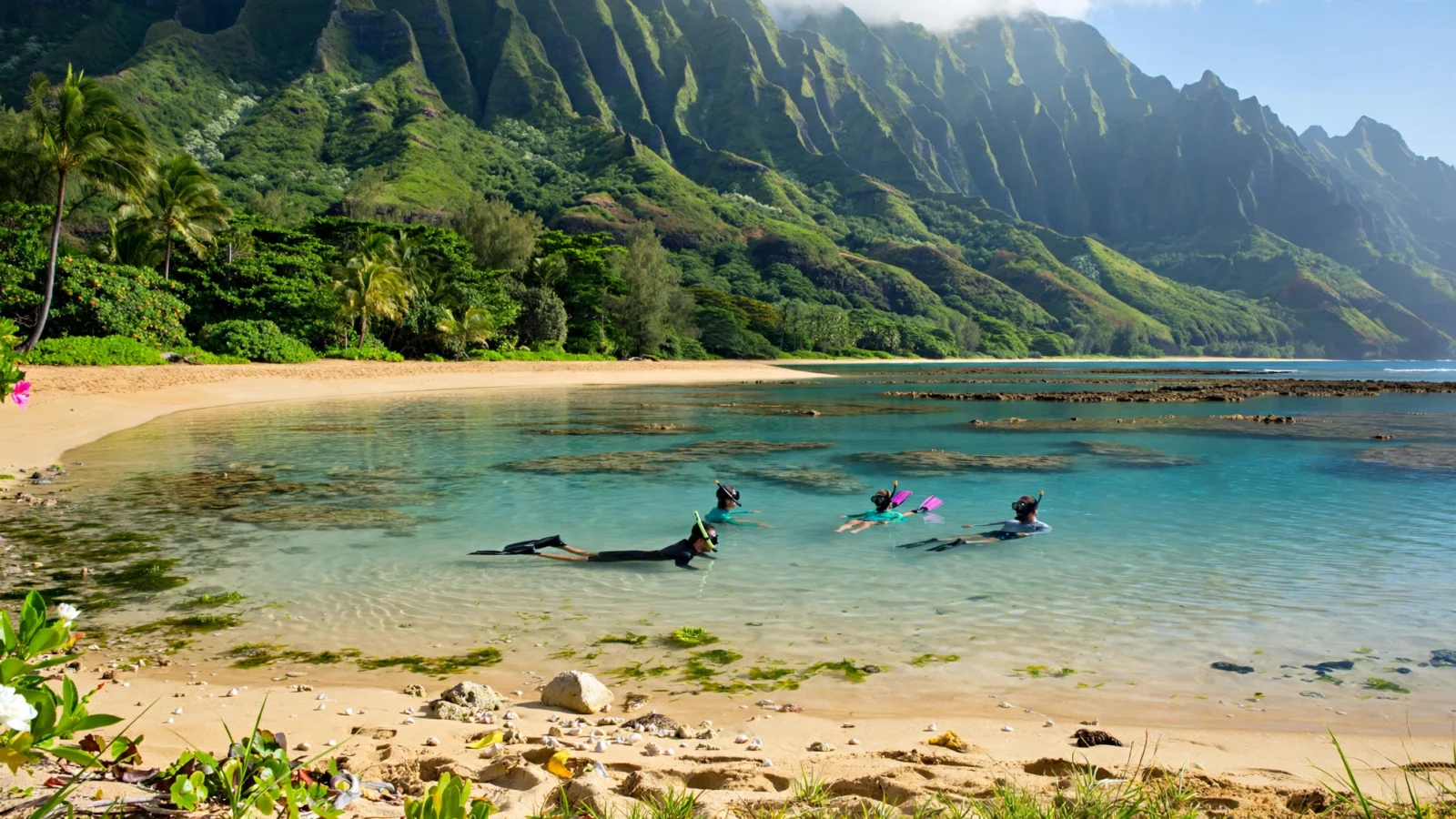
The short answer: Ke’e Beach (say keh-AY) is the reef-protected lagoon where Kuhio Highway simply stops, at the edge of Ha’ena State Park under the first cliffs of the Na Pali Coast. In the calm season it is one of Kauai’s loveliest easy snorkels — a sand-bottomed lagoon, a living reef, and a lifeguard on the sand. The price of that setting is logistics: every non-resident visitor needs an advance Ha’ena reservation, the good dates sell out within days (sometimes hours) of release, and in winter the same lagoon can become genuinely dangerous. This guide is the whole picture in one place: how the booking game works, where to get in, which parts of the lagoon to snorkel, when to go, and when to honestly skip it. You’ll also see it written Kee Beach, without the apostrophe — same beach, same lagoon.
Ke’e used to share a page here with Lydgate Beach. It has outgrown that — this is now its own dedicated guide. For the no-reservation alternative, see our Lydgate Beach guide.
Ke’e Beach at a glance
| Detail | What to know |
|---|---|
| Reservation | Required for all non-resident entry — parking, shuttle or entry-only pass via gohaena.com |
| Entry fee | $5 per person for non-residents; children 3 and under free; Hawai’i residents free with state ID |
| Parking | $20 per car, per entry timeslot for non-residents (separate parking reservation); residents free |
| Park hours | 7:00am–6:45pm in winter; 7:00am–7:45pm in summer (DLNR) |
| Best snorkeling months | Roughly May to September (calm-season lagoon) |
| Lifeguard | Tower on the beach, listed 8am–6pm daily — check the tower board on the day |
| Entry | Easy sand entry inside the lagoon |
| Facilities | Restrooms and showers at the park; no food or rentals at the beach |
| Signal | Cell reception is patchy to non-existent — download your pass before you drive |
The reservation playbook: how Ha’ena booking actually works
Since 2019, Ha’ena State Park has capped daily visitors (around 900 a day) and required advance reservations for entry. There is no walk-up ticket window, no roadside parking workaround, and no “we drove all this way” exception at the checkpoint. Book on the official site only: gohaena.com.
The three ways in:
| Pass type | What it covers | Who it suits |
|---|---|---|
| Parking + entry | A stall in the park lot plus entry for everyone in the car ($20 per car, per entry timeslot + $5 per person) | Drivers who win the fastest-selling inventory there is |
| Shuttle + entry | North Shore shuttle ride from the Waipa park-and-ride area, entry included (adult fares are $45 per adult, children ages 4-15 $25, as of October 2026 — check the booking site for current pricing) | Most visitors; no parking stress, and the ride itself is scenic |
| Entry only | Entry on foot or by bike ($5 per person) | Hawai’i residents (who enter free with ID), walkers, and cyclists based nearby |
How to actually get a pass:
- Know your release moment. Reservations open up to 30 days ahead, and new dates are released around midnight Hawai’i time. You cannot book later than the day before your visit.
- Be there at the drop. Peak-season parking passes can go within minutes to hours of release. Create your plan (date, pass type, group size) before the window opens.
- Parking first, shuttle as the strong plan B. If parking is gone, shuttle + entry is not a consolation prize — for a beach day it is arguably easier, and it is the pass most likely to still exist.
- Missed out? Keep checking. Cancellations reappear, so re-check the booking site over the following mornings before you give up on a date.
- Bring matching ID. The name on the pass is checked at entry; residents must show Hawai’i ID for free entry.
Is the shuttle worth it? This is the question visitors ask most, and the honest answer is: usually, yes. Parking is the park’s scarcest resource, while the shuttle removes the single most failure-prone part of the day. You trade a fixed departure rhythm for certainty. If you are staying on the north shore with several possible dates, try for parking first — otherwise, book the shuttle and relax.
One more reality check: parks close. Ha’ena itself closed for several weeks in September–October 2026 around a hurricane and reopened on October 15, 2026. Before any Ke’e day, check the DLNR Ha’ena State Park page for closures and current rules — and if the park is closed, Tunnels Beach, just before the park boundary, is the classic north shore fallback that currently needs no Ha’ena booking.
Is Ke’e Beach open? (and is the road open?)
Ha’ena State Park reopened on October 15, 2026, after a closure of several weeks around a hurricane — and that closure is the reason this question exists. The park, and the road to it, can close with little notice when storms, flooding or landslides hit the north shore, and a closure means no Ke’e at all: no entry, no parking, no shuttle, and no exceptions at the checkpoint.
So before any Ke’e day, check the DLNR Ha’ena State Park page for closures and current rules — on the morning of your visit, not the week before. The booking site (gohaena.com) will also show no inventory for closed dates, which is itself a signal. If the park is closed, Tunnels Beach, just before the park boundary, is the classic north shore fallback that currently needs no Ha’ena booking — and Lydgate is the year-round guarantee on the east side.
One more naming note: the reservation system is sometimes called a permit or a pass. Parking + entry, shuttle + entry and entry-only are all the same booking system on gohaena.com — there is no separate permit to chase.
The lagoon: where to snorkel at Ke’e
Ke’e’s snorkeling works because of its reef. A fringing reef arcs across the front of the beach and breaks the open ocean down into a sheltered, sand-bottomed lagoon. Inside that reef is your snorkeling area; outside it is the open Pacific, in every season, full stop.
The zones, in plain terms:
- The inner lagoon (start here). Shallow, sandy, and calm in season — the warm-up area and the right call for first-timers and kids. Fish gather around the scattered coral heads and along the sand-rock edges rather than in the bare middle.
- Along the reef (the main event). Follow the inside edge of the reef for the densest coral and fish life. This is where the lagoon deepens in places and where turtles are most often cruising. Stay on the lagoon side.
- The channel (do not). The gap where lagoon water drains back out through the reef carries a real current, and it strengthens as the tide drops and any swell rises. Ask the lifeguard where the channel current is running that day and treat that whole area as out of bounds — this one rule is most of Ke’e safety in a sentence.
Entry is the easy part: walk in from the sand anywhere along the inner lagoon, sit down in the shallows to fit fins, and push off once the water is waist-deep so you never stand on reef. Our general snorkeling safety guide covers the reef-standing and buddy rules that apply here as everywhere.
What you will see
Expect a classic Hawaiian reef community rather than a spectacle: clouds of small reef fish over the coral heads, tangs and butterflyfish working the reef edge, parrotfish grazing, and the occasional trumpetfish hanging motionless above the sand. Green sea turtles visit the reef regularly — often enough to hope for, never enough to promise. Give turtles at least 10 feet of space and never follow or touch one; our guide to snorkeling with turtles in Hawaii explains the rules and the reasoning. Hawaiian monk seals occasionally haul out on this coast to rest — admire them from at least 50 feet and let them sleep; a resting seal on the sand is a privilege, not a photo prop. Visibility is best on calm mornings after several settled days, and turns milky after rain or when swell starts wrapping in.
Best time to snorkel Ke’e
Season decides almost everything here. Ke’e faces the open north Pacific, so its snorkeling season is the north shore’s calm season:
| Months | Lagoon reality |
|---|---|
| May–September | The window: calmest water, best visibility, the lagoon at its beginner-friendly best |
| April & October | Shoulder months — good days happen, but check the surf forecast every time |
| November–March | Winter swells regularly make the lagoon unsafe; Ke’e becomes a walk-and-look beach on many days |
Time of day: mornings, before the trade winds texture the surface and before the day’s visitor rhythm peaks. Tide: a mid, gently rising tide usually gives the clearest, calmest lagoon; very low tide shrinks your swim area over the shallow reef flat and strengthens the channel drain. For the island-wide picture, see our best time to snorkel in Hawaii guide. If your trip falls outside the calm window, the north shore’s own Tunnels Beach follows the same seasonal logic — and the island’s year-round answer is Lydgate, linked above.
Ke’e Beach conditions today: how to check before you go
Ke’e’s lagoon can change overnight, so the check that matters is the one you do on the morning of your visit — not the forecast from when you booked a month ago. Three checks, in order:
- The DLNR Ha’ena State Park page. This is the official word on closures, hours and rule changes. If the park is closed, nothing else on this list matters.
- The north shore surf forecast. Look at the forecast for the north shore (the National Weather Service Honolulu surf forecast, or any surf-forecast site) and the swell direction: north swells are what shut the lagoon down. If the forecast shows a rising north swell, expect the lagoon to be rough even if the morning looks calm from the road.
- The lifeguard tower board on the day. When you arrive, read the board at the tower and ask the lifeguard where the channel current is running. The tower’s word outranks every forecast.
The decision rule is simple: if the surf is up, if the lifeguard says the lagoon is closed to swimming, or if the channel is visibly running hard, stay on the sand. The Na Pali cliffs photograph beautifully from dry land, and Tunnels or Lydgate will still be there tomorrow. Daily Kauai snorkel reports and conditions roundups exist online, but none of them replaces the three checks above — they are summaries, and the lagoon is local.
Beginners and kids: the honest verdict
In the calm season, at mid-morning, inside the inner lagoon, Ke’e is a genuinely good first snorkel: sand entry, shallow water, a lifeguard, and real reef life close to shore. Three honest caveats keep that verdict true. First, “beginner-friendly” never includes the reef edge in rising swell or anywhere near the channel — confidence is not a tide chart. Second, the reservation system means a beginner’s “let’s just try it” day takes 30-day-out planning; there is no spontaneous Ke’e. Third, in winter this is not a beginner beach at all. New snorkelers will get more from our beginners’ guide to snorkeling in Hawaii before the trip, and families who cannot face the booking game should start at Lydgate and treat Ke’e as the upgrade.
Is Ke’e Beach worth it?
For most visitors, yes — with one honest condition: only if you can get a pass. The lagoon itself earns the effort: a sheltered, sand-bottomed snorkel under the Na Pali cliffs, with a lifeguard, real reef life and turtles, at a beach that caps its crowds at around 900 people a day. What you are really paying for is the booking game — a 30-day-out midnight release, a $5 entry fee and a $20 parking pass or a $45 shuttle fare.
It is not worth it if the pass hunt is ruining the trip. If your dates are fixed, your group is large, or the midnight release has already sold out, go to Lydgate instead: no reservation, year-round calm, and a lifeguarded lagoon built for exactly this situation. Treat Ke’e as the upgrade, not the only plan — the north shore rewards the flexible, and a forced Ke’e day in bad surf is worse than an easy Lydgate morning.
Safety at Ke’e
- Winter surf is the headline risk. When north swells arrive, waves break over the reef into the lagoon and currents turn serious. If the lifeguard says no, the answer is no — the Na Pali backdrop photographs beautifully from dry sand.
- The channel current runs year-round. It is the lagoon’s drain; stay clear of the reef gap, especially on a dropping tide.
- Reef and rock cuts are the commonest injury. Enter and exit over sand, and treat any cut with care — tropical reef cuts infect easily.
- Sun and distance. There is little shade at the waterline, the drive back along the north shore is slow, and there is effectively no phone signal at the beach. Download passes and maps before you leave, and tell someone your plan.
- Check conditions on the day. Park closures, surf advisories and lifeguard flags outrank anything written here — start with the DLNR park page and the tower board.
Facilities, parking and getting there
Ke’e sits at the very end of Kuhio Highway (Highway 560), past Hanalei and Ha’ena, roughly a 15-minute drive beyond Hanalei town in normal traffic — allow much longer on a wet or busy day, as the north shore road is narrow and crosses one-lane bridges. The park lot is small by design (that is the point of the reservation system) and there is no legal overflow parking along the highway; if you did not book it, do not drive in hoping. At the beach you will find restrooms and showers, a lifeguard tower, and the Kalalau Trail trailhead steps away — many groups split the day between a morning snorkel and the first stretch of trail viewpoint. There is no food, drink or gear rental at Ke’e itself: bring water, reef-safe sunscreen and your full kit (our Hawaii snorkeling gear checklist is the packing list we would use), or rent in Hanalei or Princeville on the way.
Ke’e Beach sunset — and the Kalalau Trail from the beach
Ke’e faces west, into the open Pacific, so on a clear evening the sun drops straight into the ocean in front of the Na Pali cliffs. It is one of the best sunset seats on the North Shore — and it is also the reason to time your exit: the park closes in the early evening (7:45pm in summer, 6:45pm in winter), so watch the sunset, then leave promptly. The road out is narrow and dark.
The Kalalau Trail starts at the beach itself — the trailhead is steps from the sand, which is why so many groups split the day between a morning snorkel and the first stretch of trail. The opening climb rises to a viewpoint over Ke’e and the Na Pali coast about half a mile in, and the classic day-hike goal beyond it is Hanakapiai Beach and Falls. Two things to know before you lace up: trail access runs through the same Ha’ena reservation system, so your park pass is your entry ticket, and the trail is a real mountain path — muddy and slippery after rain, with steep drop-offs. Check the DLNR Ha’ena page for current trail rules before you plan a hike, and carry water: there is nothing to buy at Ke’e.
Ke’e vs Tunnels vs Lydgate vs Anini
| Spot | Reservation | Best season | Lifeguard | Best for |
|---|---|---|---|---|
| Ke’e Beach | Yes — Ha’ena booking mandatory | May–Sep | Yes, listed 8am–6pm | Setting + lagoon in one; Kalalau Trail days |
| Tunnels Beach | No Ha’ena pass (park before the boundary) | May–Sep | At neighbouring Ha’ena Beach Park | The richest north shore reef |
| Lydgate Beach | No — county park, walk in | Year-round | Yes, 8am–6pm | Beginners, kids, winter days |
| Anini Beach | No | Best in summer; sheltered more often | No | Long calm lagoon, turtles, space |
The pattern: Ke’e is the north shore’s special-occasion snorkel — the one you plan a month out for. Tunnels is its reef-first sibling without the gate, Lydgate is the island’s guarantee, and Anini is the quiet middle ground. All four sit on our Kauai snorkeling hub, alongside Poipu Beach on the south shore.
FAQ
Do I need a reservation just to snorkel at Ke’e Beach?
Yes, if you are not a Hawai’i resident. Ke’e Beach is inside Ha’ena State Park, and every non-resident needs a booked pass — parking + entry, shuttle + entry, or entry-only — from gohaena.com. There is no walk-up entry, and residents enter free only with Hawai’i state ID.
How far ahead should I book Ha’ena for Ke’e?
As early as the system allows: reservations open up to 30 days ahead, new dates release around midnight Hawai’i time, and peak-season parking in particular can sell out fast. Book parking the moment your dates are fixed; if it is gone, take the shuttle pass rather than losing the day.
How much does a Ke’e Beach day cost?
For non-residents, entry is $5 per person and parking is $20 per car, per entry timeslot with its reservation, so a driving couple pays $30 ($20 parking + $5 entry per person = $30 for two) before fuel. Shuttle + entry fares are $45 per adult (children ages 4-15 $25) as of October 2026. Always confirm current pricing on gohaena.com — fees and fares change.
Is the Ha’ena shuttle worth it, or should I fight for parking?
For most visitors, the shuttle is worth it: parking is the park’s scarcest inventory and the likeliest point of failure, while the shuttle guarantees your entry and removes the end-of-road parking problem entirely. Fight for parking only if you are based nearby with flexible dates.
Can you snorkel Ke’e Beach in winter?
Often, no — and sometimes, emphatically no. Winter north swells break across the reef, fill the lagoon with surge and current, and can make even wading risky. A rare flat winter morning can be snorkelable with lifeguard approval, but plan winter Kauai snorkeling around Lydgate or the south shore instead.
Is Ke’e Beach good for beginners and kids?
In the calm season, inside the inner lagoon, yes: sand entry, shallow water and a lifeguard make it a kind first snorkel. It is not a beginner beach in winter, near the channel, or outside the reef in any season — and the advance booking means it rewards planners, not spontaneous first-timers.
What is the best month for Ke’e Beach snorkeling?
June, July and August offer the most reliable combination of small surf, warm water and clear lagoon conditions, with May and September close behind. Shoulder months can deliver excellent days between swells — they just demand a forecast check the day before.
Are there sharks at Ke’e Beach?
Hawai’i’s reefs are ocean habitat and sharks exist in these waters, but incidents at Ke’e are rare and the lifeguarded lagoon is where the park directs swimmers. The realistic risks here are surf and the channel current, not sharks: snorkel in the morning’s clear water, stay inside the reef, and follow lifeguard guidance.
Can you go to Ke’e Beach without a reservation?
No — not as a non-resident. Every non-resident visitor needs a booked Ha’ena pass (parking + entry, shuttle + entry, or entry-only) from gohaena.com, and there is no walk-up entry at the checkpoint. The only exception is Hawai’i residents, who enter free with state ID. If you arrive without a pass, you will be turned around at the checkpoint — book first, drive second.
Can you feed the fish at Ke’e Beach?
No. Fish feeding is prohibited in the Hā’ena Community-Based Subsistence Fishing Area, which covers the reef off Ke’e Beach — and beyond the rule, it harms the fish you are there to see: fed fish crowd swimmers, abandon their natural diet and damage the reef community. Watch them, photograph them, and leave them alone.
How do you pronounce Ke’e Beach?
keh-AY. The “e’e” is two syllables with a glottal stop between them — keh-AY, not “key”. You will also see it written Kee Beach, without the apostrophe.
Where is Ke’e Beach?
At the very end of Kuhio Highway (Highway 560) in Ha’ena, on Kauai’s North Shore — the road literally stops at the beach, under the first cliffs of the Na Pali Coast. The mailing address is Ha’ena, Kapaa, HI 96746, about 15 minutes past Hanalei town in normal traffic.
Sources & fact basis
Hawai’i DLNR Ha’ena State Park page (hours, fees, reservation rules) and DLNR reopening notice, October 2026; Go Ha’ena booking information (pass types, 30-day window); Hawai’i Ocean Safety lifeguard listings. Fees, fares and hours checked October 2026 — park rules change, and the official sources above always outrank this guide.