Richardson Ocean Park Snorkeling: Hilo’s Black-Sand Turtle Beach
Ask a Hilo local where to snorkel on the east side and one name comes back more than any other: Richardson. Richardson Ocean Park — most people still call it Richardson Beach Park — is the Keaukaha coast’s anchor beach: a county park with black lava sand flecked with green crystals, a lifeguard on duty every day, sheltered inner water that suits first-timers, and green sea turtles so regular that a morning without one feels like the exception.
It is also the easiest snorkel decision in Hilo. Entry and parking are free, there is no reservation system, the facilities are the best of any Hilo beach park, and the drive from downtown takes about ten minutes. What this guide adds is the part the short listings skip: exactly where to get in, which part of the bay to aim for, when the freshwater springs help and when they ruin the visibility, and how Richardson honestly compares with its neighbour Carlsmith — because the two parks, five minutes apart on the same road, suit different swimmers.
Quick facts
- Where: 2349 Kalanianaole Ave, Hilo, HI 96720 — Keaukaha shoreline, about 10 minutes east of downtown Hilo
- Hours: Roughly 7:00 AM to early evening (listings vary between 7:00 and 8:00 PM closing; the county/Google listing showed a 7:30 PM close when checked in October 2026 — confirm on the park signage on the day)
- Cost: Free entry and free parking; no ticket or reservation
- Lifeguard: On duty daily, roughly 9:30 AM to 4:45 PM
- Best for: Beginners, families, turtle encounters, a full park day with a snorkel in the middle
- Facilities: Restrooms (ADA-accessible), outdoor showers, picnic areas and tables, barbecue grills, parking
Why Richardson is Hilo’s default snorkel beach
Three things combine here that no other Hilo park quite matches.
First, protection with life in it. A broken reef and rocky shoreline take the edge off the open ocean, so the inner water stays comparatively calm and shallow while still holding real reef structure — coral patches, lava rock and the fish that live on them. It is a genuine snorkel, not just a swim, in water a nervous beginner can handle.
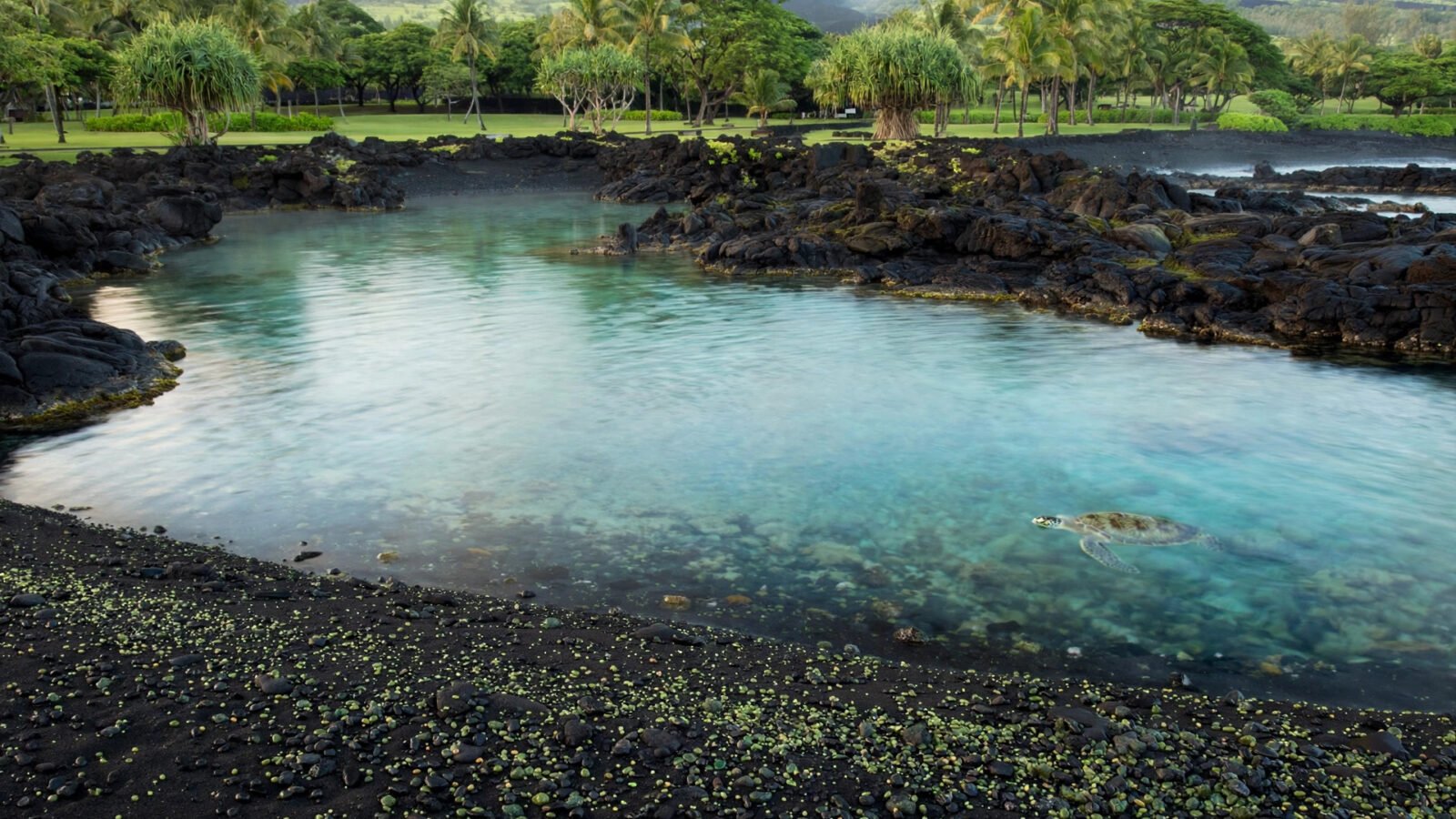
Second, the turtles. Hawaiian green sea turtles (honu) feed and rest at Richardson with a reliability that has made the park famous for it. They graze the algae on the rocks, cruise the inner reef, and haul out on the sand to rest. Sightings are never guaranteed with wild animals, but if seeing a turtle is the goal of your Hilo day, this is the highest-percentage spot on the east side. Hawaiian monk seals also visit occasionally — a privilege to see, and one that comes with strict distance rules covered below.
Third, the safety net. Richardson has a lifeguard on duty daily — unusual for Hilo’s beach parks, where cover is often weekends-only — plus restrooms, showers, picnic space and a proper parking lot. For families, that infrastructure is the difference between a plan and a gamble. Our wider Hilo snorkeling roundup puts Richardson in context with the rest of the east side, and the Big Island hub covers the Kona coast for the rest of your trip.
The sand: black lava, green olivine
Before you even get wet, look down. Richardson’s shoreline is black sand ground from lava, and mixed through it are tiny green crystals — olivine, the same mineral that colours Papakolea, Hawaii’s famous green sand beach near South Point. The mix is often described as the only sand in the Hilo area that is both black and green, and in bright sun the green flecks genuinely glitter against the black.
Two practical notes. The shoreline is rocky as much as sandy — this is a lava coast with sand pockets, tide pools and a seawall in places, not a wide Waikiki-style beach — and the dark sand and rock get hot and sharp underfoot. Water shoes or reef walkers earn their place in your bag here, on the walk in as much as at the entry.
Richardson black sand beach: how black is it, really?
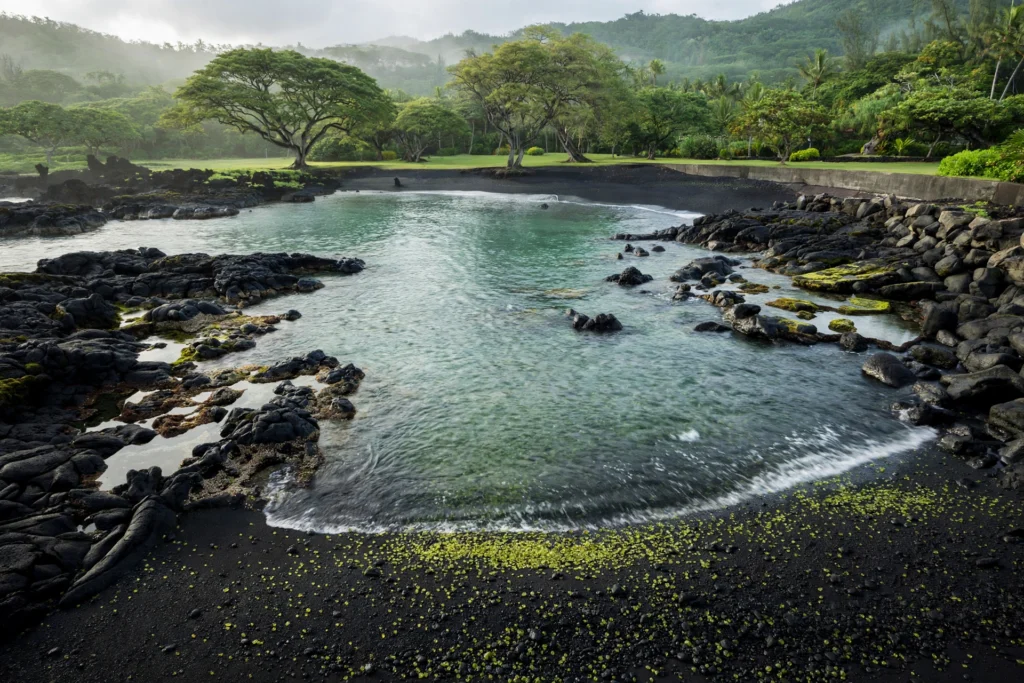
If you arrive expecting a long sweep of jet-black sand, reset the picture first: Richardson black sand beach is a small pocket of black sand on a mostly rocky lava shoreline, and that is exactly what makes it photograph so well. The sand itself is black lava grains flecked with tiny green olivine crystals — the same green flecks you see in the sand at Papakolea (Green Sand Beach), only here they are scattered through black sand rather than forming the whole beach. The green shows best when the sand is wet and the light is low, which is one more reason mornings suit this beach.
Where the sand actually is: the sandiest stretch is the small sheltered cove around the main entry by the seawall gap — the same spot this guide recommends for getting in. Away from that cove, the shoreline turns to irregular black lava rock with tide pools, which is why water shoes earn their place on the packing list. The beach is often listed as Richardson Ocean Park black sand beach, and the two names mean the same park: the county’s official name is Richardson Ocean Park, while most visitors (and most listings) still call it Richardson Beach Park.
A note on taking sand home: don’t. The olivine crystals are part of the beach, the park is a county beach park, and removing sand or rocks is the kind of souvenir that quietly damages the place other visitors came to see. Photos travel far better, and they leave the beach as you found it. For the full Hilo picture — Carlsmith’s lagoons, Leleiwi and Onekahakaha — see our guide to snorkeling in Hilo.
Where to snorkel: the inner reef vs the outer edge
The inner reef is the main event for most visitors. Enter from the sandy/rocky access points along the park’s central shoreline, where the bottom shelves gently into sheltered water over sand patches and low reef. This is beginner and family water: shallow enough to stand in places (stand on sand, never on coral), calm on ordinary days, and where the turtles most often feed. Reef fish work the rock edges — yellow tang, parrotfish, surgeonfish and butterflyfish are the regular cast, with eels tucked into the structure if you look slowly.
The outer edge, where the reef meets open water beyond the rocks, holds more coral and more variety, and also more current and surge. Confident snorkelers on a calm day will enjoy it; everyone else should treat the outer rocks as a boundary. If you cannot comfortably hold your position, the ocean has made the decision for you — come back inside.
The tide pools along the rocky margins are worth a careful look at low tide, from above or in very shallow water: small fish, crabs and invertebrates sheltering until the tide returns. Look, photograph, and leave everything exactly where it is.
Wherever you enter, put fins on in the water rather than walking in them over lava, and keep beginners inside the sheltered zone, in sight of the lifeguard tower during lifeguard hours.
The springs, the shimmer, and the rain rule
Richardson shares the Keaukaha coast’s defining quirk: cold freshwater springs seep up through the lava and mix with the warmer ocean. Where the two waters meet they form a visible shimmering band — a halocline — that first-time visitors often mistake for a fogged mask. It is normal here, strongest close to shore, and it is part of why Hilo snorkeling looks and feels different from Kona’s gin-clear bays.
The same freshwater system sets the park’s one hard rule: rain ruins it. Hilo is the wet side of the island, and after heavy rain the runoff and spring flow cloud the water and drop visibility sharply, sometimes for a day or more. A dry morning after a dry night is the Richardson sweet spot. If it poured overnight, either wait a day or head for the park anyway and make it a picnic-and-tide-pools visit with modest snorkeling expectations — just do not judge the place by a post-rain morning. Our best time to snorkel in Hawaii guide explains the island-by-island seasonal pattern behind this.
Best time to snorkel Richardson
Mornings win, for the usual stack of reasons: calmest water before the trade winds build, clearest visibility before the day’s use stirs the shallows, emptiest parking lot, and turtles behaving naturally before the beach fills.
Seasonally, Richardson is a year-round spot — the protected inner water works in winter far more often than exposed east-side beaches — but winter also brings the big-surf days when even the inner reef gets hazardous surge and churned water. On those days the lifeguard’s call is final: if the tower says stay out, stay out. Weekends and holidays are the park’s social peak, with local families filling the picnic areas and the lot; weekday mornings are the quiet version. Aim to be in the water inside lifeguard hours (roughly 9:30 AM–4:45 PM) whenever you can, especially with kids.
Getting there and parking
From downtown Hilo, follow Kalanianaole Avenue east along the Keaukaha coast, past James Kealoha and Carlsmith Beach Parks. Richardson sits near the end of the beach-park run, roughly ten minutes from the centre of town (distance estimates vary a little by source; the drive is short either way).
Parking is free in the on-site county lot — and like every good thing in Hilo, it fills on sunny weekends. Arrive in the morning and it is rarely an issue; arrive at midday on a holiday weekend and expect to wait or walk. Lock the car and leave nothing visible inside, the standard discipline for beach parks across Hawaii. There is no entrance fee, no ticket and no reservation — if any site tries to sell you a Richardson “ticket,” it is not the park. Guided snorkel tours do visit Richardson from Hilo if you want an instructor-led outing, but there is no rental shack at the park itself: bring your own mask, snorkel and fins, or rent in Hilo town before you drive out. Our Hawaii snorkeling gear checklist covers what to pack.
Is Richardson good for beginners and kids?
Yes — it is the Hilo park we would send a first-timer to first, and the reasons are structural rather than lucky: sheltered shallow inner water, a daily lifeguard, easy entries, restrooms and showers for the aftermath, and picnic space for the non-snorkelers in the group. Our beginner’s guide to snorkeling in Hawaii covers the technique side; Richardson supplies the forgiving classroom.
Three honest caveats. The bottom is rocky in places, so water shoes are close to mandatory for children. The halocline shimmer can briefly unsettle a nervous new snorkeler — reassure them it is the spring water, not their mask. And “sheltered” does not mean “always safe”: on high-surf days the inner water gets surge and current, and the lifeguard’s flags and instructions overrule any plan you made in the car. For the full safety picture, read whether snorkeling in Hawaii is safe before your trip, and our shore snorkeling guide for entry skills that apply at every lava-coast spot.
Turtles and monk seals: the distance rules
Richardson’s wildlife is protected by law, and the etiquette is simple and non-negotiable:
- Turtles: stay at least 10 feet (3 metres) away, in the water and on land. Never touch, feed, chase or crowd one, and never block its route to deeper water. A calm snorkeler floating quietly at a respectful distance almost always watches a honu longer than someone who swims at it with a camera.
- Monk seals: give them far more room. Hawaiian monk seals are critically endangered and haul out at Richardson occasionally. Admire from a distance, keep dogs and children well back, never approach for a photo, and report sightings to the state’s seal-sighting line, 808-987-0765.
- Everything else: look, don’t take. No collecting shells, coral or rocks from the reef, no standing on coral, and reef-safe sunscreen only — lagoons and sheltered reefs like this one are exactly what Hawaii’s sunscreen law exists to protect.
Our statewide guide to snorkeling with turtles in Hawaii covers the viewing rules and the other reliable turtle spots in one place.
Richardson vs Carlsmith: which Hilo park should you pick?
The two parks sit about five minutes apart on the same avenue, both are free, and locals use them differently. Here is the honest split:
- Pick Richardson if you want the fuller beach-park day: the stronger all-round snorkel, a daily lifeguard, black-and-green sand and tide pools for the kids, picnic facilities, and the best odds of turtles on the east side.
- Pick Carlsmith if calm is the whole point: its lava-walled lagoons are the most protected water in Hilo, the handrail entries suit the least confident swimmers, and the lawn-and-pavilion setup is quieter — but lifeguard cover there is mainly weekends and holidays, and there is no sand beach. Our full Carlsmith Beach Park snorkeling guide has the lagoon-by-lagoon detail.
With a free morning, do both: Carlsmith’s glassy lagoons early, then Richardson for the lifeguarded swim, the sand and the picnic. That pairing is Hilo’s classic snorkel morning.
A short history, briefly told
The park carries the name of George Richardson, a former chief detective for the County of Hawai’i. The commonly told local account is that the Malo family, who owned this stretch of coast, gave him the land in gratitude after he helped them through a typhoid outbreak — the story is repeated in park histories, though the surviving documentation is thin enough that it is best enjoyed as local tradition rather than settled record. The Richardson house on the grounds, built around 1920, still stands and now serves as the Richardson Ocean Center, the park’s small interpretive hub.
Make a day of it: nearby stops on the same road
- Carlsmith Beach Park — walled lagoons and handrail entries, five minutes back toward town (see above).
- Leleiwi Beach Park — Richardson’s immediate neighbour: rocky coves, tide pools and a quieter, local feel.
- Onekahakaha Beach Park — farther along the coast, an enclosed sand-bottomed pool that is ideal for toddlers.
- James Kealoha Beach Park — lawns, pavilions and calm coves closer to town; handy for a second swim or a sunset picnic on the way back.
What to bring
- Mask, snorkel and fins — there is no rental at the park; rent in Hilo town or bring your own
- Water shoes or reef walkers for the lava and olivine sand
- Reef-safe sunscreen (apply before you arrive), rash guard, towel
- Drinking water and food — picnic tables and grills are on site, shops are not
- A dry bag for valuables on the lawn, and a camera you can keep 10 feet from the turtles
Richardson Ocean Park, by its official name
If you search for this park, you will meet it under two names, and that is the first thing to clear up. The county’s official name is Richardson Ocean Park. Most locals and most guides shorten it to Richardson Beach Park, and some just say Richardson’s. They are all the same county park at the end of the Keaukaha beach-park run — there is no separate “Ocean Park” and “Beach Park” to choose between. Hawai’i County’s facility directory lists it as Richardson Ocean Park, 2349 Kalanianaole Avenue, Hilo, HI 96720, phone (808) 961-8688. Use the official name if you are calling the county about access or conditions, and expect the short name on local signs and in conversation.
The name matters for one practical reason: it tells you this is a county beach park, not a resort beach or a ticketed attraction. Entry and parking are free, there is no reservation, and the facilities — restrooms, showers, picnic areas, the lifeguard tower — are county facilities. If a website tries to sell you a Richardson ticket or a timed entry slot, it is not selling you the park.
The entry that matters: the seawall gap near the parking lot
Richardson looks like a beach from the parking lot, but much of its shoreline is a seawall, not open sand. That changes how you get in. The usable beach entry is a short stretch near the parking area, where the seawall breaks and the sand and rock meet the water. Plan around that gap rather than walking the seawall looking for a better spot: set up near the parking end, enter where other snorkelers are entering, and keep the gap clear for people coming in and out.
Inside that entry, the middle of the bay sits above a shallow reef, about 3 to 6 feet deep in places. That depth is part of why Richardson works for beginners — you are floating over reef and sand in water you can stand up in if you need to, though you should stand on sand, never on coral, and keep fins off the reef. The outer edge of the bay is deeper and rougher, and it is where the confident-swimmer water starts. If you are choosing between staying inside and pushing out, the depth change is your signal: shallow, calm and sandy means you are in the beginner zone; deeper water with surge at the rocks means you have left it.
The same spring system covered above also forms several ponds at and near the beach. They are shallow, nearly current-free water, and they are worth a look for small fish and the way the cold spring water meets the warmer bay — but they are not a substitute for the bay itself. Treat the ponds as part of the park’s spring landscape, and do your main snorkel in the bay, inside the sheltered water, during lifeguard hours.
FAQ
Can you swim at Richardson Ocean Park?
Yes. Swimming and snorkeling are the park’s main activities, the inner water is sheltered and comparatively shallow, and a lifeguard is on duty daily (roughly 9:30 AM–4:45 PM). On high-surf days conditions can still become hazardous — follow the lifeguard’s instructions.
Is Richardson Beach a black sand beach?
Yes — with a twist. The sand is black, ground from lava, and mixed with green olivine crystals, giving it a black-and-green sparkle that is unusual even for Hawaii. The shoreline is rocky in places, so it feels more like a lava coast with sand pockets than a wide sandy beach.
Is Richardson Ocean Park good for snorkeling?
It is Hilo’s best all-round snorkel spot: sheltered inner reef, regular turtles, reef fish in real variety, and a daily lifeguard. Visibility is good on dry mornings but a step below Kona’s clearest bays, and it drops after heavy rain because of the freshwater springs.
Do you need a ticket or reservation for Richardson Ocean Park?
No. Entry and parking are both free and there is no reservation system or ticket — anyone selling a “ticket” for this county park is not the park. Guided tours from Hilo do visit Richardson, but those are optional extras, not admission.
Where do you park for Richardson Ocean Park?
In the park’s own free lot at 2349 Kalanianaole Ave. It fills on sunny weekends and holidays — arrive in the morning to avoid the squeeze, and leave nothing visible in the car.
What are Richardson Ocean Park’s hours?
The park opens around 7:00 AM and closes in the early evening. Sources differ on the exact close (listings show between 7:00 PM and 8:00 PM; the county/Google listing showed 7:30 PM when checked in October 2026), so plan around an early-evening close and check the signage at the gate on the day.
Can you see turtles at Richardson Ocean Park?
Frequently — green sea turtles feed, cruise and rest here on most days, which is why the park is famous for them. Keep at least 10 feet away and never touch or chase them. Hawaiian monk seals also visit occasionally; give them much more distance.
What is the best beach in Hilo?
For snorkeling with facilities and a lifeguard, Richardson Ocean Park is the local answer. For the calmest beginner water, neighbouring Carlsmith Beach Park’s lagoons edge it; for toddlers, Onekahakaha’s enclosed pool wins. The three sit minutes apart on the same road, so most visitors simply do more than one.
Is Richardson Ocean Park the same as Richardson Beach Park?
Yes. Richardson Ocean Park is the county’s official name for the park at 2349 Kalanianaole Avenue in Hilo; Richardson Beach Park and Richardson’s are the common local names for the same place. There is only one park, one free parking lot and one lifeguarded bay — if a guide lists them as two stops, it is double-counting.
How deep is the water at Richardson Ocean Park?
The middle of the bay sits above a shallow reef about 3 to 6 feet deep in places, which is why the inner water suits beginners and families. The outer edge beyond the rocks is deeper, with more current and surge, and it is for confident snorkelers on calm days only. Depth varies with tide, so judge the water you can see on the day, not a number in a guide.
What is the phone number for Richardson Ocean Park?
Hawai’i County’s facility directory lists (808) 961-8688 for Richardson Ocean Park. Use it for access and facility questions; for conditions on the day, the lifeguard tower and the signs at the park itself are the final word.
Are dogs allowed at Richardson Ocean Park?
No. Dogs are not allowed at county beach parks in Hawaii, and Richardson Ocean Park is a county park — so leave your dog at home. (The park’s wildlife rules do ask visitors to keep dogs and children well back from any monk seal hauled out on the sand.)
Can you rent snorkel gear at Richardson Ocean Park?
No — there is no rental shack at the park itself. Bring your own mask, snorkel and fins, or rent in Hilo town before you drive out. Our guide to snorkel gear rental in Hawaii lists the Hilo options.
Is Richardson Ocean Park crowded on weekends?
Yes — weekends are the park’s busy time, and the free lot fills up. Come on a weekday morning if you can, or arrive early on a Saturday or Sunday. Weekday mornings are also when the water is usually at its calmest.
Is there shade at Richardson Ocean Park?
Some. Shade trees edge the picnic lawns and the grassy areas behind the beach, but the sand itself is mostly open sun — so bring a rash guard, reef-safe sunscreen and a hat if you burn easily.
Facts checked October 2026 against Hawai’i County park listings, Google’s park listing, and on-the-ground visitor reports. Hours, lifeguard times and conditions change — always follow park signage and lifeguard advice on the day.