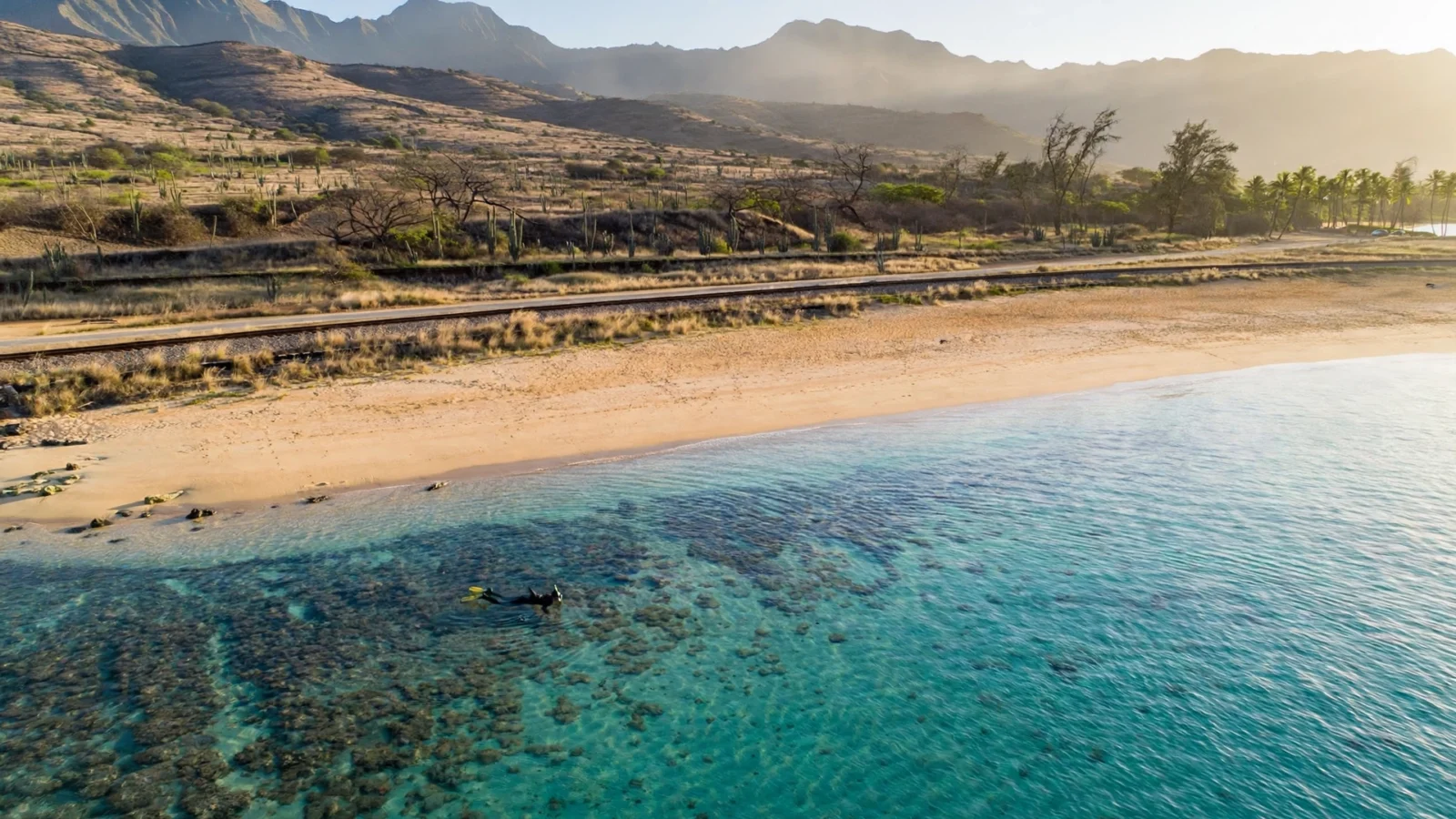
Most guides to this stretch of Oahu’s west coast send everyone to the same place: the outflow pipe at Kahe Point, in deep water, past a rough shore break. Tracks Beach, the next stretch of sand north along the old railroad tracks, is the quieter half of that coast — a shallow reef that starts close to shore, no pipe swim, and usually a fraction of the people. It sits inside the area locals call Electric Beach, in Kapolei on Farrington Highway, and it is the part of this coast a confident snorkeler should try first. This guide covers what Tracks actually is (and is not), where its reef runs, how to get in over rock without wrecking your feet or the coral, and the two rules that decide every visit here: calm mornings only, and never on a surf day.
One clarification before anything else, because almost every source mixes these names up. Kahe Point Beach Park, Tracks Beach and Electric Beach are three names for adjoining pieces of one coast — not three spellings of one beach. The snorkeling at each end is genuinely different, and choosing the wrong end is how beginners end up over a power-plant pipe in 20 to 30 feet of water. Our separate guide to Electric Beach and the Kahe Point outflow covers the south end in full. Everything below is the north stretch: Tracks.
Quick facts
| Detail | Tracks Beach, Oahu |
|---|---|
| Where | Tracks Beach Park, Farrington Highway, Kapolei — west coast of Oahu, north of Kahe Point Beach Park and the Ko Olina turnoff |
| Also listed as | Hawaiian Electric Beach Park (park listings use the same Farrington Highway address for this stretch) |
| Snorkel area | Shallow reef close to shore along the Tracks frontage, improving as you work south toward Kahe Point |
| Entry | Sandy pockets between rock and reef. Rocky and sharp in places — fins on early, never walk the reef flat |
| Lifeguard | None at Tracks. The nearest tower is Ocean Safety Tower 40 at Kahe Point Beach Park, to the south |
| Facilities | Restroom and an outdoor shower / rinse reported at Tracks Beach Park (basic). Picnic tables and unpaved, partly shaded parking in park listings and reviews |
| Best for | Confident snorkelers who want a shore reef without the Kahe Point pipe swim; strong-swimming families on flat mornings |
| Not for | True beginners, small children in the water, any day with surf breaking on the reef, or anyone expecting a lifeguard |
Three names, one coast: Kahe Point, Tracks, Electric Beach
Drive north on Farrington Highway past the end of the H-1 and you pass the whole story in about a mile. The Hawaiian Electric Kahe power plant stands on the mountain side of the road — the largest generating station on Oahu — and the coast across from it took its nickname from the plant. Here is how the names divide up:
| Stretch | Where it is | Snorkeling read |
|---|---|---|
| Kahe Point Beach Park | The southernmost small beach, directly across from the power plant. Main parking, and Ocean Safety Tower 40, staffed during the day. | The outflow end. Warm discharge water leaves a pipe roughly 200 yards offshore in 20 to 30 feet of water and draws dense marine life — and a rough, funnelled entry, a steep drop-off and real current. Experienced snorkelers and divers only. |
| Tracks Beach / Tracks Beach Park | The stretch further north, where the old railroad tracks run along the road — the source of the name. No lifeguard tower. | The gentler end, and the subject of this guide. Reef begins close to shore, the water over it is shallower, and there is no pipe to swim to. Still an exposed west-coast reef: calm days only. |
| Electric Beach | The local name for the whole Kahe–Tracks coast, after the power plant. | Useful as a search term, useless as a direction. If a guide says “Electric Beach” without saying which end, check whether it means the pipe (Kahe Point) or the reef (Tracks) before you plan around it. |
That split is the whole secret of this coast. The two best independent guides to the area both make the same point: the Kahe Point entry is narrow, wave-funnelled and current-prone, while the stretch closer to the old railway tracks is the gentler option, where most families should start. Tracks is not a different, tamer beach park that happens to be nearby — it is the same reef system, read from its shallow end.
Where the snorkeling actually is at Tracks
There is no single marked snorkel zone at Tracks, and no buoy line. The pattern regulars follow is simple:
Start on the reef in front of the park. The reef begins close to shore here — you are over rock, coral heads and reef fish within a short swim of the sand, not after a long offshore push. Work the pockets and edges rather than the flat itself: fish hold along the reef margins, turtles feed over the algae-covered rock, and the structure is where eels and octopus hide.
Head south if conditions allow. Every experienced account of this coast says the same thing: the coral gets better, the water clearer and the marine life more abundant as you move south toward the power plant. That gradient is real — the warm-water influence strengthens in that direction — but it comes with a trade. The further south you go, the closer you are to the Kahe Point entry zone, its drop-off and its currents. Treat the southward swim as a calm-day extension for confident snorkelers, turn around well before the water deepens and starts to move, and never treat the outflow pipe itself as a Tracks destination. The pipe, and how to approach it safely from the Kahe Point entry, is covered in our Electric Beach guide.
Stay off the surf lineup. Tracks is first and foremost a locals’ surf break — a consistent left in summer, with a north-west wrap in winter, ridden by the neighbourhood. The surf zone and the snorkel reef overlap on this narrow coast. Snorkel the inner reef pockets away from breaking waves and boards, give surfers the right of way without being asked, and on any day the break is working, the snorkeling is simply off. That is not a downgrade; it is the local rule of the beach, and the reef will be churned and low-visibility anyway.
Getting in: the rocky-entry method
The most repeated practical warning in reviews of Tracks is not about currents — it is about feet. The bottom here mixes sand with rock and sharp reef, and the standard advice from regulars is blunt: wear your fins, not water shoes, and do not walk in the water.
The entry that works: pick a sandy pocket between rock shelves, ideally where other snorkelers are already getting in. Sit or crouch in the shallows, pull your fins on before you need them, and push off into a float as soon as the water is deep enough — then swim, float or tread over the reef flat instead of standing on it. “Toe-walking” in fins, in the words of one regular, beats planting bare or shod feet on sharp reef. Coming out is the reverse: swim in until you can stand on clean sand, not on the flat.
Two reasons, not one. The obvious one is cuts — sharp reef and hidden rock punish anyone who wades. The quieter one is the reef itself: standing on coral and reef flat kills the structure you came to see and is exactly what Hawaii’s reef etiquette asks visitors not to do. If a spot has no sandy pocket you can enter cleanly, move along the beach until you find one. On a rough day, no pocket is clean enough — see the conditions rules below.
What you see
Tracks is a reef-fish snorkel first. Expect the standard west-Oahu reef community over close-to-shore structure: schools of reef fish along the edges, triggerfish (including lagoon and lei triggerfish reported on this stretch), boxfish, and the small hunters — eels tucked into crevices and the occasional octopus, both reported repeatedly here. Reviewers on clear mornings also report nudibranchs and occupied shells on the reef — the kind of small finds a shallow, slow snorkel is actually best for.
Green sea turtles are the headline sighting. Honu feed on algae over the rock along this whole coast, and Tracks mornings regularly produce them. Give a feeding turtle its space — stay at least 10 feet away, never chase, block or touch one, and let it choose to pass you. Our guide to snorkeling with turtles in Hawaii covers the distance rules and the law in full.
Two occasional visitors deserve a honest mention, not a promise. Spinner dolphins work this coast and reviewers at Tracks describe a pod swimming past — and even hearing dolphins underwater. That is a lucky offshore encounter, never a plan: do not swim toward, chase or try to join a pod (spinner dolphins are protected, and approaching them is both illegal and the fastest way to end the encounter). Hawaiian monk seals also haul out on this stretch of sand from time to time. If one is on the beach, it owns that piece of beach — keep a wide distance, keep dogs and children back, and snorkel somewhere else along the frontage.
What you should not expect at Tracks is the pipe spectacle. The dense, warm-water crowds of fish around the outflow opening belong to Kahe Point, a long and serious swim south. Tracks trades that intensity for access: a reef you can reach in minutes, in water you can stand up from in the sandy pockets, on a beach where you might share the morning with a handful of locals instead of a tour group.
Best time and the conditions rules
Morning is the snorkel. On Oahu’s west coast the pattern is reliable: early mornings are calmest and clearest, and wind and chop build through the day. Aim to be in the water early, ideally on a weekday, and plan the rest of the beach day — picnic, sunset, the drive north — around a morning swim. Our guide to the best time to snorkel in Hawaii explains the seasonal pattern island by island.
Summer is calmer; winter is surf season. The leeward coast is the island’s sunny, dry side, but it is unprotected ocean. Summer generally brings the manageable, snorkelable days; winter swells wrap into this coast and turn the reef entry dangerous. There is no month that guarantees a Tracks snorkel — there are only mornings that offer one.
The three no-go signals: (1) surf breaking across the reef, not just at the surf break — entry and exit become genuinely dangerous, with waves pushing you onto rock; (2) churned, milky water after wind or swell — visibility collapses and the current that does it is still running; (3) any current you can feel pulling along or off the reef at the start of your swim. Any one of the three ends the snorkel. Walk the sand, watch the surfers, and come back on a flat morning — or switch to a protected spot such as the lagoons at Ko Olina, a short drive south.
Safety at Tracks: no lifeguard, real ocean
Be exact about this: Tracks Beach Park has no lifeguard tower. The nearest staffed tower is at Kahe Point Beach Park to the south — Tower 40, staffed during daytime hours (listed as 8am to 6:30pm). A practical routine used by careful visitors here is to check in at that end first: look at the ocean from Kahe Point, and if the lifeguards are warning people out of the water there, Tracks is not a loophole — it is the same ocean with nobody watching it.
Snorkel with a buddy, stay within your stamina, and consider a flotation device if there is any doubt — the wider Electric Beach coast has a rescue history precisely because confident-looking water here moves. Never swim in front of the outflow discharge if you venture south toward Kahe Point: the fast-flowing warm water pushes offshore. Keep reef-safe sunscreen on, take more water and shade than you think you need (the leeward sun is strong and the park shade is limited), and read our general Hawaii snorkeling safety guide before any west-coast swim.
One land-side warning every serious source repeats: car break-ins are a real problem on this stretch. Leave nothing of value in the car — nothing visible, nothing in the trunk you cannot afford to lose — and keep valuables with you on the sand. This advice appears in guide after guide for the Kahe–Tracks parking areas, including from writers who were robbed here themselves. Plan for it rather than hoping around it.
Parking, facilities and access
Tracks Beach Park sits directly on Farrington Highway in Kapolei, roughly 45 minutes from Waikiki in normal traffic, just north of the Ko Olina turnoff and the Kahe Point parking. Park listings describe free parking, picnic tables and freshwater showers; reviewers describe the Tracks parking more precisely as an unpaved area with some shaded spots, which fills and tightens on busy weekends — arrive early, especially in summer.
Facilities are basic, and sources disagree about which end of the coast has what, so plan conservatively: a restroom and an outdoor shower / rinse are reported at Tracks Beach Park itself, with reviewers calling the restroom poorly maintained; the Kahe Point end to the south is also reported to have bathrooms and showers alongside its lifeguard tower. Either way, treat Tracks as a bring-everything beach — gear, water, food, shade — rather than a serviced park. There is no gear rental at the beach; bring your own or rent on the way out of town, and use our snorkel gear checklist to make sure the mask you bring is one you have already tested. Fins are not optional here — they are your entry method and your insurance against current.
Is Tracks good for beginners and families?
The honest answer is: it is the family end of Electric Beach, which is not the same as a beginner beach. Independent family guides to this coast put it exactly that way — the Tracks / Electric Beach side is where most families should start on THIS coast, because the reef is close and shallow compared with the pipe swim at Kahe Point. But the same guides are clear that this coast as a whole is not beginner snorkeling: the entry is rocky, there is no lifeguard at Tracks, and conditions change fast.
So the verdict by swimmer: true beginners and anyone with untested gear — no. Start somewhere protected (Ko Olina’s lagoons are minutes away) and build the skills first; our beginners’ snorkeling guide ranks the island’s learn-here spots. Confident snorkelers, and families with strong-swimming older children, on a flat morning — yes, with fins on, a buddy in the water, and the willingness to call it off at the shoreline if the reef is breaking. Children belong in the sandy shallows under direct supervision, not out over the reef flat — reviewers who love this beach say the same in plainer language.
Tracks vs Kahe Point: which end should you snorkel?
Choose Tracks if you want a shore reef without a long swim, shallower water, fewer people, and a morning you can end with a picnic and a sunset-facing beach — and if your group tops out at confident snorkeler rather than diver. Choose Kahe Point if the outflow pipe and its marine density are the whole point of the trip, everyone in the group is an experienced ocean swimmer, and conditions are calm enough for a funnelled entry and a 200-yard swim to deep water. Many strong snorkelers do both across two mornings rather than forcing both into one: Tracks first, to learn how this coast behaves, then the pipe on the calmest morning of the trip. What nobody should do is drift south from Tracks, find the water deepening and warming, and improvise a pipe visit without the entry, the plan or the stamina for it.
Nearby west-coast snorkeling
If Tracks is surfed out or the wind is already up, the west coast gives you honest alternatives rather than consolation prizes. South, the Ko Olina lagoons are the protected, beginner-safe option on this side of the island. North, Makaha Beach offers a bigger beach-park snorkel with its own turtle reputation, and Pokai Bay is the calm, family-first harbour beach further up the coast. All three are proper shore snorkeling days in their own right — check conditions at each rather than assuming the whole coast shares one mood.
Frequently asked questions
Is Tracks Beach the same as Electric Beach?
Partly. Electric Beach is the local name for the whole Kahe Point–Tracks coast, taken from the power plant across Farrington Highway. Tracks Beach is the northern stretch of that coast, along the old railroad tracks. Kahe Point Beach Park is the southern end, where the outflow pipe is. A guide to “Electric Beach” may mean either end — check which before you go.
Where exactly is Tracks Beach Park?
On Farrington Highway in Kapolei, on Oahu’s west coast — north of Kahe Point Beach Park and the Ko Olina turnoff, about 45 minutes from Waikiki in normal traffic. Park listings also show this stretch as Hawaiian Electric Beach Park, at the same highway address.
Is Tracks Beach good for snorkeling?
Yes, on the right morning. It has a shallow reef close to shore with reef fish, turtles feeding over the rock, and occasional eels and octopus — the gentler snorkeling on the Electric Beach coast. It is good specifically for confident snorkelers on calm days. On surf days, or for beginners, it is not a good snorkel at all.
Is Tracks Beach safe for beginners?
No — and it is important not to let “gentler than Kahe Point” blur into “beginner-friendly.” There is no lifeguard at Tracks, the entry crosses rock and sharp reef, and waves breaking on the reef make entry and exit dangerous. Beginners should start at a protected spot such as the Ko Olina lagoons, minutes south.
Is there a lifeguard at Tracks Beach?
No. Tracks Beach Park has no lifeguard tower. The nearest staffed tower is Ocean Safety Tower 40 at Kahe Point Beach Park, to the south, during daytime hours. Snorkel accordingly: buddy up, check conditions before entering, and stay well inside your stamina.
What is the difference between Tracks Beach and Kahe Point?
Kahe Point (south) is the outflow end: a narrow, wave-funnelled entry, a steep drop-off, and a roughly 200-yard swim to the plant’s discharge pipe in 20 to 30 feet of water, with the densest marine life and the strongest currents. Tracks (north) is the shallow reef end: reef close to shore, no pipe, fewer people, and no lifeguard. Same coast, different swim.
When is the best time to snorkel Tracks Beach?
Early on a calm morning, ideally a weekday in summer. Mornings are calmest and clearest on the west coast before the wind builds; winter swells can close this reef entirely. If surf is breaking across the reef when you arrive, do not enter — that is the single clearest no-go signal here.
Where do you park for Tracks Beach, and is it safe?
Park at Tracks Beach Park on Farrington Highway — parking is listed as free, in an unpaved area with some shade, and it tightens on weekends, so arrive early. On safety: break-ins are a well-documented problem along this stretch. Leave nothing of value in the car, visible or hidden, and keep what matters with you on the sand.