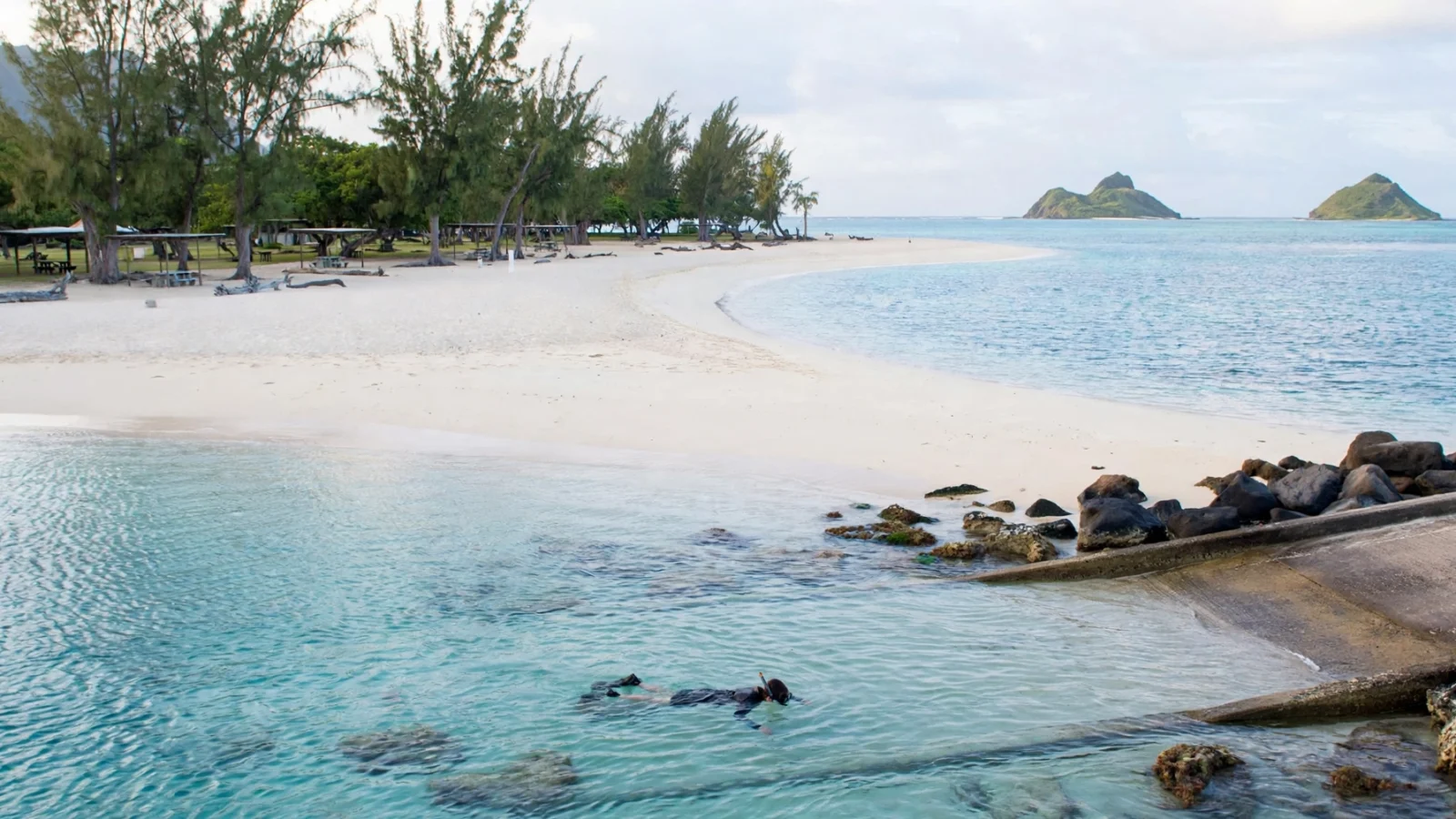
Kailua Beach is the beach that breaks snorkelers’ hearts in the nicest possible way. The water is the clearest turquoise on Oahu’s windward side, the sand runs for two and a half miles, the twin Mokulua islands sit on the horizon like a screensaver — and under the surface, for most of that length, there is almost nothing to look at. The bottom off Kailua is sand. Beautiful, fish-poor, reef-free sand. Travel sites that call this a vibrant snorkeling destination are selling the colour of the water, not what lives in it.
And yet Kailua does have a snorkel — one genuine spot, plus an offshore option that strong paddlers rate among the best on this coast. At the south end of the bay, the rocks beside the boat ramp hold octopus, eels, turtles and proper reef fish. Kayak out to Popoia Island or the Mokes and the snorkeling turns genuinely good. This guide separates the postcard from the reef: where the one shore spot actually is, what the sand flats will and will not show you, how the trade winds run this beach’s clock, and when you should walk ten minutes south to Lanikai instead — because for a pure shore snorkel, that is often the right answer, and an honest guide should say so.
Quick facts
- Location: Kailua Beach Park, Kawailoa Road, Kailua — windward (east) Oahu, about 12 miles and 30 minutes from Waikiki via the Pali Highway (H-1 exit 21A, Highway 61)
- Snorkeling verdict: One real shore spot — the rocks by the boat ramp at the south end. The rest of the bay is sand flats: fine for a first float and the odd turtle, poor for reef life
- The offshore upgrade: Kayak snorkeling around Popoia (Flat Island) and the Mokulua islands — both state seabird sanctuaries, with landing rules to check before you go
- Lifeguard: Yes — lifeguard towers at the beach park (one local guide posts roughly 9am–5:30pm; follow the towers’ posted signs on the day)
- Parking: Free, in several public lots — and competitive on weekends, holidays and canoe-regatta days
- Facilities: Restrooms, outdoor showers, picnic tables, boat ramp, shade trees at the park
- Reservations: None for the beach park
- Best beginner move: A calm morning float at the boat-ramp end, then Lanikai Beach for a first real reef
The geography: one bay, three beaches, one reef corner
Kailua Bay is a long, sheltered crescent on Oahu’s windward coast, protected by an offshore reef that takes the energy out of the Pacific before it reaches shore. The sand strip runs about two and a half miles and changes name as you walk it: Kailua Beach Park at the south end, with the lots, lifeguards and facilities; Kalama Beach Park along the middle; and Castles toward the north end, where the crowds thin to locals and dog-walkers. It is one continuous beach and one continuous underwater story almost the whole way: a gently sloping sandy bottom, shallow for a long way out — the bay is less than about 25 feet deep across most of it — with no fringing reef off the sand.
The exception sits at the very south end, where the beach park’s boat ramp meets a stretch of rock and reef rubble. That rocky corner — the transition between Kailua Beach and the Lanikai side of the bay — is where hard bottom, structure and marine life concentrate. Everything honest about shore snorkeling at Kailua starts and ends there.
Offshore, two landmarks complete the picture. Popoia Island — Flat Island — is the low, flat-topped islet a paddle from shore, and beyond it the two Mokulua islands, the Mokes, rise about two miles out. Both are Hawaii State Seabird Sanctuaries: wedge-tailed shearwaters burrow-nest on Popoia, and the Mokes host their own nesting colonies. That status matters for snorkelers, and the kayak section below covers it properly.
Zone 1: The boat-ramp rocks — Kailua’s one real shore snorkel
Swim to the rocks at the end of the bay, beside the boat ramp, and Kailua finally gives a snorkeler something to watch. The rock and rubble hold the bay’s resident cast: he’e (octopus) tucked into holes by day, puhi (moray eels) in the crevices, reef fish working the structure, and honu (green sea turtles) cruising through or resting near the rocks — local outfitters describe exactly this spot, in almost these words, and for once the outfitters are underselling nothing. It is a small zone — a snorkel of tens of minutes, not hours — but it is real reef snorkeling: structure, camouflage, and the slow, patient kind of looking that finds an octopus by its garden of shells.
Work it properly and it rewards you. Go on a calm morning before the trade winds texture the surface. Enter off the sand near the ramp, stay aware of boat traffic around the ramp itself — give launching and landing boats a wide berth and make yourself visible — and snorkel the rock line slowly, hovering rather than finning hard over it. Look into holes before you drift over them; the best sightings here are the hidden ones. Keep the standard distance from turtles — at least 10 feet — and never reach into crevices: what lives in them bites, stings or is simply entitled to be left alone, a rule our Hawaii snorkeling safety guide covers in full.
Set the ceiling honestly, too: this corner is a good small snorkel, not a Hanauma-class reef. If the boat-ramp rocks are your whole plan and you have a car, the comparison table at the end of this guide may reroute you — and that is fine. Kailua’s snorkel is a bonus on a great beach day, not a destination reef.
Zone 2: The sand flats — a first float, not a fish hunt
The other two-plus miles of Kailua Bay are sand: clean, pale, gently sloping sand under clear, shallow water. Snorkel it and you will mostly see — sand. Ripples, light patterns, the occasional small fish, and every so often a turtle passing over the flats between feeding areas, which is a genuinely lovely sight precisely because the stage is so empty. There is no fringing coral reef off the beach to explore; sources that promise coral gardens here are describing some other beach, possibly on some other island.
That does not make the flats useless. For a true first-timer — a nervous beginner, a child with a new mask — Kailua’s combination is close to ideal practice water: a soft sandy entry with a tiny shorebreak, shallow water for a long way out, lifeguards at the park end, and nothing underfoot to fear or to damage. Fifteen minutes of mask practice here, floating over sand in water you can stand up in, is exactly how many people should start; our beginners’ guide to snorkeling in Hawaii builds that progression beach by beach. Just graduate knowing what this was: a classroom with a world-class view, not the reef itself.
One windward-side caution belongs here. Kailua faces the trade winds, and on strong-trade days the bay gets choppy, visibility drops over the sand, and wind-blown stingers can occasionally wash in on this coast — lifeguards post signs when they do; read them before you swim. Calm, light-wind mornings are this beach’s snorkeling window, full stop.
Zone 3: Kayak snorkeling — Popoia and the Mokes
Kailua’s best snorkeling is not walked to; it is paddled to. This is Oahu’s kayak capital — outfitters in Kailua town rent kayaks and snorkel sets by the hour or day — and the two sanctuary islands offshore are the destinations.
Popoia (Flat Island) is the nearer paddle, sitting just off the beach park end of the bay. The water around it holds more structure and fish than the beach flats, and it is the realistic target for a first kayak-snorkel outing. The Mokulua islands, about two miles out, are the full expedition: the snorkeling and freediving around the Mokes are rated by local paddling guides among the best in Hawaii, with reef fish in real numbers and turtles as regulars — a half-day trip in settled weather, not a casual add-on.
The rules matter as much as the reef. Both Popoia and the Mokulua are Hawaii State Seabird Sanctuaries with protected nesting colonies. Landing is restricted and regulated — historically, landing on the larger Mokulua (Moku Nui) has required a permit and the smaller island is closed to landing — and the rules and permit system change, so check the current DLNR Division of Forestry and Wildlife guidance before you plan to land anywhere; snorkeling from your kayak in the surrounding water is the low-impact way to do this trip regardless. Go on a light-wind morning, take a guided tour if you are new to ocean kayaking (tours handle permits, gear and the route), never paddle out alone into building trades, and plan the return before the afternoon wind makes it a workout. Our best time to snorkel in Hawaii guide explains the morning pattern that governs this whole coast.
Access and parking: free lots, real competition
Kailua Beach Park is one of the easiest major beaches on Oahu to reach. From Waikiki or Honolulu, take the H-1 to exit 21A and cross the Ko’olau on the Pali Highway (Highway 61) into Kailua town, then follow Kailua Road to the beach park — roughly 12 miles and about 30 minutes. There are no reservations or permits for the park itself.
Parking is free, spread across several public lots: the main beach-park lot off Kawailoa Road, just past the bridge over the Kawainui Canal; additional areas off Lihiwai Road; and the boat-ramp lot reached by continuing on Kawailoa Road and turning onto Mokulua Drive — the lot to aim for if the boat-ramp rocks or the Lanikai side are your plan. Free does not mean easy: the lots are limited and genuinely competitive on weekends, holidays, summer days and during canoe regattas, when the park fills with paddlers. Arrive in the morning — which the snorkeling conditions wanted anyway — and the parking, the lifeguards and the calm water all line up at once.
Facilities at the park are complete: restrooms, outdoor showers, picnic tables, the boat ramp, and broad shade from the ironwood and palm trees behind the sand, with Kailua town’s food and rental shops a few minutes away. Gear is easy: outfitters in town (Kailua Beach Adventures on Kailua Road is the best-known, and not the only one) rent snorkel sets, kayaks and paddleboards. Pack reef shoes for the boat-ramp rocks and the full kit list from our snorkel gear checklist if you are paddling out.
Best time, seasons and the trade-wind clock
Kailua runs on the trade winds. The trades blow from the northeast with famous predictability — they are why this bay is a world-class kiteboarding and windsurfing beach — and they strengthen through the day. For snorkeling, that sets a simple clock: early morning is the window, when the bay is calmest, the water clearest, the parking emptiest and the boat-ramp rocks at their most readable. By mid-afternoon on a typical trade day, the surface is textured, visibility over the sand drops, and the snorkel is done — switch to the beach, the shade and the town.
Seasonally, summer brings the bay its longest runs of light-wind mornings and warmest water. Winter on the windward side is wetter and windier, with more chop and more murk after rain — the boat-ramp snorkel still works on the calm mornings that do occur, but they must be picked, not assumed. Year-round, sunrise is this beach’s signature hour: the sun comes up beyond the Mokes, the bay is at its calmest, and an early snorkel at the rocks can be finished before most of Oahu has had coffee.
What you will see
At the boat-ramp rocks: octopus in their holes, moray eels in the crevices, the standard reef-fish cast around the structure — tangs, wrasses, butterflyfish — and green sea turtles cruising or resting, reliably enough that local guides name honu as this spot’s headline. Around Popoia and the Mokes: fuller reef communities, more fish in more variety, and turtles as a matter of course. Over the sand flats: light, space, the occasional small fish — and every so often a turtle crossing the empty stage, which visitors consistently describe as a highlight out of all proportion to its rarity. Overhead and offshore in winter, humpback whales pass this coast; watch from shore. What you will not find, anywhere along the beach itself, is a coral garden off the sand — for that, from this neighbourhood, the answer is Lanikai’s reef or a drive to Hanauma Bay. The turtles you do meet deserve the full etiquette — 10 feet minimum, no touching, no chasing — laid out in our snorkeling with turtles guide.
Kailua vs Lanikai: the honest reroute
These two beaches share a bay, a town and a parking problem, and they are not interchangeable for snorkelers.
| Spot | Choose it when… | The trade-off |
|---|---|---|
| Kailua — boat-ramp rocks | You are already having a Kailua beach day and want a small, real reef snorkel inside it | Small zone; boats near the ramp; done in under an hour |
| Kailua — sand flats | A first-timer needs calm, shallow, lifeguarded practice water | Almost no reef life; a classroom, not a destination |
| Kailua — kayak to Popoia / the Mokes | You paddle, it is a calm morning, and you want this coast’s best snorkeling | Sanctuary landing rules; weather-dependent; a half-day commitment to the Mokes |
| Lanikai Beach | You want a proper shore reef — extensive coral, especially along its northern section | No lifeguards, no facilities, and residential-street parking that fills brutally early |
| Kaiona Beach | You are continuing south toward Waimanalo and want its reef patches in a local park setting | A separate drive; smaller beach-day infrastructure than Kailua |
The short version: come to Kailua for the beach day — the sand, the shade, the kayaks, the town — and take the boat-ramp snorkel as its built-in bonus. Come to this coast purely to snorkel from shore, and start at Lanikai. Both answers are in our Oahu snorkeling hub, which lines the island’s spots up in order.
Frequently asked questions
Is Kailua Beach good for snorkeling?
Mostly no — and partly yes. Most of the bay is sandy bottom with very little reef life. The rocks beside the boat ramp at the south end hold a genuine small snorkel (octopus, eels, reef fish, turtles), and kayak snorkeling around Popoia Island and the Mokulua islands is genuinely good. Judge it by which of those three you are actually doing.
Where is the best snorkeling at Kailua Beach?
At the south end of the bay, around the rocks by the Kailua Beach Park boat ramp. That rocky corner is the only shore spot with consistent structure and marine life. Offshore, the waters around Popoia (Flat Island) and the Mokulua islands hold the area’s best snorkeling, reached by kayak.
Can you snorkel to Flat Island or the Mokes?
Strong swimmers do reach Popoia, but the standard and safer way to both islands is by kayak. Both are state seabird sanctuaries and landing is restricted and regulated — Moku Nui landing has historically required a permit and Moku Iki is closed — so check current DLNR rules before planning to land; snorkeling from your kayak avoids the issue. The Mokes are about two miles out: a calm-morning, half-day paddle, best done guided if you are new to ocean kayaking.
Is Kailua Beach good for beginners?
For a first float, yes: sandy entry, tiny shorebreak, shallow water and lifeguards at the park make it gentle practice water. For a first reef snorkel, no — there is almost no reef off the beach. Do your mask practice here, then snorkel Lanikai or another reef beach.
Are there lifeguards, restrooms and showers?
Yes. Kailua Beach Park has lifeguard towers (one guide posts roughly 9am–5:30pm — follow the posted signs), restrooms, outdoor showers, picnic tables and a boat ramp. Lanikai, by contrast, has no lifeguards and no facilities.
How much is parking at Kailua Beach, and when does it fill?
Parking is free in several public lots around the beach park and boat ramp. It is also limited and competitive — weekends, holidays, summer and canoe-regatta days fill early. A morning arrival solves parking and gets the calmest water in the same move.
When is the best time to snorkel Kailua Beach?
Early morning, before the trade winds build. Trades strengthen through the day and chop the bay up by afternoon; light-wind summer mornings give the longest, clearest window. Check the lifeguard signs for any stinger or advisory postings before swimming.
Kailua or Lanikai for snorkeling?
Lanikai, for a shore snorkel: it has an extensive reef, especially along its northern section, while Kailua’s beach is sand. Kailua wins the wider beach day — lifeguards, facilities, parking lots, kayak rentals — and its boat-ramp rocks and kayak islands are real snorkeling. Many visitors do both in one windward day.
The bottom line
Kailua Beach is a magnificent beach and a modest shore snorkel, and it deserves a guide that says both things in the same breath. The turquoise water is real; so is the empty sand beneath most of it. Snorkel the boat-ramp rocks slowly and well, paddle to the sanctuary islands on a glassy morning if you can, use the flats to teach a beginner — and when the day calls for a true reef from shore, walk south to Lanikai without a flicker of disappointment. Read Kailua for what it is, and it stops breaking snorkelers’ hearts and starts being what it has always been: the best beach day on the windward side, with a small, honest snorkel built in. Start with our Oahu hub to line the whole coast up.
From Kailua, the next bay north is a very different snorkel — our Kaneohe Bay snorkeling guide covers its sandbar, patch reefs and the boat access you need to reach them.