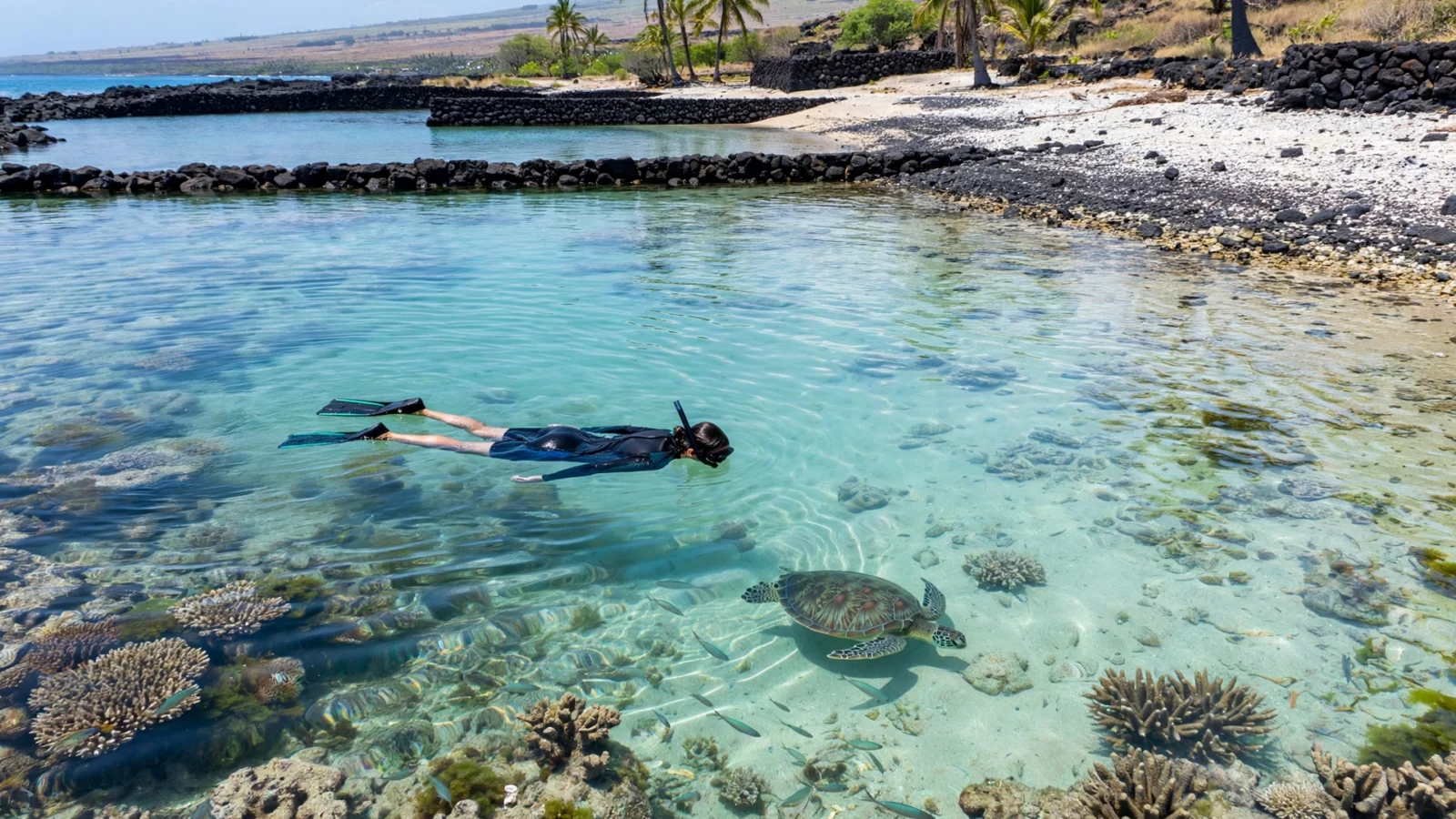
Honokohau Beach sits inside a National Park, and that changes everything about snorkeling here. The reef is protected by federal law, the turtles are everywhere, and the star attraction is not the beach at all — it is the Ai’opio Fishtrap, a 1.7-acre ancient Hawaiian fishpond walled off from the ocean with a manmade stone and coral wall. If your idea of a snorkel day is a reef teeming with corals right off the sand, read the verdict below first. If your idea is a calm, culture-rich morning with turtles, clear shallow water, and history under your fins, this is one of the most underrated snorkel stops on the Kona coast.
Big Island or Maui? Read this first. There are two Honokohau Bays in Hawaii. The one on Maui, north of Napili, is a surf break — not a snorkeling spot. This guide is about Honokohau Beach on the Big Island, inside Kaloko-Honokohau National Historical Park just north of Kailua-Kona. Every “Honokohau snorkeling” search result that matters is about the Big Island one; the Maui one only shows up to confuse you.
The quick verdict: who should snorkel Honokohau
Honokohau is a calm-water, beginner-friendly cultural snorkel — not a big-reef spectacle. Go for:
- Easy, protected-water snorkeling in a reef-buffered cove
- Near-guaranteed green sea turtle sightings (they haul out on the beach here)
- Snorkeling inside a 1.7-acre ancient Hawaiian fishtrap — a story none of your friends have
- A half-day that combines snorkeling with real Hawaiian history (fishponds, petroglyphs, heiau)
Skip it (or lower your expectations) if you want dramatic coral walls and big fish schools — drive south to Kealakekua Bay or Two Step for that. And know that there are no facilities at the beach itself — no restrooms, no rentals, no lifeguard. The visitor center has restrooms and water; the beach has none.
The three zones: fishtrap cove, Honokohau Beach, and the outer reef
Everyone calls the whole place “Honokohau Beach,” but there are three distinct snorkeling zones with very different characters. Pick the right one and you will have a great morning; pick wrong and you will wonder what the fuss was about.
| Zone | Water | Best for |
|---|---|---|
| Ai’opio Fishtrap cove (southern entrance) | Shallow, calm, protected cove with tide pools | Beginners, kids, turtle watching, history nerds |
| Honokohau Beach (~quarter mile north) | Calmer reef-protected swimming/snorkeling water, salt-and-pepper sand | Adults wanting a proper swim-snorkel, fewer crowds |
| Outer reef edge / north of the harbor entrance | Strong break — an advanced surf spot ~200 yards north of the harbor entrance | Not for snorkeling. Surfers only. |
Ai’opio Fishtrap — the reason to come
Directly in front of Aiopio Beach, the ancient Hawaiians built a 1.7-acre pond enclosed by a manmade stone and coral wall along the curving shoreline. It was designed to let fish in during high tide and trap them behind the lava structure when the tide dropped. Today the fishtrap is a shallow, protected cove — calm enough for kids to play in the shallow water and tide pools, with Hawaiian green sea turtles usually lounging on the small beach and drifting through the cove.
The sand here is a rough salt-and-pepper mix of coral and lava rock with broken shells — water shoes earn their keep. Offshore reefs throughout the area act as a buffer for incoming waves and currents, which is what keeps the cove calm even on breezy days.
Honokohau Beach — the quieter swim
About a quarter mile north of Aiopio Beach, Honokohau Beach has a pahoehoe lava shelf along the shoreline and coarse salt-and-pepper sand. It is usually not crowded, and the offshore reef keeps the surf off, so swimming and snorkeling happen in calmer water than the name “lava shelf” might suggest. Behind the beach sits the Aimakapa Fish Pond, another ancient Hawaiian fishpond with a sluice gate and the Kanaka Leo Nui (“Man with a loud voice”) stone — worth the walk even with dry hair.
What you’ll see under water
Set reef expectations honestly: this is a turtle and tropical-fish cove, not a coral garden. In the fishtrap cove expect the usual Kona coast residents — yellow tang, kole, damselfish, the occasional humuhumunukunukuapua’a — plus the main event: green sea turtles (honu), both cruising the cove and hauled out on the sand. Off Honokohau Beach the fish life picks up slightly with the reef structure. Visibility is typically good in the morning and degrades as the day warms; the cove’s shallow, sheltered water reads gin-clear on calm mornings.
The snorkeling rules that matter here
This is a National Park, protected by federal law — the rules are real, not suggestions:
- Do not stand on, climb, or break the fishtrap walls. The 1.7-acre stone-and-coral wall is an archaeological treasure built by hand with no mortar. Treat it like a museum piece that happens to be in the ocean.
- Do not touch or take anything — coral, shells, rocks, artifacts. Leave the park as you found it.
- Stay off the heiau (temple) sites along the shore; they are sacred.
- Keep your distance from turtles. The federal and state guidance is to stay at least 10 feet (3 meters) away and never chase, touch, or feed them. The turtles here are used to people — let them come to you, and give hauled-out turtles wide berth on the sand.
- Reef-safe sunscreen only. Hawaii law bans oxybenzone and octinoxate; mineral sunscreen (non-nano zinc oxide) is the safe choice. See our reef-safe sunscreen guide before you pack.
Getting there, parking, fees, and hours
Kaloko-Honokohau National Historical Park sits on the west coast about 3.7 miles north of Kailua-Kona and about 4 miles south of the Kona airport, on the makai (ocean) side of Highway 19 near mile marker 97.
- Fees: none. No entrance fee, no parking fee — one of the best free activities on the Big Island.
- Visitor center (Hale Ho’okipa): open daily 8:30 a.m.–4 p.m. Restrooms and water here. The main parking lot gates lock outside those hours — do not leave your car inside after 4 p.m.
- The easy route: park in the back parking lot at Honokohau Harbor (the small-boat harbor on Kealakehe Parkway) and walk the trail under a quarter mile to Aiopio Beach. You skip the visitor center this way, but the walk is short.
- The scenic route: park at the visitor center and hike the ~1-mile trail through petroglyphs, fishponds, and heiau sites to the beach. Flat, hot, and worth it once.
Pack water, a hat, and slip-proof footwear — the climate here is arid-hot desert, the trail crosses lava rock (very slippery where algae-coated near the ponds), and there is minimal shade. The beach itself has no restrooms and no trash cans: pack everything out.
Best time to snorkel Honokohau
Morning, always. Trade winds build through the day on the Kona coast, and this shoreline is at its calmest and clearest before about 11 a.m. Summer (April–October) brings the flattest water; winter can push north swells toward the reef edge and the surf break north of the harbor entrance. If the harbor mouth looks rough, stay in the fishtrap cove — the offshore reef does the filtering for you. See our best time to snorkel in Hawaii guide for the island-wide picture.
Safety: the honest version
- No lifeguard. You are on your own — snorkel with a buddy, and check conditions before you get in.
- Rocky, urchin-y entries. Water shoes are not optional here; the pahoehoe shelf and fishtrap wall rocks hide sea urchins.
- The surf break north of the harbor entrance is advanced-only. About 200 yards north of the harbor mouth the offshore reef throws a strong break. Snorkelers stay south of it, in the cove and beach zones.
- Beginners and kids: the fishtrap cove is genuinely good for both — shallow, protected, and turtle-rich. Nervous first-timers should still read our beginners guide and stay in the cove. If anyone in your group is not a confident swimmer, this beats the North Shore or the open-ocean boat spots.
Gear rental and the manta connection
There is no rental stand at the beach — bring your own gear or rent in town first. Kona has plenty of options; our snorkel gear rental guide covers what to get and what to skip. (Boss Frog’s, the big Kona rental chain, nicknames this spot “Kona Dog” — you’ll see it on their snorkel maps.)
One more thing the harbor is famous for: manta ray night snorkels depart from Honokohau Harbor, right next door. The same boats that load up at sunset for the manta ray night snorkel — the Big Island’s signature after-dark experience — launch from here. Snorkel the fishtrap in the morning, come back to the harbor at night, and you have done the two most distinctive Kona water experiences in one day.
Honokohau vs the other Kona snorkel spots
Honokohau fills a specific slot on the Kona coast. Here is how it compares, so you can build the right day:
| Spot | Vibe | Snorkeling | Facilities |
|---|---|---|---|
| Honokohau / Ai’opio | Cultural, calm, uncrowded | Easy cove + fishtrap, turtles guaranteed, modest reef | None at beach; visitor center has restrooms |
| Kealakekua Bay | Showpiece, busy | Best coral walls and fish on the coast, spinner dolphins | Kayak tours; shore access limited |
| Two Step | Local favorite, easy entry | Excellent reef right off the lava shelf | Basic; no rentals |
| Kamakahonu (Kailua Bay) | Town beach, family | Calm, sandy-bottom, beginner-easy | Full town facilities nearby |
If you only have one snorkel day in Kona: do Honokohau in the morning and a manta ray night snorkel from the harbor after dark. If you have two days, add Kealakekua or Two Step for the big-reef experience Honokohau does not try to be.
Pair it with a Kona coast day
Honokohau is a half-day stop, and it pairs naturally with the rest of the Kona coast. Combine it with Kamakahonu (Kailua Bay) in town for an easy town-beach second act, or save it as the calm morning before an afternoon at the Kona coast’s bigger snorkel spots. The full Big Island snorkeling hub has the whole coastline mapped.
Honokohau Beach snorkeling FAQ
Is Honokohau Beach good for snorkeling?
Yes — with the right expectations. The reef-protected fishtrap cove at Aiopio Beach is calm, shallow, and full of turtles and tropical fish, and Honokohau Beach a quarter mile north offers calmer swim-snorkel water. It is not a dramatic coral-wall destination; go for turtles, calm water, and history.
Is Honokohau Beach on the Big Island or Maui?
Both exist, and the confusion is real. This guide covers Honokohau Beach on the Big Island, inside Kaloko-Honokohau National Historical Park north of Kailua-Kona. Maui’s Honokohau Bay is a surf spot, not a snorkeling destination.
Is there an entrance fee for Kaloko-Honokohau National Historical Park?
No. Entry and parking are free. The visitor center is open daily 8:30 a.m.–4 p.m., and the main parking lot gates lock outside those hours.
How do I get to Honokohau Beach?
The shortest route is to park in the back lot at Honokohau Harbor and walk the trail under a quarter mile to Aiopio Beach. The longer, scenic route is the ~1-mile trail from the park visitor center off Highway 19 near mile marker 97.
Can I snorkel inside the Ai’opio Fishtrap?
Yes — the fishtrap cove is the calmest snorkeling water here. But the 1.7-acre stone-and-coral wall is a protected archaeological structure: never stand on, climb, or break it, and don’t take anything from the park.
Is Honokohau Beach good for beginners and kids?
The Ai’opio Fishtrap cove genuinely is — shallow, reef-protected, and calm on most mornings. There is no lifeguard and entries are rocky, so wear water shoes, go in the morning, and keep kids in the cove.
Where do the manta ray night snorkel tours leave from?
Honokohau Harbor, right next to the park — the same harbor whose back parking lot gives you the short trail to the beach. See our manta ray night snorkel guide for how to pick a tour.
Are there sea turtles at Honokohau Beach?
Reliably yes — Hawaiian green sea turtles (honu) cruise the fishtrap cove and haul out on Aiopio Beach. Keep at least 10 feet (3 meters) of distance, never touch or chase them, and give beached turtles a wide berth.
Heading south along the Kona coast, our Ho’okena Beach Park snorkeling guide covers the hidden reef at Kauhako Bay.