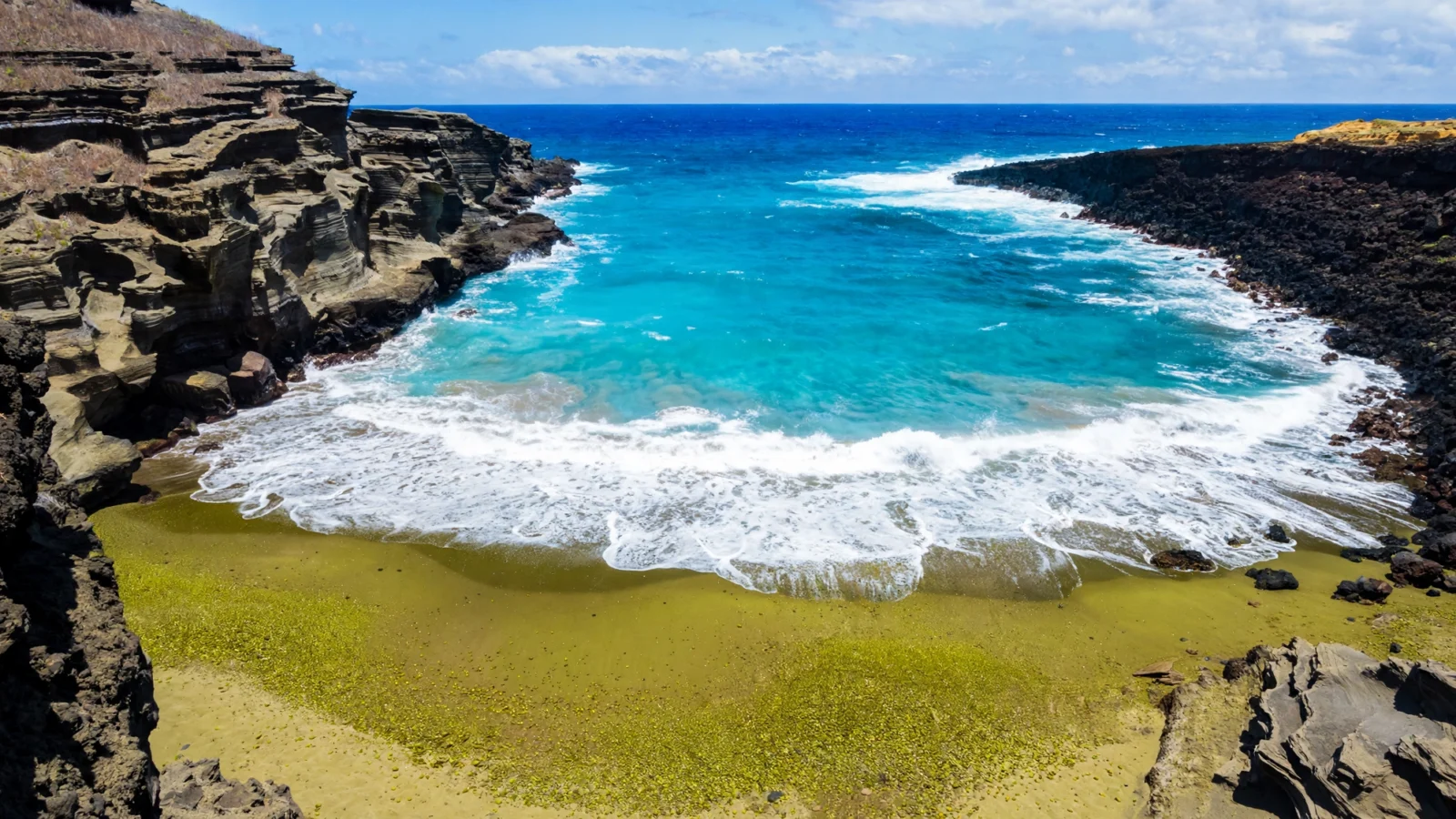
Everyone who makes the long, hot walk to Papakōlea asks the same question at the same moment. They have just come down the cinder cone trail into Mahana Bay — olive-green sand underfoot, one of only a handful of green-sand beaches on the planet, turquoise water foaming white against black lava — and it looks so inviting that the snorkel gear comes out of the pack almost by reflex. Then they look a little longer. The waves are not breaking on a reef out there. They are standing up and dumping straight onto the beach, the water churning green-white across the whole cove. Someone is always standing at the waterline doing the same maths you are: the most unusual beach on the Big Island, and the ocean in front of it behaving like it does not want anyone in it. Both impressions are correct. This guide is the snorkel-first version of Papakōlea that the travel guides do not write: what the snorkeling here actually is (and mostly is not), the rare flat morning when a strong snorkeler can honestly get in, the hike that decides whether you even arrive with energy to spare, and where on the Ka’ū coast your snorkel time is genuinely better spent.
The honest summary, up front: Papakōlea is a sightseeing stop first and a snorkeling spot almost never. The bay faces the open southern Pacific with no sheltering reef, south swells arrive at close to full strength, and the result is a heavy shorebreak and turbulent water as the documented normal — not the exception. There is no lifeguard and no facilities of any kind. On a genuinely flat morning — most often in summer, early, before the trades fill in — confident snorkelers do get in along the rocky edges and find lava structure and scattered reef fish in water that can be surprisingly clear. That window is real, but it is measured in occasional mornings per season, and the hike means you cannot simply come back tomorrow and try again inside the same trip unless you walk the whole thing twice. If your Big Island trip needs one dependable snorkel, this is the wrong beach for it — pick from our Big Island snorkeling hub instead. If you are already walking out to South Point and want to know exactly how to judge the bay when you arrive, read on.
Quick facts
- Location: Papakōlea Beach (Mahana Bay), at the base of Puʻu Mahana cinder cone near South Point (Ka Lae), Kaʻū district, Big Island — the southernmost beach in the United States.
- The snorkeling, honestly: A green-sand cove with no sheltering reef; lava-rock edges that hold scattered fish on flat days only. Most days of the year the correct snorkel decision here is no.
- Getting there: About a 2.5–3 mile hike each way from the trailhead parking area, across open, shadeless pasture and lava — no water, no shade, no facilities. Unofficial 4WD shuttle rides are often offered at the trailhead by locals.
- Lifeguard: None.
- Facilities: None — no restrooms, no food, no gear rental, no cell service to count on. Bring everything.
- Best (only realistic) snorkel window: A flat summer morning, early — and only after the go/no-go check below passes.
- Bring: Far more water than you think, sun protection, sturdy footwear for the hike, water shoes for the lava, and your own mask and fins — there is nothing to rent or buy anywhere near the beach.
Why the water fights you: the snorkeling truth
Start with the geography, because it explains everything else. Papakōlea sits in a cove that opens directly onto the southern Pacific. There is no fringing reef standing between the beach and the open ocean, and the south swells that roll up from the southern hemisphere arrive here at close to full strength. That is why the shorebreak has the reputation it does, why the water churns across the whole bay instead of just at the edges, and why the swimming and snorkeling verdicts from every serious source converge on the same line: this is not a snorkeling beach. The AI summary atop Google’s results for this exact question puts it plainly — snorkeling at Papakōlea is generally not recommended and considered hazardous due to strong south swells, powerful surf, turbulent water, and the complete absence of lifeguards — and the travel guides say the same in their own words. One popular Big Island guide writes it in a sentence: this isn’t a snorkeling beach. Snorkelers on forums describe a shore break that “can be really strong” with “kind of turbulent water.” That is the normal. The old 2012 visitor review that reports snorkeling all day with great fish viewing is the exception that proves it — one flat day, fourteen years ago, remembered precisely because it was unusual.
The green sand itself is real and worth understanding: it is olivine — the gemstone peridot in sand form — eroding out of the Puʻu Mahana cinder cone faster than the surf can wash it away. That is the whole reason for the trip. It is also, indirectly, part of the snorkel problem: a young, steep volcanic cove like this has not had the thousands of years it takes to build the wide, wave-breaking reefs that shelter the Big Island’s famous leeward snorkel beaches. What is down there on the day the ocean does lie down is lava structure along the rocky margins, scattered reef fish working that structure in ones and twos, and surprisingly clear water — but no coral garden, no turtle cleaning station, nothing resembling a mature reef. Think of it as a rugged lava-coast rock snorkel that happens to sit under one of the strangest beaches on earth — worth doing if the day hands it to you, never worth planning the trip around. If coloured sand is the draw and reef fish are the requirement, the honest pairing is east along the Kaʻū coast: our Punaluʻu Black Sand Beach guide covers a beach with its own strict conditions, and the Kona coast guide runs the island’s dependable reefs the way this page runs the exception.
The go / no-go checklist: which Papakōlea did you arrive at?
You have already paid for this decision with a two-hour round-trip hike, which makes it tempting to get in regardless. Do not. Run the checklist in order, standing on the sand, in about ten minutes of watching; any single “no” ends it.
- Watch a full set cycle first. Stand clear of the waterline for at least ten minutes. If sets are dumping on the beach with any power — the shorebreak you can hear thumping — that is a no, whatever the water looks like between sets. Flat means flat: long, calm lulls and a shoreline that is lapping, not breaking.
- Read the whole bay, not one corner. The turbulence here is not localised to a channel you can swim around. If the centre looks busy, confused or discoloured, the edges are not a workaround — the whole bay is working. On a true flat morning the entire cove reads quiet at once.
- Check the season and the hour honestly. South swells run strongest in the southern-hemisphere winter (roughly April–October), which is most of the year; the realistic snorkel mornings cluster in the calmer months and almost always early, before the trade winds stand the surface up. A midday arrival in July is a sightseeing arrival — treat it as one and enjoy it as one.
- Be honest about the swimmer. This cove has no lifeguard, no easy exit once conditions change, and no one coming to help quickly — you are miles from the road. The flat-day snorkel here is for confident ocean snorkelers with fins, a buddy and a conservative turnaround plan — never for a first snorkel, and never for kids in the water. Newer snorkelers should take the beach for what it is on the day and save their in-water time for a spot from our beginners’ guide.
If the checklist passes — and some summer mornings it genuinely does — enter where the entry is visible and the bottom is readable along the rocky margin, stay along the lava edge rather than crossing the open bay, keep the session short, and get out while the conditions that let you in are still the conditions you are swimming in. The bay can change inside an hour. The full ocean-safety framework behind this checklist is in our Hawaii snorkeling safety guide.
Getting there is the actual trip
Most Papakōlea content is really hiking content, and for good reason: the beach is the reward at the end of one of the Big Island’s more committing walks. From the trailhead parking near South Point it is about 2.5–3 miles each way across open ranch land and lava — shadeless, windy, and hot by late morning, with no water and no facilities anywhere on the route or at the beach. Start early, carry far more water than feels reasonable, and wear real footwear for the walk plus water shoes for the lava at the cove. Unofficial 4WD shuttle rides are often offered at the trailhead; they are a local arrangement, not a park service, so treat them as a convenience, not a plan. The descent into the cove itself is steep in places — the green sand you see in photographs sits at the bottom of a cinder cone bowl, and the climb back out in the midday heat is the part people underestimate. Plan the visit as a half-day expedition with the snorkel as a conditional bonus, not the objective. And while you are at the southern tip of the island anyway, the South Point cliffs and the drive through Kaʻū’s ranch country are the second and third acts — the snorkel-or-nothing framing fails this trip the same way it fails the beach.
Where your snorkel time is better spent
If the bay says no — the usual outcome — the Kaʻū coast still gives you options, and the island’s real reefs are a drive away:
- Punaluʻu Black Sand Beach — east along the Kaʻū coast, the island’s famous black-sand beach with turtles hauled out on the sand and snorkeling along its edges under strict conditions. Our Punaluʻu guide gives the honest version of that one too.
- The Kona coast — the leeward side’s calm, clear water is where Big Island snorkeling actually lives: Kahaluʻu for beginners, Two Step for shore snorkeling, Kealakekua Bay for the best reef. The Kona snorkeling guide ranks them by distance from town.
- The month-by-month timing — for when each coast is at its calmest, see our best time to snorkel in Hawaii guide.
Safety and etiquette, without the sugar-coating
Everything in our general safety guide applies here at double strength, plus the local list: never turn your back on this shorebreak while wading or photographing at the waterline; keep children back from the wet sand when sets are running; the remoteness is the real hazard multiplier — a twisted ankle on the trail or a problem in the water is a long way from help, so the buddy system is non-negotiable and someone should know your plan; bring reef-safe sunscreen as Hawaii law expects, covered in our reef-safe sunscreen guide, since nothing is sold within miles; and never take sand home — removing sand from Hawaii beaches is illegal, and at Papakōlea the olivine sand is the entire point of the place. Treat the cove as a cultural and geological site that you happen to be allowed to visit, because that is what it is.
Frequently asked questions
Can you snorkel at Papakōlea Green Sand Beach?
Technically yes, practically almost never. The bay faces the open southern Pacific with no sheltering reef, so strong surf and turbulent water are the normal conditions. Snorkeling is only realistic on a genuinely flat morning — most often a calm summer morning, early — when strong, confident snorkelers can work the rocky edges of the cove. On the majority of days the correct decision is to enjoy the beach from the sand.
Can you swim at Green Sand Beach?
The same answer as snorkeling, more so: the shorebreak and turbulence make swimming inadvisable on most days, and there is no lifeguard. Wade at the waterline with caution on calm mornings; do not plan a swim here.
Is the hike to Papakōlea worth it?
For the beach itself — yes, if you are prepared. It is one of only a few green-sand beaches in the world, and the cove is genuinely spectacular. Go for the geology and the expedition, with any snorkeling as a bonus you will probably not take. Do not make the hike solely to snorkel.
How long is the hike to Green Sand Beach?
About 2.5–3 miles each way from the trailhead parking area near South Point — roughly 1.5 to 2.5 hours round-trip depending on your pace and the heat — across open, shadeless terrain. Start early and carry plenty of water.
Can you drive to Papakōlea Green Sand Beach?
There is no public road to the beach itself. Visitors hike from the trailhead parking, and unofficial 4WD shuttle rides are often offered at the trailhead by locals — a private arrangement, not a park service, so confirm the details on the day and have a backup plan.
Where is the best snorkeling near South Point?
Nowhere at the point itself — the south-facing Kaʻū coast is surf-exposed. The nearest honest options are Punaluʻu Black Sand Beach to the east and, for the island’s best snorkeling, the leeward Kona coast — plan those as separate outings rather than add-ons to the Papakōlea hike.