- Where
- Poipu Beach Park, Ho’owili Rd off Poipu Rd, Koloa — south shore Kauai
- Cost
- Free entry and free beach-park parking (sources agree; the lot still fills early)
- Difficulty
- Beginner — sandy entry, protected shallow options, lifeguarded
- Depth
- Mostly shallow over the reef pockets; snorkel reports put the spot at roughly up to 12 ft (about 4 m)
- Season
- Year-round — the south shore is Kauai’s winter answer
- Wildlife
- Green sea turtles often; reef fish; monk seals haul out regularly (50-ft rule, roped off when present)
- Best time
- Morning, before wind and any south swell build; always check conditions on the day
- Facilities
- Restrooms, showers, picnic areas, grass and shade, lifeguards
Is Poipu Beach good for snorkeling?
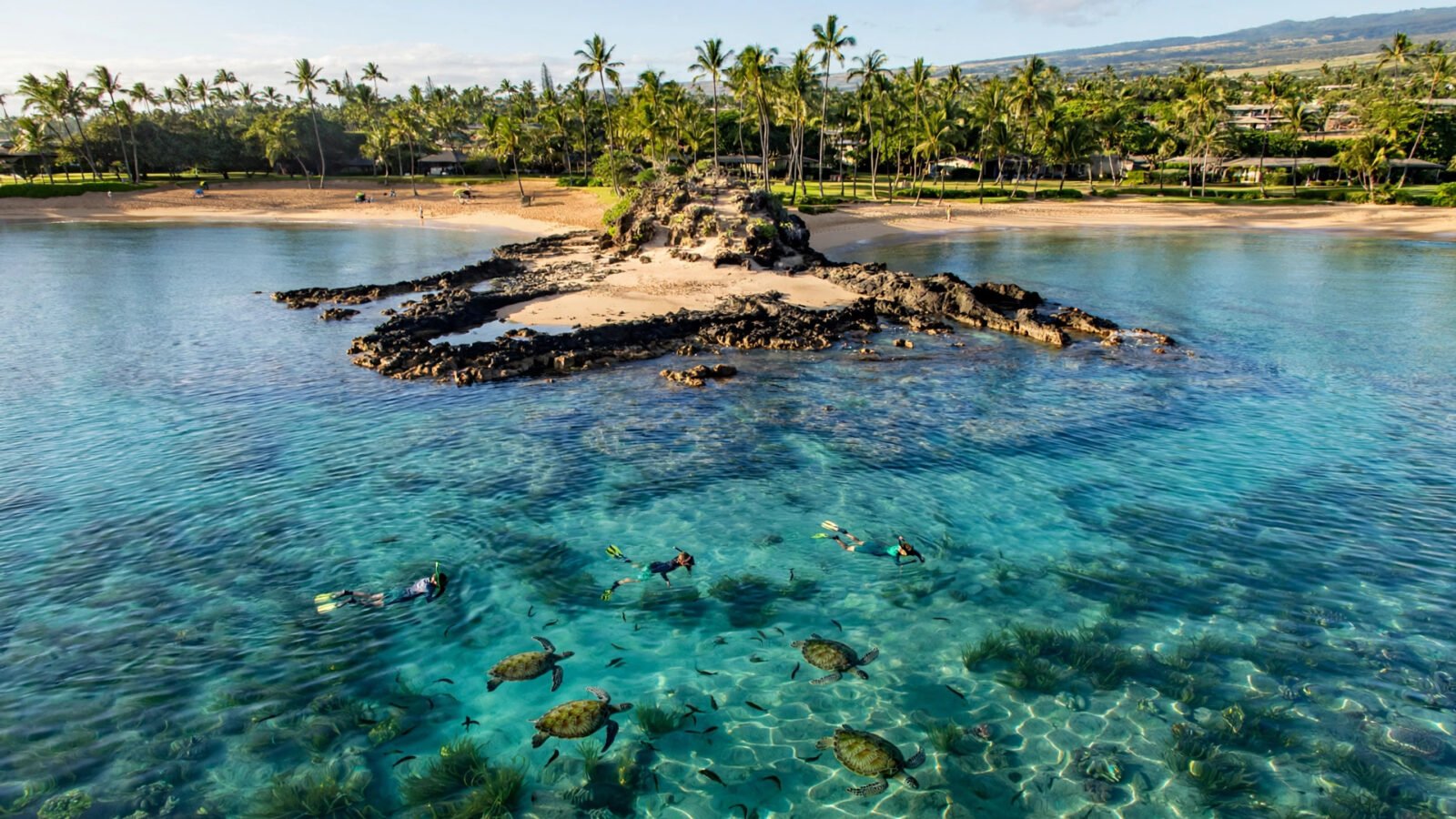
For most visitors, yes — and the reason is reliability rather than one spectacular reef wall. Many celebrated Hawaii spots are seasonal, exposed, or dependent on a calm forecast. Poipu is different: the bay is broken into sheltered pockets by a narrow sand spit, called a tombolo, that reaches out to a rocky point known as Nukumoi Point. That shape softens much of the open-ocean energy before it reaches the entry areas, so there is usually a readable, swimmable corner here when other Kauai beaches are closed out. Add lifeguards, easy sand entries and facilities a family actually needs, and Poipu becomes the snorkel you can plan a trip around instead of one you hope the weather allows.
Set expectations honestly. The coral here is patchy rather than lush — longtime snorkel guides describe Poipu as decent rather than elite coral — but the fish life makes up for it. A large mix of reef species works the rocks and reef edges, turtles are regular rather than lucky, and the chance of sharing the beach (from a respectful distance) with a resting monk seal is something almost no other beginner beach in Hawaii offers. If you are an experienced snorkeler chasing Kauai’s biggest reef system in summer, pair Poipu with Tunnels Beach and compare the two moods of the island.
Where is Poipu Beach? Poipu snorkeling on Kauai’s south shore
Poipu Beach Park sits on Kauai’s south shore in Poipu, the resort community in Koloa, at 2179 Hoone Road, at the end of Hoowili Road, off Poipu Road. From Lihue Airport it is about 17 miles southwest, about a 30-minute drive. Brennecke Beach is the next beach east, joined to Poipu by the same park, and Moir Gardens and the Kiahuna Plantation grounds lie just to the west. If you are asking where is Poipu Beach, that cluster of landmarks is the answer: one beach park, at the southern tip of the resort coast, with Poipu Road as its main approach.
That south-shore position is exactly why poipu beach kauai snorkeling works when the rest of the island does not. Kauai’s North Shore faces the winter swell head-on, and its famous reefs can be shut down for days. Poipu faces south, sheltered from that north swell, and the tombolo and the reef around Nukumoi Point break up what surf does arrive, leaving the shallow pockets behind them calm. For poipu snorkeling, that shelter is the whole point: snorkeling kauai poipu is a plan you can make in advance in any month, rather than a hope you check on the morning. Come in the morning, when the wind is lightest, and you will usually find the calmest water of the day.
Why Poipu works all year
Kauai snorkeling runs on a seasonal switch. In summer, the north shore is famous: big reefs and calm seas at places such as Tunnels and Ke’e. In winter, Pacific swells roll straight into that same north shore and shut it down for days at a time. The south shore faces away from the worst of that winter energy, so Poipu keeps working through the months when the north is a spectator sport. Locals and repeat visitors treat Poipu Beach Park as the island’s anchor snorkel — the plan that survives a winter itinerary.
Year-round does not mean every day is flat. Summer can send south swells into the bay, stirring the water and adding afternoon chop. The honest rule for Poipu Beach snorkeling conditions is simple: mornings are the reliable window in every season, and the daily picture matters more than the month on the calendar. Check conditions before you drive, look at the water when you arrive, and ask the lifeguards — at Poipu, unlike at remote spots, there is someone qualified to ask.
Where to snorkel at Poipu Beach
Poipu is really three snorkels sharing one beach park, and picking the right pocket for your ability is most of the skill involved.
The keiki pond. On one side of the tombolo sits a shallow, reef-walled pool calm enough for small children and nervous first-timers. It is the place for a first mask-fit, a first look at little reef fish, and building water confidence without waves pushing you around — with supervising adults only ever a few steps away.
Around the tombolo point. The best fish life hangs around the rocky point at the end of the sand spit and along the reef edges on either side of it. This is the main event for most snorkelers: work slowly along the rocks, peer into the ledges, and let the fish come back out after your entry splash settles. Entries are over sand, depth stays modest, and turtles regularly cruise through this zone.
The wider bay water. Stronger swimmers can range a little further across the bay’s reef pockets, where the species mix changes. Stay inside the sheltered geometry of the bay, keep an eye on how far the point has drifted behind you, and never follow a good fish toward open water or boat traffic. When Poipu is rough, it is visibly rough — trust that signal and save the session for another morning.
What you will see snorkeling at Poipu
Poipu’s underwater draw is variety. Snorkel reports and species checklists for this spot consistently log the classic Hawaiian reef cast: green sea turtles, Moorish idols, raccoon butterflyfish and other butterflyfish, convict tangs and other surgeonfish, parrotfish grazing the reef, wrasses, damselfish, and Hawaii’s state fish, the humuhumunukunukuapua’a (reef triggerfish). Moray eels hide in the rocky structure, and an octopus is a patient snorkeler’s prize around the point. You are snorkeling over a working reef community rather than a coral garden — fish density and diversity are the headline.
Turtles deserve a special note. Green sea turtles (honu) feed and rest around Poipu often enough that seeing one is a realistic hope rather than a promise — and the rule is always the same: watch from at least 10 feet away, never touch, chase or crowd one, and let it surface and move freely. Our guide to snorkeling with turtles in Hawaii explains the etiquette in full.
Poipu’s reef, zone by zone: where the fish actually are
Poipu Beach is really two crescent-shaped beaches split by the tombolo, and the snorkeling is not the same on both sides. The sand bar that joins the beach to the little island has eroded enough that you can swim from the east side to the west side at high tide, but the reef, the depth, and the fish change as you move across the bay. Work the zones in this order and you will see far more than someone who just wades in and floats.
| Zone | Depth | What you will see | Best for |
|---|---|---|---|
| Sheltered east cove (left of the tombolo) | Very shallow, under a foot in places | Fewer fish; a gentle first taste of the reef | First-timers and kids getting comfortable |
| Tombolo edge and the channel | Shallow to waist-deep | Sandy entry by the lifeguard station; the crossing point between the two coves | Entering the water and moving between sides at high tide |
| West / right reef, toward the island | Up to 12 feet and deeper | Larger coral masses, sandy patches, the best fish and the clearest water | The real snorkeling — this is where to spend your time |
The fish list is long for such a small bay. The Moorish idol is the most common fish here, and you will also see sergeant majors, saddle wrasse, yellowfin goatfish, surgeonfish including the orangeband surgeonfish, bird wrasse, manybar goatfish, and parrotfish. Look into the rocks and you may find small zebra moray eels; whitespotted sea cucumbers rest on the sand. Green sea turtles swim through the whole bay, and they haul out on the sand to rest.
The coral is healthy but moderate — small patches of rice coral, cauliflower coral, finger coral, lobe coral, blue rice coral, and lichen coral rather than big coral gardens. Look, do not touch, and keep your fins off the reef: the shallow east side is under a foot deep in places, so float rather than stand.
Visibility follows the same pattern as the fish. It is murkiest close to the beach and improves as you move out toward the island, and it is best on calm mornings before the wind and the crowds stir the water up.
When do the turtles come out at Poipu Beach?
There are two different turtle moments at Poipu, and visitors mix them up. The first happens in the water, all day: green sea turtles (honu) feed around the reef while you snorkel Poipu Beach Park, and the morning is the most reliable window — the water is calmest, the light is best, and the turtles are grazing along the reef edges around the tombolo (Nukumoi) point. Midday is good too; turtles often bask in the shallows between about 11 AM and 1 PM. The second moment happens on the sand, and it is the one Poipu is famous for: from late afternoon, roughly 4 to 6 PM, turtles start hauling themselves out of the surf to rest, and the crowd gathers around sunset to watch them. On a good night dozens are on the sand after dark, sleeping through the night before slipping back into the water around sunrise.
No time is guaranteed — some evenings a handful come ashore, some evenings dozens — and the turtles do not keep a schedule you can set a watch by. What is reliable is the pattern: snorkel in the morning for turtles in the water, stay for sunset for turtles on the sand. Wherever you see them, the rules are the same: keep at least 10 feet away in the water, never touch, chase or crowd one, and on the sand stay behind the ropes and follow the volunteers, who rope off the resting area and set the viewing distance for the night.
The monk seals
Poipu is one of the most regular haul-out beaches for Hawaiian monk seals — among the world’s most endangered marine mammals, with only about 1,600 left. When a seal is on the sand, volunteers typically rope off a perimeter; the federal viewing rule is 50 feet regardless of whether a rope is up. A napping seal is not sick, not stranded and not a photo opportunity — it is the rarest animal most visitors will ever share a beach with, doing exactly what it needs to do. Watch from a distance and count yourself lucky. If a seal appears in the water while you are snorkeling, give it space, do not follow or block its path to shore, and simply swim the other way; seals consistently ignore snorkelers who do that.
Best time to snorkel Poipu Beach
Time of day: go in the morning. Winds are usually lighter, visibility is at its best and the car park still has spaces; by afternoon, trade winds and any south swell tend to add chop. Time of year: Poipu snorkels in every month, which is its superpower. Winter visitors get the south shore’s relative shelter while the north shore rests; summer visitors get the warmest water but should watch the south-swell forecast and favour early starts on swell days. On the day: conditions are the deciding vote. Search habits tell the story — ‘poipu beach snorkeling conditions today’ is one of the most common things people look up before coming — because a flat Tuesday and a bumpy Thursday at Poipu are different beaches. Check a current conditions report, then confirm with your own eyes and the lifeguard’s flags before you get in.
Poipu Beach Park snorkeling conditions today: how to check before you go
There is no single live feed for Poipu, so check three things and they will tell you what you need to know. First, the numbers: SnorkelForecast’s Kauai report scores the south shore hourly — the same thresholds our Kauai conditions guide uses, wave height under about 1.2 feet and wind under about 12 miles per hour counting as calm. Read the south-shore numbers, not the island average: the same morning can be flat at Poipu and rough at Tunnels, and that is normal. Second, the safety picture: Safe Beach Day rates the hazards at your beach, and Hawaii Weather Today’s island-wide snorkel report plus Kauai Explorer’s ocean report cover brown-water advisories after heavy rain. Third, the beach itself: read the lifeguard’s flags at the tower, then do your own five-minute watch from the sand before you get in. If the water in front of you looks worse than the forecast, trust your eyes and the tower, not the screen — and if the south shore is running, Lydgate’s ponds are the usual fallback. The full check, with the thresholds explained, is in our Kauai snorkeling conditions guide.
Poipu’s conditions follow a seasonal rhythm, and knowing it saves a wasted trip:
| Season | Swell | What to expect at Poipu |
|---|---|---|
| Winter (November to March) | North swells hit the north shore; the south shore stays calm | Poipu’s most reliable season — flat mornings, best visibility |
| Spring (April to May) | Transition | Generally good; watch for the first early south swells |
| Summer (June to September) | South swells | Check conditions every day; mornings are calmest, afternoons can turn rough |
| Fall (October) | Transition | Often calm with good visibility as the south swell season fades |
Whatever the season, the rule is the same: check the morning conditions report, look at the water before you get in, and ask the lifeguard if you are unsure. A flat calm morning in July beats a rough afternoon in January.
Getting there, parking and fees
Poipu Beach Park sits on Ho’owili Road, just off Poipu Road in Koloa, on Kauai’s south shore — an easy drive from the Poipu resort area and Koloa town. Entry to the park is free, and the beach-park parking lot is free as well; the sources we checked agree on that, and there is no reservation or entry pass for this county beach park. What sources also agree on is demand: the lot fills on weekends, holidays and sunny late mornings. Arriving before mid-morning solves the parking problem and the conditions problem in one move.
Facilities are a big part of Poipu’s family appeal: restrooms, outdoor showers for rinsing off sand and salt, picnic areas, lawns and shade trees, and a lifeguard station covering the swimming area. Park once, snorkel, rinse, picnic, repeat. Gear is available nearby too — snorkel rental shops operate in the Poipu and Koloa area, and ‘snorkel gear rental near Poipu Beach’ is a well-served search for a reason. Bringing your own well-fitting mask is still the comfort upgrade; see our Hawaii snorkel gear checklist for what actually matters.
Is Poipu good for beginners and kids?
Yes — Poipu is the beginner snorkel we recommend first on Kauai, and it anchors our guide to the best snorkeling in Hawaii for beginners. The formula is hard to beat: a protected keiki pond for first dips, sandy entries instead of reef-rock scrambles, lifeguards on the beach, and shallow water where new snorkelers can stand up, clear a mask and start again without stress. First-timers should start in the pond or the calmest edge of the bay, practise breathing through the snorkel in standing depth, and only drift toward the point once relaxed. Our primer on how to snorkel in Hawaii walks through that first session step by step.
For kids, the honest split is this: the keiki pond suits toddlers and young children under close supervision, while the main snorkeling water suits children who are genuinely swimming-confident, ideally with a flotation aid and an adult within arm’s reach. Skip novelty inflatables — a proper snorkel vest keeps a child comfortable face-down and face-up when tired. On the east side, Lydgate Park’s rock-walled lagoons, covered in our Ke’e Beach and Lydgate guide, are the runner-up for very small children.
Safety at Poipu Beach
Poipu is one of Kauai’s safer snorkels, and it still deserves respect — our overview of snorkeling safety in Hawaii applies here in full. Snorkel where the lifeguards can see you, check with them about the day’s conditions, and stay out when flags, signs or the lifeguard say no. The hazards are the ordinary Hawaiian ones: shore-break and surge on south-swell days, currents that strengthen outside the sheltered bay, slippery rocks around the point, and holiday-ruining sunburn. Never snorkel alone, keep an eye on your entry point so the swim back stays short, and exit while you still feel strong.
Wildlife safety is mostly distance: 10 feet from turtles, 50 feet from monk seals, no touching coral and no standing on the reef — standing damages the reef, and reef cuts infect easily. Wear reef-safe sunscreen, as Hawaii law requires for sale on the islands, and reapply after your session rather than before you get in, so less washes onto the reef. If sources ever seem to disagree about Poipu’s conditions on a given day, trust the most local, most current source available: the lifeguard stand.
Poipu faces south, so summer brings the swell that matters here. From roughly May to September, south swells can turn the same sheltered cove that is flat-calm in winter rough and dangerous, and the change can arrive within a day. Poipu is protected from much of the south swell by Nukumoi Point, but when a south swell does arrive, Poipu gets waves. If the surf is up, stay out of the water — no fish is worth a bad entry. Check the conditions report or ask the lifeguard before you get in; that is what the lifeguard is there for, and the guards are on duty during the day, seven days a week.
There is also a slight to moderate rip current that runs east to west through the tombolo spit, and it gets stronger in rough seas. It is not usually strong enough to be obvious from the sand, which is exactly why it catches people. If you feel yourself being pulled sideways, do not fight it — swim parallel to the beach until you are out of the pull, then angle back in. And stay on the Poipu Beach Park side of the bay: the beach immediately to the west, Kiahuna Beach in front of the Sheraton, looks just as inviting and is not a snorkeling spot. Two deep channels are cut through its reef and currents flow out through them — in November 2024 a snorkeler there was pulled more than 100 yards offshore in water only about five feet deep, and only escaped because he was a strong swimmer who knew to swim parallel to shore instead of fighting straight back in. He was not wearing fins, and there was no lifeguard at Kiahuna; the lifeguard station is at Poipu Beach Park, a long way down the sand. Kiahuna can look calm and still be dangerous, so snorkel in the lifeguarded cove at Poipu instead. Always wear fins — without them you have far less power against a current — and never snorkel alone where there is no lifeguard.
Nearby snorkeling spots
Poipu pairs naturally with the rest of the south shore. Lawai Beach, a few minutes away, is smaller, rockier and often fishier — locals love it, but its entry suits stronger swimmers better than beginners. Koloa Landing, Baby Beach and the coves toward Kiahuna give confident snorkelers variety within a short drive, each with its own entry quirks and calm-day rules. For the full island picture, work through our Kauai snorkeling hub, then read the dedicated guides to Tunnels Beach snorkeling and Ke’e Beach and Lydgate Park. A smart Kauai week snorkels Poipu early and often, then spends its one calm summer day up north.
Things to do in Poipu beyond snorkeling
Most visitors come to Poipu for the snorkeling and stay for everything around it. The pattern that works best is simple: snorkel in the morning, when the water is calmest and the car park still has spaces, then spend the afternoon on the rest of the south shore. Winter visitors can add whale watching to the list — humpbacks pass offshore roughly December to March — and the whole area works as a base for a full day, not just a beach stop. Here is how the day fills out, including the free things to do in Poipu, what works with kids, and what to do after dark.
Snorkel the other Poipu beaches: Poipu Beach vs Lawai vs Baby Beach vs Shipwreck
Poipu is not one snorkel but a cluster of beaches within a few minutes of each other, and picking the right one matters more than picking the right gear. Poipu Beach Park is the beginner anchor: lifeguards, facilities, sandy entries and the protected keiki pond, with the best fish life around the rocky tombolo point. Lawai Beach, a few minutes east, is smaller and rockier at the entry and suits stronger swimmers — but the reef there is often fishier, which is why locals rate it. Baby Beach is the quiet family option: small, calm and shallow, good for a first dip with kids and for anyone who wants an easy float rather than a reef swim. Shipwreck Beach is the exception that proves the rule: do not snorkel there. It is a surf beach with strong currents and shore-break, and its job is sunbathing, watching the surfers and the sunset. If you only have one morning, snorkel Poipu Beach Park; if you have a second, add Lawai for the fish. Read the dedicated guides to Lawai Beach snorkeling and Shipwreck Beach snorkeling before you choose.
Watch turtles and monk seals haul out on the sand
The second Poipu show happens on dry land, and it is free. From late afternoon, roughly 4 to 6 PM, green sea turtles start hauling out on the sand to rest, and on a good evening there can be dozens of them. Monk seals haul out here too — Poipu is one of the most regular seal beaches on Kauai — and volunteers usually rope off a perimeter when one is ashore. The federal viewing rule is 50 feet for a monk seal whether a rope is up or not, and the same respectful distance applies to resting turtles. A napping seal is not sick or stranded; watch from a distance and count yourself lucky. The turtle timing and the seal rules are covered in full in the sections above.
See Spouting Horn blow
A short drive west along Lawai Road brings you to Spouting Horn, the blowhole on the rocky Koloa coast — and it costs nothing to visit. When a south swell is running, waves force water up through the lava tube and it erupts in a tall plume, with a roar you hear before you see it. It is at its best on bigger-swell days and at high tide, and it is a quick stop: a viewpoint, a few photos, and you are on your way. Stay behind the railings and keep an eye on children — the rocks around the blowhole are slick and the ocean here is not a swimming spot.
Hike the Maha’ulepu Heritage Trail
From Shipwreck Beach, the roughly 4-mile Maha’ulepu Heritage Trail follows the coast east past sea cliffs, lithified sand dunes and tide pools, with views back toward the south shore the whole way. It is the best walk in Poipu and the antidote to a beach-only day: no shade, so go early, wear proper shoes rather than flip-flops, and carry water. You do not have to do the whole trail — the first stretch out of Shipwreck Beach gives you the cliffs and the views, and you can turn back whenever you have had enough. Our Maha’ulepu Beach snorkeling guide covers the beach at the far end of the walk.
Spend an afternoon in Koloa Town
A few minutes inland from Poipu, Koloa Town is the old plantation town that the resort coast grew out of: a walkable main street of shops, galleries and cafes, food trucks, and shave ice for the walk back. It is the natural fallback for a windy afternoon or a rest day — browse, eat, and pick up anything you forgot for the beach. It is also the closest thing to a town centre the south shore has, so it is where you will end up anyway for dinner supplies or a rainy-hour wander.
Tour Allerton Garden
In the Lawai Valley just west of Poipu sits Allerton Garden, part of the National Tropical Botanical Garden — a landscaped valley of tropical plants, water features and old estate gardens that has doubled as a film location. It is visited on booked guided tours only, so reserve ahead rather than turning up at the gate. It is the quietest, greenest contrast to a beach morning, and the one Poipu activity that feels nothing like a beach day.
Free things to do in Poipu
Poipu is an easy place to spend a day without spending money. The beach itself is free — entry, parking and facilities at Poipu Beach Park cost nothing — and snorkeling costs nothing once you have gear. Add Spouting Horn (free viewpoint), the Maha’ulepu Heritage Trail (free), the sunset from Shipwreck Beach (free), and tide-pooling with kids at low tide, and you have a full day for the price of parking. That is the honest answer to the free-things question: the best of Poipu was never the paid part.
Things to do in Poipu with kids
Poipu is the most family-friendly base on Kauai’s south shore, and the day plans itself. Start in the keiki pond for a first dip, move to Baby Beach for a calm float, and let the kids hunt tide pools at low tide while the adults take turns on the tombolo reef. The Maha’ulepu trail’s first stretch works for older kids with proper shoes, and Koloa Town’s shave ice is the standard bribe for the walk back. For the wider island picture — including the family activities beyond the south shore — our guide to things to do in Kauai has the full list.
Things to do in Poipu at night
Poipu after dark is quiet, and that is the point. The sunset from Shipwreck Beach or Poipu Beach Park is the main event — the south shore faces the evening sun — and on a clear night the stars come out properly once you are away from the resort lights. Dinner is in Poipu or Koloa Town, and the classic evening out is a luau: the Auli’i Luau at the Sheraton is the one most visitors book. Book the luau ahead in peak season; for everything else, the plan is a slow dinner, a sunset, and an early night before another morning snorkel.
What to bring
- A mask that fits your face (test the seal at the shop), snorkel and fins — rented nearby in Poipu/Koloa or brought from home
- Reef-safe sunscreen, a rashguard for sun protection, and a towel for the grass
- A snorkel vest or flotation aid for beginners and children
- Water, snacks and picnic supplies for the park lawns and tables
- A dry bag for keys and phone, and a camera you are happy to use from a respectful distance
- Patience for the car park at peak times — or an early alarm, which is better
Snorkel gear rental near Poipu Beach
Renting in Poipu itself beats hauling gear across the Pacific: a standard mask-snorkel-fins set is a silicone-skirt mask, a snorkel and a pair of fins, usually with a carry bag and anti-fog solution. The two main rental shops are Boss Frog’s and Snorkel Bob’s. Boss Frog’s Poipu shop, at 5022 Lawai Road, is listed as temporarily closed as of November 10, 2026, so check before you go — its Koloa shop, at 3414 Poipu Road, is open 8 a.m. to 5 p.m. daily. Snorkel Bob’s Koloa store, at 3236 Poipu Road, is also open 8 a.m. to 5 p.m. daily. On price, Boss Frog’s Kauai Deluxe Snorkel Set is $12 for 24 hours and $42 for 4–7 days on a 2-for-1 weekly special; Snorkel Bob’s Ultimate Truth Ensemble is $16 a day and $48 a week. A week usually beats the day rate if you will snorkel several days; Snorkel Bob’s switches to the weekly rate after four days. Before you leave, check the mask seal, ask for defog, and confirm the return time — both shops count a day as 24 hours. Our snorkel gear rental guide explains what to check before you pay.
Field reports we drew from
- Consensus of firsthand Kauai reports in our source set — Poipu’s year-round reliability is the least disputed claim on the island.
- Monk seal population and rules: NOAA Fisheries — Hawaiian monk seal viewing guidelines.
- Facilities, lifeguard cover, free access and parking, and typical depths: county beach-park information and established snorkel-spot reports for Poipu Beach Park, cross-checked October 2026. Daily conditions vary — the lifeguard stand is the final word.
Poipu Beach Park snorkeling: parking, layout, and which end to pick
Poipu Beach Park is a county beach park, and its listed address is 2179 Hoone Road in Koloa, at the end of Ho’owili Road just off Poipu Road. Entry and parking are fre, and there is no reservation or entry pass. Park-phrased searches are usually planning searches, so the two facts that matter most are where to park and which end of the beach to walk to — and both are answered here.
In practice the park has parking on both sides of Ho’owili Road where it meets Hoone Road, not a single lot. The west lot is the larger one, by the main pavilion and lifeguard tower. The east lot puts you closer to the left-hand, eastern end of the beach, where the lava-rock barrier forms the shallow pool described above. If you are snorkeling with beginners or small children, park east and walk to that sheltered pool end. If the tombolo point is your target, or you want the pavilion, restrooms and lifeguard tower as your base, the west lot is the easier base. Both lots fill on weekends, holidays and sunny late mornings, so arriving before mid-morning matters twice over here.
FAQ
Is Poipu Beach good for snorkeling?
Yes. Poipu offers Kauai’s most reliable snorkeling: a protected bay, regular turtles, diverse reef fish and monk seal sightings on the sand, in water swimmable in every season. The coral is patchy rather than spectacular, but for consistency, safety and variety together, Poipu is hard to beat.
Can you snorkel at Poipu Beach?
Yes — snorkeling is the main event at Poipu Beach Park, with sandy entries, a shallow keiki pond for practice and the best fish life around the rocky tombolo point. It is a public county beach park with free entry, lifeguards and facilities, so no booking or permit is needed; just check the day’s conditions first.
Where do you snorkel at Poipu Beach?
Start at the keiki pond if you are learning, then work the reef edges around the tombolo (Nukumoi) point for the densest fish life and the best turtle chances. Stronger swimmers can explore the wider bay’s reef pockets, staying inside the sheltered bay and within sight of the lifeguards.
What is the best time to snorkel at Poipu Beach?
Morning, in every season — lighter wind, clearer water, easier parking. Poipu snorkels year-round; winter leans on the south shore’s shelter from north swells, while summer visitors should watch for south swells and favour early starts on those days. Always check conditions on the day.
Is Poipu Beach good for beginners and kids?
It is Kauai’s best beginner beach: a calm, reef-walled keiki pond, sandy entries, shallow standing depth and lifeguards. Young children belong in the pond under close supervision; the main bay suits kids who can genuinely swim, with a snorkel vest and an adult close by.
Is there parking at Poipu Beach, and does it cost anything?
Yes — there is a free beach-park lot at Poipu Beach Park off Ho’owili Road, and park entry is free too. The trade-off is popularity: the lot fills on weekends, holidays and late mornings, so arriving early is the practical fix.
Does Poipu Beach have bathrooms, showers and lifeguards?
Yes. Poipu Beach Park has restrooms, outdoor showers, picnic areas, grass and shade, and a lifeguard station — one reason families use it as a half-day base. Lifeguard hours and cover can vary, so check the stand when you arrive.
What will I see snorkeling at Poipu Beach?
Expect green sea turtles, Moorish idols, butterflyfish, convict tangs, parrotfish, wrasses and the humuhumunukunukuapua’a around the rocks and reef edges, with eels tucked into the structure and monk seals more likely on the sand than in the water. Keep 10 feet from turtles and 50 feet from seals.
What if a monk seal is in the water while I’m snorkeling?
Give it space and let it move on — don’t follow, don’t approach, don’t block its path to the beach. In practice seals ignore respectful snorkelers completely; the 50-foot rule is easiest to keep by simply swimming the other way.
Which parking lot should I use for snorkeling at Poipu Beach Park?
Use the east lot for the sheltered lava-barrier pool at the beach’s eastern end — the best first dip for beginners and kids. Use the larger west lot, by the pavilion and lifeguard tower, if the tombolo point is your target or you want facilities as your base. Both lots are free, and both fill on weekends, holidays and sunny late mornings, so arrive before mid-morning.
What time do the turtles come out at Poipu Beach?
In the water, turtles feed around the reef through the day, with the morning the most reliable window for snorkeling alongside them. On the sand, they haul out to rest from late afternoon, roughly 4 to 6 PM, with the best viewing around sunset — dozens can be on the beach after dark. Keep at least 10 feet away in the water and stay behind the volunteers’ ropes on the sand.
How do I check Poipu Beach snorkeling conditions today?
Check SnorkelForecast’s Kauai report for the south-shore numbers (wave height under about 1.2 feet counts as calm), Safe Beach Day for the per-beach hazard rating, and the lifeguard’s flags at the tower when you arrive. If the water looks worse than the forecast, trust your eyes — and fall back to Lydgate’s ponds if the south shore is running.
Is snorkeling at Poipu Beach Park free?
Yes. Poipu Beach Park is a free county park: no entry fee, no reservation, and free parking in both lots. The only costs are your own gear or a rental if you bring none — there is no charge to swim or snorkel here.
Where is Poipu Beach?
Poipu Beach is on the south shore of Kauai, in Poipu (Koloa), at 2179 Hoone Road, at the end of Hoowili Road off Poipu Road — about 17 miles, or a 30-minute drive, southwest of Lihue Airport.
Can you rent snorkel gear at Poipu Beach?
Yes — Boss Frog’s and Snorkel Bob’s rent mask-snorkel-fins sets in Poipu and nearby Koloa, and a weekly rental usually costs less per day than a daily one. Check the shops before you go: Boss Frog’s Poipu shop is listed as temporarily closed, while its Koloa shop and Snorkel Bob’s Koloa store are open 8 a.m. to 5 p.m. daily.
What is the best snorkeling in Poipu?
For beginners, the tombolo-protected east end — the shallow keiki pond and the reef edges around the point. Confident swimmers can work the outer reef at Nukumoi Point, and Brennecke Beach next door is the pick for turtles.
Head west along the south shore and you reach another sheltered option: Salt Pond Beach, whose rock-walled ponds stay calm for beginners on many days when Poipu is busy.
Staying around Poipu, the surf beach in front of the Grand Hyatt is a short hop east — our Shipwreck Beach snorkeling guide explains when its rocky edges are calm enough to snorkel and when to just watch the cliff jumpers.
What is there to do in Poipu besides snorkeling?
Plenty. Beyond Poipu Beach Park itself there is Spouting Horn, the Maha’ulepu Heritage Trail, Shipwreck Beach for sunbathing and sunset, Koloa Town for shops and food, Allerton Garden tours, and an evening luau. Most visitors snorkel in the morning and spend the afternoon on one or two of these.
Is Poipu worth visiting for a full day?
Yes — it is the best full-day base on Kauai’s south shore. A morning snorkel, an afternoon on the trail or in Koloa Town, and a sunset at Shipwreck Beach fill a day without repeating anything, and the beach park’s facilities and free parking make it easy to stay put.
What are the best free things to do in Poipu?
The beach day itself (free entry and parking), Spouting Horn, the Maha’ulepu Heritage Trail, the sunset at Shipwreck Beach, and tide-pooling at low tide. Snorkeling is free too once you have gear — the only cost is the rental if you do not bring your own.
What fish will I see snorkeling at Poipu Beach?
Moorish idols are the most common, along with sergeant majors, saddle wrasse, yellowfin goatfish, surgeonfish, bird wrasse, and parrotfish. You will also see green sea turtles throughout the bay, zebra moray eels in the rocks, and whitespotted sea cucumbers on the sand. The best fish are on the deeper west / right reef, not in the shallow east cove.
Is Poipu Beach safe for snorkeling in the summer?
Usually yes on a calm morning, but summer is south-swell season at Poipu, and a swell can make the cove rough with little warning. Check the conditions report, ask the lifeguard, and stay out if the surf is up. Do not snorkel at Kiahuna Beach next door — two reef channels there carry strong rip currents out to sea, and there is no lifeguard on that stretch.