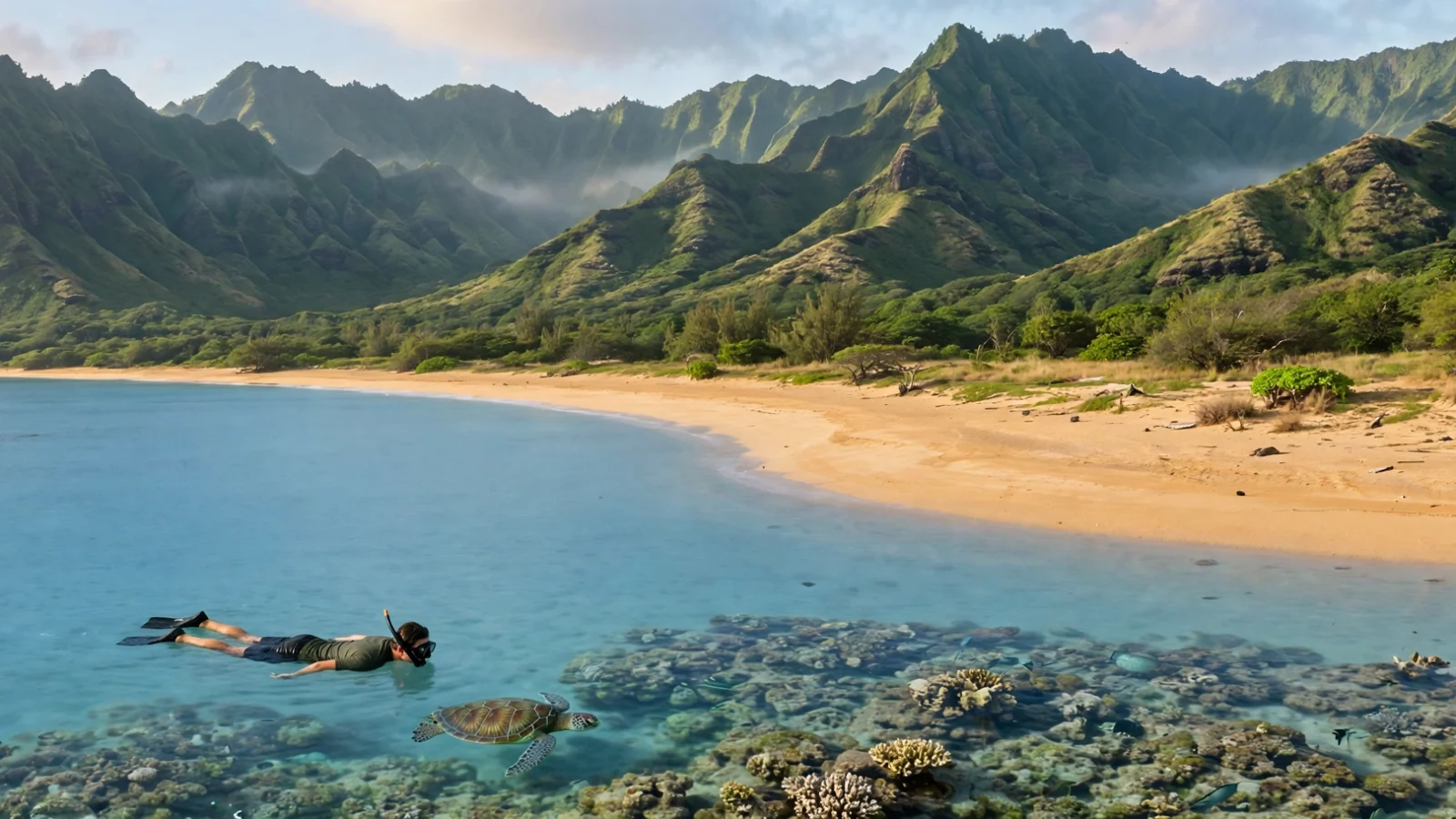
Yokohama Bay is where Oahu’s west-side road gives up. Farrington Highway runs out at Keawa’ula Beach, the mountains close in, the Ka’ena Point trail takes over on foot — and in front of you is a mile of golden sand that most of Oahu never sees. It is also a beach with two completely different oceans. For much of the year this is surf country: fast, hollow waves breaking over very shallow coral, strong currents, and water that experienced surfers respect and swimmers should stay out of. Then, on flat summer mornings, the same bay goes calm and clear, the coral platform under those breaks becomes a snorkel reef, turtles work its edges, and spinner dolphins pass offshore in the early light. Almost every mention of this beach online picks one of those two oceans and pretends the other does not exist — the surf pages ignore the snorkeling, and the snorkel listicles call it a tranquil beginner spot, which on most days of the year it simply is not. This guide covers both, because at Yokohama the calendar and the lifeguard’s call decide which beach you get. Our Oahu snorkeling hub has never listed this beach at all. It earns its place — with its conditions printed in large type.
The honest summary, up front: Yokohama Bay is a real snorkel with a narrow window. The window is a calm, flat morning, almost always in summer, after you have checked with the lifeguard at the south end of the park and been told the water is suitable. Inside that window, this is one of the most beautiful shore snorkels on Oahu — clear water over a shallow coral platform, reef fish, a genuine chance of turtles, and an empty beach. Outside that window — any day with surf running, which is most of winter and plenty of other days besides — there is no snorkel here at all, and entering the water to look for one is how visitors get hurt on this coast. If you only remember one line from this page, make it that one.
Quick facts
- Location: Keawa’ula Beach (Yokohama Bay), at the end of Farrington Highway, Waianae, far-west Oahu — the Keawa’ula section of Ka’ena Point State Park; the Ka’ena Point trail starts where the road ends
- The snorkeling, honestly: A shallow coral platform off the beach that is a surf break on swell days and a snorkel reef only on flat, calm mornings — almost always a summer window, always confirmed with the lifeguard on the day
- Lifeguard: Yes — a lifeguard station at the southern end of the park. Ask before you enter; their call defines whether a snorkel exists today. The guarded area is the south end; the reef stretches beyond it, which is part of the judgement call
- Fees and reservations: Free entry and free parking (state park). No reservation for beach use
- Parking: Free lots at the park by the beach. Park and trailhead hours in state listings run roughly 6 AM to 7 PM — the gates keep posted hours, so check them on arrival and never plan to be locked in. Do not leave valuables in the car; remote end-of-road lots on Oahu are break-in country
- Facilities: Restrooms and outdoor showers at the southern end by the lifeguard station. No rentals, no vendors, no shade of consequence — bring everything, including far more water than you think you need
- Best time: First light to mid-morning on a flat summer day. Winter is surf season and the snorkel is closed by the ocean, not by any sign
- The one rule that matters: If there are waves breaking on the reef, there is no snorkeling today. That single test settles almost every decision at this beach
Where Yokohama Bay is — the end of the road
Keawa’ula Beach sits at the northwestern end of the Waianae coast, where Farrington Highway ends against the flank of the Waianae range. Getting here is part of its character: you drive the full length of Oahu’s west side — past Makaha, past Makua Beach just south of the park — and the road simply stops. Beyond the parking lots, the only way onward is the Ka’ena Point trail, a shadeless coastal walk of about two and a half miles each way to the point and its Natural Area Reserve, where Laysan albatrosses nest in season and Hawaiian monk seals haul out on the rocks. Ka’ena is a place of deep cultural significance in Hawaiian tradition, and the whole end of this coast carries that weight: it feels less like a beach suburb and more like the edge of the island, because it is.
That remoteness cuts both ways, and the article will not pretend otherwise. The reward is a sweeping, west-facing crescent — a mile or so of golden sand under steep green mountains — that is rarely crowded even on weekends, with sunsets that locals rate among the island’s best. The cost is that everything is far away: no shops, no rentals, no shade, limited help if you misjudge the water, and a long drive back to anywhere. Snorkelers should arrive here self-sufficient — full gear, water, food, reef-safe sunscreen — and treat the beach the way its regulars do: as a wild place that happens to have a lifeguard tower, not a resort beach that happens to be far away.
Two name notes, briefly. The beach’s Hawaiian name is Keawa’ula; “Yokohama Bay” is the nickname the whole island uses, and “Yoks” is what you will hear in the car park. And do not confuse it with Makua Beach, the broad beach a few minutes south — a beautiful, dolphin-famous stretch with the same surf-first personality. Makua gets its own honest paragraph further down this page; the two are neighbours, not the same beach.
The two oceans: surf break and flat-morning reef
Everything at Yokohama Bay hangs on one underwater feature: a shallow coral platform running off the beach. It is the reason for both versions of this beach, and understanding it is the whole guide.
When there is swell — northwest swell in winter above all, but this coast picks up energy in several seasons — the platform does what shallow coral does: it trips the swell into waves. Surfline’s guide to this spot describes two fast, hollow waves here, a left-hander and a right-hander, breaking over very shallow coral. That is expert surf over an unforgiving bottom, and the shorebreak at the sand’s edge builds its own undertow. On those days the bay is a surf beach and a sunset beach. It is not a swimming beach with worse visibility; it is a different ocean, and the snorkeling does not exist.
When the ocean goes flat — most reliably on summer mornings, when the west side sits in its calm season — the same platform becomes the snorkel. The water over and around the coral clears, the sand channels between coral heads hold the calm, and you can float the platform’s edges watching reef life in water that, on the best mornings, is as clear as anywhere on Oahu. This is the version the listicles photograph. It is real. It is also conditional in a way the listicles leave out: “flat” is not a season, it is a morning. Summer produces the window most often; it does not guarantee any given day, and a summer south swell wrapping up the coast or a leftover northwest bump can close the reef while the calendar says it should be open. Which is why the next section is the most important one on this page.
The flat-day test: how a Yokohama snorkel actually starts
A Yokohama snorkel does not start with your mask. It starts with three checks, in order, and failing any one of them ends the plan — kindly, because the beach is still a superb place to spend a morning on the sand.
First, look at the reef. From the sand, watch the water for a full set cycle — several minutes, not a glance. If waves are breaking anywhere on the coral platform, or whitewater is rolling across it, there is no snorkel today. Flat means flat: a glassy or lightly rippled surface over the whole reef.
Second, ask the lifeguard. There is a lifeguard station at the southern end of the park, and checking in is the local protocol on this coast, not a tourist extra. Tell them you are thinking of snorkeling, ask where — and whether — they would go in, and treat the answer as the decision. Lifeguards here watch this water every day; if they say stay out, the correct snorkel is a walk to Ka’ena and a swim somewhere else tomorrow. Note the geometry honestly: the guarded water is at the south end, and the reef platform runs along the beach beyond it, so even on a good day you are balancing reef access against staying within reach of the guarded zone. On a marginal day, that balance answers itself — stay south, stay shallow, or stay out.
Third, read the water itself. Even on a flat-looking morning, this coast can run current along the shore, and visitors describe the water here turning murky with a noticeable current on days that looked promising from the car park. If the water is brown or milky, if you can feel a steady pull standing waist-deep, or if the surface over the reef is textured by wind, the window is not open — visibility and drift are the snorkel here, and both have just failed. Our snorkeling safety guide covers the general discipline; Yokohama is simply where it matters most on the west side.
Pass all three, and you have earned one of Oahu’s quietest snorkels. The routine from there: enter over sand in the guarded south-end area, fin out slowly toward the coral edges as the bottom shelves, and work the boundary where sand channels meet coral — that edge is where the fish concentrate and where you can always retreat over sand. Stay inside the line where surf would break; the shallowest coral, the part that stands dry-looking and sharp at low tide, is both fragile and a surge trap on any set that does arrive. Plan your exit before you need it, come in over the same sand, and keep the whole swim in the morning calm — by early afternoon the trades and the day’s energy usually start texturing this coast again.
What you will see
- Reef fish over the coral platform: the standard west-Oahu cast — tangs and surgeonfish over the coral heads, wrasses, butterflyfish and goatfish working the sand channels at the reef’s edge. One visitor’s honest report from this beach — beautiful fish everywhere, in water that was murkier than expected — is a fair expectation to carry in
- Green sea turtles (honu): reported over the reef here by visitors and guides alike — possible, never promised, and governed by the usual law and etiquette: ten feet of distance, always, per our turtle snorkeling guide
- Spinner dolphins — from a distance: pods pass offshore along this coast in the early morning; locals rate this one of the best shore-viewing stretches on the island. Watch them from the sand or from the water where you happen to be — never swim toward, chase or position yourself in their path. Dolphins resting inshore by day are protected by federal guidance (keep at least 50 yards); a dolphin encounter here is something the ocean offers, never something a snorkeler pursues
- Hawaiian monk seals: seals haul out on the sand along this coast and around Ka’ena Point. A resting seal gets at least 50 feet, no exceptions, and never get between a seal and the water
- In winter (from shore): the surf itself, and whales offshore — the season when this beach is watched, not snorkeled
Conditions and the best time to go
The seasonal pattern is the mirror image of the Kihei-style winter advice on Maui and the opposite of Oahu’s sheltered south shore. Winter — roughly November through March — is when the northern Pacific sends its swells down onto this coast, and Yokohama sits exposed to them as an extension of the North Shore’s big-wave shoreline. In winter the snorkel window is effectively closed: even between sets, the shorebreak, undertow and shallow-coral breaks make entry and exit the hazard, and no visibility prize waits on the other side. If you are visiting Oahu in winter, snorkel the protected water instead — Waimea Bay on its calmest winter days has the same surf-first warning, which tells you everything about this coast in winter; the reliable winter snorkeling is on the south shore.
Summer — roughly May through September — is the window season: the west side’s calm months, when flat mornings happen often enough to plan around (while staying ready to be told no). Even then, go at first light. The early hours hold the clearest water, the dolphins pass early, and you will be snorkeling in the guarded morning rather than racing the afternoon wind. After heavy rain, west-side streams can brown the nearshore water — skip until it clears. The best time to snorkel in Hawaii guide maps these patterns island by island; Yokohama is the extreme case of the west-Oahu line in it.
Safety, honestly
- The shorebreak is the hazard. Fast, hollow waves over very shallow coral and a steep, coarse sand edge: the entry and exit, not the reef, are where this beach hurts people. On any day with breaking waves, the water is for surfers and the beach is for watching
- Currents run here even on swimmable days. Alongshore drift is normal on this coast. Snorkel with a buddy, stay aware of where you entered, and never snorkel the reef tired — the swim back against a drift is the one people misjudge
- Ask the lifeguard, then obey the answer. This is the west side’s standing rule and it exists because conditions here change faster than forecasts. If the tower says no, it is no
- Never stand on the coral. The platform is shallow, sharp and alive; standing damages it and cuts feet that then have to cross hot sand and a long drive. Float, or stay over sand
- No shade, no shop, no second chances on supplies. Sun and dehydration end more days here than the ocean does. Bring water, food, and shade of your own — and tell someone your plan, because help and signal are both thinner at the end of the road
- This is not a beginner’s snorkel. Even on a flat morning, the entry judgement, the current awareness and the distance from the guarded zone put Yokohama beyond a first snorkel. New snorkelers belong at Pokai Bay or the other protected west-side and south-shore water in our beginners’ guide — Yokohama is the reward later in the trip, or on a later trip
Parking, facilities and the Ka’ena pairing
The park lots sit right behind the beach near the south end, free, under Ka’ena Point State Park. State listings put park and trailhead hours at roughly 6 AM to 7 PM — treat the posted gate hours as the law of your day, because an end-of-road car park is a bad place to test them, and plan sunset accordingly (the famous sunset is best watched with your exit already sorted). Restrooms and outdoor showers are at the southern end by the lifeguard station. There are no rentals or vendors anywhere near — the last real shops are back down Farrington Highway in Waianae — and the standard end-of-road warning applies in full: lock up, and leave nothing visible in the car, because remote Oahu lots are worked by thieves precisely because everyone is far away at the beach or on the trail.
The natural pairing is the Ka’ena Point trail itself: snorkel the flat morning, then walk the coast in the cooler late afternoon — or reverse them on a surf day and make the hike the main event. The trail is flat but utterly shadeless: carry serious water, start early or late, and give the point its full respect — nesting albatrosses in season, seals on the rocks, and a cultural landscape that predates every beach towel on the sand below it. Between the snorkel window, the trail and the sunset, Yokohama is one of the few Oahu beaches that can honestly fill a whole day — as long as the day is built around the ocean’s terms, not yours.
Yokohama Bay vs Makaha vs Pokai Bay vs Electric Beach
The west side’s four snorkels solve four different problems. Here is the honest trade.
| Yokohama Bay (Keawa’ula) | Makaha Beach | Pokai Bay | Electric Beach (Kahe Point) | |
|---|---|---|---|---|
| Best for | A wild, empty, flat-morning reef at the end of the road | The west side’s classic reef swim with a lifeguard culture | The protected first snorkel on the west side | The warm-outflow fish bowl for confident swimmers |
| Snorkel window | Flat summer mornings only — closed by surf much of the year | Calm days; winter surf closes it too, but the window is wider | The widest on this coast — protected most days | Most days, with an outflow-current skill requirement |
| Reef quality | Shallow coral platform, good fish, turtles possible | The strongest reef of the four | Modest reef, gentle water | Dense fish life around the outflow |
| Lifeguard | Yes — south end; ask before entering | Yes | Yes | Limited/none at the entry — check on the day |
| Facilities | Restrooms + showers (south end), free parking, no shade/shops | Restrooms, showers, parking | Full beach-park facilities | Small park, showers, free parking |
| The catch | The flat-day test rules everything; long drive; car security | Crowds and parking pressure in season | Reef is modest — it trades wow for calm | Outflow current + shorebreak entry demand respect |
The short version: choose Pokai Bay to learn, Electric Beach for fish density, Makaha for the classic west-side reef day — and Yokohama when you want the island’s edge: an empty mile of sand, a reef that only opens on the ocean’s terms, and the Ka’ena trail waiting when the water says no.
Nearby spots to pair with Yokohama Bay
- Makaha Beach — fifteen minutes south: the west side’s benchmark reef snorkel, and your fallback when Yokohama’s reef is closed but Makaha’s more sheltered entry is working
- Pokai Bay — further south in Waianae: the protected harbour-mouth water where this coast’s beginners and families belong on any day Yokohama is marginal
- Electric Beach (Kahe Point) — the warm-water outflow reef down the coast: the confident swimmer’s alternative when you want guaranteed fish life instead of a weather window
- Makua Beach — five minutes south of the park, Yokohama’s dolphin-famous neighbour: the same surf-first rules, the same early dolphin passes offshore, and a beach day that pairs naturally with a Ka’ena morning. Snorkel it only under the same flat-day test, and view the dolphins from a respectful distance — it is their resting coast, not a swim-with programme
- The Ka’ena Point trail — starting at your car park: the non-snorkel half of the day, and on surf days the whole day, done properly with water and an early start
Frequently asked questions
Is Yokohama Bay good for snorkeling?
Yes — inside a narrow window. On a flat, calm morning, almost always in summer and always confirmed with the lifeguard, the shallow coral platform off Keawa’ula Beach becomes a clear, fish-holding reef with turtles possible and almost nobody else in the water. On any day with surf breaking on that platform — most of winter and many other days — there is no snorkeling here at all. Judge this beach by the morning, not by the brochure.
When is the best time to snorkel at Yokohama Bay?
Early morning on a flat day in the summer months, roughly May to September, when Oahu’s west side is in its calm season. Winter brings the big northwest swells to this coast and closes the snorkel entirely. Even in summer, flat is a daily verdict: check the reef for breaking waves, then ask the lifeguard before you commit.
Is Yokohama Bay good for beginners?
No. Even on its calmest mornings it demands entry judgement, current awareness and comfort beyond the guarded zone’s edge, with help a long way away. Beginners should start at protected water like Pokai Bay on the same coast, and treat Yokohama as a later goal once the flat-day discipline is second nature.
Are there lifeguards at Yokohama Bay?
Yes. There is a lifeguard station at the southern end of Keawa’ula Beach, with restrooms and showers there. Asking the lifeguard about conditions before entering is the standing local protocol on this coast — their call decides whether a snorkel exists that day.
Where do you park for Yokohama Bay, and does it cost anything?
In the free Ka’ena Point State Park lots behind the beach, at the end of Farrington Highway. State listings put park hours at roughly 6 AM to 7 PM — follow the posted gate hours on the day. Leave nothing visible in the car; remote end-of-road lots are a known break-in risk.
Can you see dolphins at Yokohama Bay?
Spinner dolphins commonly pass offshore along this coast in the early morning, and watching them from the sand is one of the beach’s quiet highlights. View them from a distance — at least 50 yards — and never swim out to pursue them: these are resting, protected animals, and the encounter belongs to whoever the ocean brings past, on the dolphins’ terms.
Is there shade or food at Yokohama Bay?
Effectively no shade, and no food, rentals or vendors at all. The nearest shops are back in Waianae. Bring water, food, reef-safe sunscreen and your own shade — the Waianae sun over an unshaded mile of sand is a genuine hazard by midday.
What else is there to do at Yokohama Bay if the surf is up?
Plenty — which is why a surf day here is a good day, not a failed one. Walk the Ka’ena Point trail toward the Natural Area Reserve (flat, shadeless, roughly two and a half miles each way — carry serious water), watch the surf and the sunset from the sand, and save the snorkel for a flatter morning or a more protected beach like Makaha or Pokai Bay.