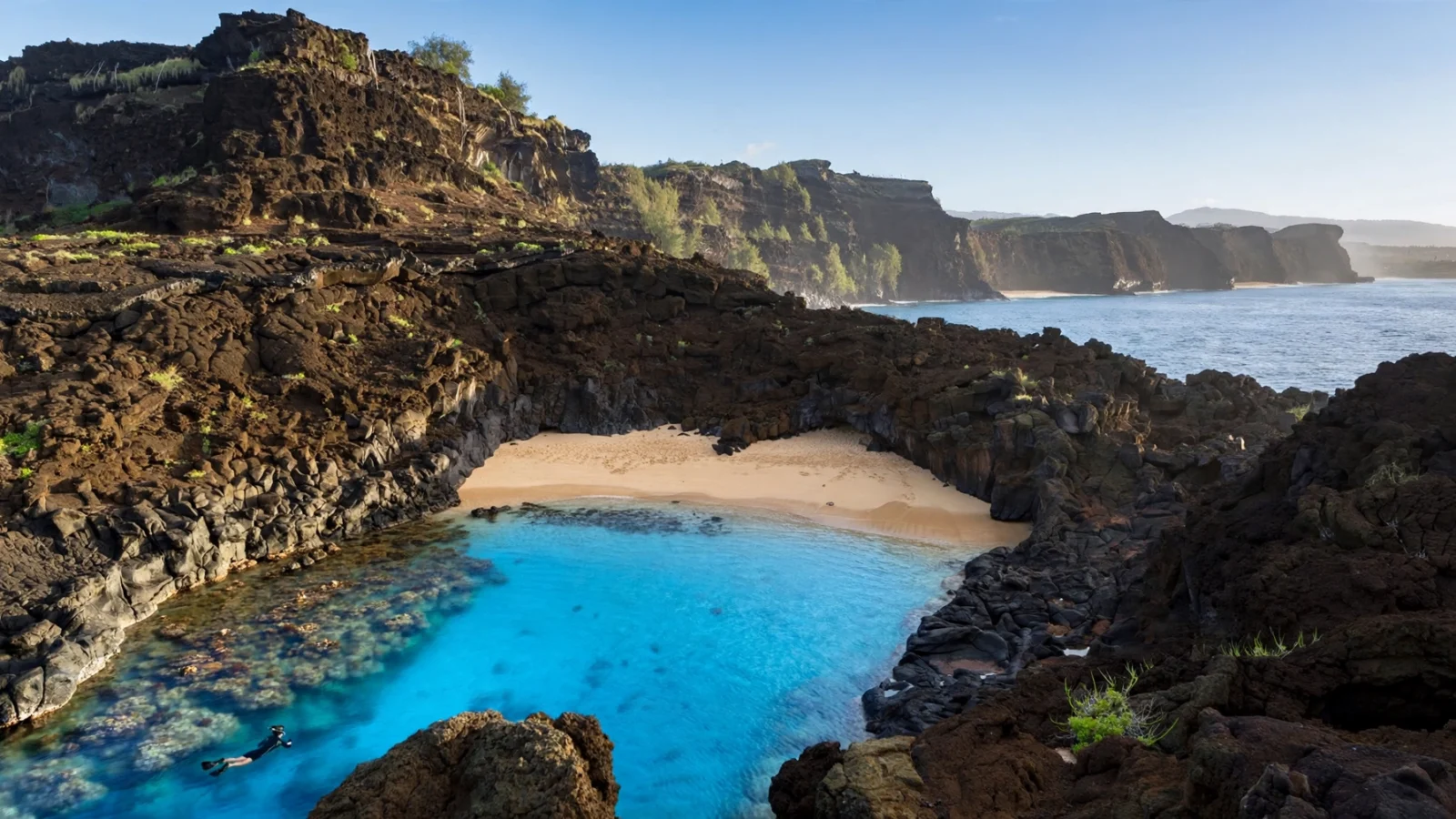
From the lookout above, Halona Beach Cove looks like a movie set — because it is one. A small pocket of golden sand folded into black lava cliffs, water an impossible turquoise, waves detonating through the blowhole next door. This is Eternity Beach, where Burt Lancaster and Deborah Kerr rolled in the surf in From Here to Eternity in 1953, and the photograph every visitor takes from the railing raises the same question: can you actually snorkel down there?
Yes — on the right morning, if you are a confident swimmer, and only on the right morning. Halona is a calm-day-only reef wrapped around a genuinely hazardous cove: currents that have swept swimmers out to sea, a cave beneath the blowhole that has killed people, no lifeguard, and a steep, unmarked scramble down the rocks just to reach the sand. Most pages about this beach either sell the romance and skip the water entirely, or mention snorkeling in one vague line. This guide does the opposite. It maps the one route that works — the reef wall inside the cove — and gives you the observation checklist that decides, in ten minutes at the railing, whether today is a snorkel day or a lookout day. Both are good days. Only one of them should involve getting wet.
Quick facts
- Location: Below the Halona Blowhole lookout on the Ka Iwi coast, southeast Oahu — between Hanauma Bay and Sandy Beach, about 10 miles east of downtown Honolulu
- Also known as: Eternity Beach, from the 1953 film From Here to Eternity; Halona means “lookout” in Hawaiian
- Snorkeling verdict: Calm-day only, confident swimmers only. A rewarding small reef inside the cove on flat mornings — and a hard no in any surf
- Best zone: The wall and ridge on the right (west) side inside the cove; the shallower east side and its tide pools only in dead-calm conditions
- Lifeguard: None. No facilities of any kind at the cove — no restrooms, no water, no shade
- Parking: Free at the Halona Blowhole lookout lot above the beach; the lot is small and fills — and do not leave valuables in the car
- Access: An unmarked, unmaintained steep rocky descent from the lookout — proper shoes, hands free, not suitable for anyone with mobility limits
- Signature hazards: Strong offshore and longshore currents, surge entering the cove from two angles, waves washing the rocks on both sides, and the cave beneath the blowhole — never enter it
- Best beginner move: Don’t snorkel here. Hanauma Bay, a few minutes west, has lifeguards, facilities and a protected lagoon — snorkel there and come to Halona for the view
The cove: a film set with a real ocean in it
Halona is a pocket, not a beach in the Waikiki sense — a short crescent of sand at the bottom of lava cliffs on Oahu’s wild southeast coast, with the Halona Blowhole breathing beside it and the Ka Iwi shoreline running away toward Makapuu in one direction and Hanauma Bay in the other. The lookout above it is one of the standard stops on the Kalanianaole Highway scenic drive, which is why the cove is famous and why most people never touch its water: they see it for four minutes through a railing, between the blowhole’s eruptions.
The film history is real but it is also the trap. The 1953 love scene was shot in surf that the actors were rolled in for cinema, not safety, and later productions — Pirates of the Caribbean among them — reused the cove for the same reason: it looks dramatic because the ocean here is dramatic. The water inside the cove can be glassy and clear on a flat morning, full of fish and the occasional turtle. It can also receive sets from two directions at once, build a current across its mouth, and turn the exit into a washing machine against the rocks. The whole skill of Halona is telling those two coves apart before you climb down — which is why the checklist below, not the calendar and not the photos, runs this guide.
The honest verdict: who should snorkel here — and who should not
Snorkel Halona if: you are a strong, experienced ocean swimmer; the morning is genuinely flat (start with the test in the next sections); you have read the route and the exit before getting in; and you are happy to climb back up and leave if the cove fails any check. Experienced local divers have called this one of their favourite winter sites on Oahu precisely because the sheltered southeast coast can be calm while the North Shore is enormous — but the same divers add the condition in the same breath: if there is surf at Sandy Beach, a few hundred yards east, do not even make the drive down the hill.
Skip Halona if: you are a beginner, a weak swimmer, or snorkeling with children who would be in the water; there is any visible surf breaking at Sandy Beach or sets washing into the cove; you cannot manage a steep, slippery rock descent in both directions; or your plan needs a lifeguard, a restroom or shade. There are posted warning signs at this access — weathered and sticker-covered, but posted because the hazards are documented, not theoretical. A strong offshore current here has swept at least two people out to sea, in the diver reports that know this coast best. Treat the signs as the first page of this guide, printed by the county.
Where the snorkeling is
There is one route, and it stays inside the cove. Enter from the sand, and work the right-hand (west) side, where a wall and ridge run along the cliff with reef following the coastline in the direction of Hanauma Bay. This is the cove’s real snorkeling: coral canyons and reef structure against the wall, dense schools of reef fish that catch the light as they turn, and green sea turtles cruising the inside edges — visitor accounts of calm-day snorkels here consistently describe fish and turtles right inside the cove, and the diver route along the west wall is the reason. Keep the wall on your shoulder, keep the beach in easy reach behind you, and treat the mouth of the cove as a wall you do not cross: the open water beyond it is where the offshore current lives.
The left (east) side is shallower and smaller in reward, and the diver guidance is blunt about it — not recommended if there is any surf at all, because sets wrap into that side first. On a dead-calm low tide its intertidal pools are the cove’s gentle feature: small fish and reef life between the rocks, explored from the sand and the pool edges, which is also the only part of Halona that makes sense for children, closely supervised and out of the surf zone entirely.
Two places are not snorkeling spots at all, whatever you see online. The cave beneath the blowhole is the deadliest few yards on this coast — surge drives through it with pressure changes you can feel through your body, and people have died at the blowhole above it; never enter it, in any conditions, at any tide. And the small lava-tube opening at the back of the beach is a look-from-the-sand feature: enjoy it from outside, and stay away from it entirely when waves or surge are reaching that part of the cove.
The GO / NO-GO check: ten minutes at the railing
Halona does not have a season; it has a daily verdict. Sources disagree about whether winter or summer is “its” season — southeast Oahu eases when the north swells are huge, and sours when south or east surf is running — and both camps are really saying the same thing: the cove answers to today’s surf on its own coast, not to the month. Our best time to snorkel in Hawaii guide covers the island-wide pattern; at Halona, run these checks in order, from the lookout, before anyone changes into swim gear:
- The Sandy Beach test: look east. If surf is breaking at Sandy Beach Park, the same energy is wrapping into Halona. NO-GO.
- The set watch: watch the cove for a full ten minutes — sets arrive in groups with lulls between them, and the lull is what fools people. If any set in that window washes the rocks on either side of the cove, or breaks across the mouth, NO-GO.
- The surface test: you want a surface you can read the bottom through — glassy or lightly rippled, with the reef visible from above. Churned, milky or fast-moving water at the mouth means current. NO-GO.
- The swimmer test: everyone in the group is a strong swimmer, briefed on the west-wall route and the exit, with a buddy. One “probably fine” swimmer makes the whole group a NO-GO.
- The descent test: if the rocks on the way down are wet and slippery from spray, the same spray is working the cove. NO-GO — the lookout, the blowhole and the coast walk are the day instead.
Pass all five and you have the cove at its best: an early, short, wall-side snorkel, out before the wind and the crowds build. The full hazard framework — currents, shorebreak, fatigue, the buddy rules — is in our Hawaii snorkeling safety guide; at a no-lifeguard cove with this one’s record, read it before the trip, not after.
The descent, the entry and the exit
Getting to the sand is the first swim-skill test, and it is on dry land. From the lookout parking lot, walk back toward the highway and find the unmarked opening where the path drops between the guardrail and the rocky hillside. The descent is steep, crumbly and unmaintained — not a trail so much as a negotiated route down the rocks. Wear real shoes (the rocks are steep, sharp and slippery), keep both hands free, carry gear in a bag or on your back, and take it slowly: a twisted ankle at the bottom of this cove, with no lifeguard and no facilities, is a serious problem, not an inconvenience. The lookout itself is the accessible experience here; the descent is not suitable for anyone with mobility limits, and there is no shame in the railing being your Halona — it is most visitors’ Halona.
Enter from the sand in the calmest water inside the cove, put fins on in the water, and set your exit before you set your route: the same sandy pocket, approached slowly, in a lull, never across the rocks on either side. If the surface has built while you were in — it can, quickly — wait in the calmest inside water for a flat spell rather than fighting a set to get out. Reef shoes earn their place in the bag for the rocks around the entry; the full kit logic is in our snorkel gear checklist, and on a coast with no shade and no water supply, the reef-safe sunscreen guide applies double — mineral sunscreen and a rash guard, applied before the climb down.
What you might see
On the mornings that pass the checklist, the inside of the cove is a small, vivid reef. The west wall holds the life: schools of reef fish over the coral structure — the turning, light-catching schools reviewers describe are the signature sight — with the usual Oahu cast of tangs, wrasses, butterflyfish and Moorish idols along the wall and ridge, parrotfish grazing the reef, and moray eels in the ledges. Green sea turtles work this coast and come inside the cove to feed and cruise; the rule is the statewide one — at least 10 feet away, never follow, touch or crowd one; our snorkeling with turtles guide lays out the full picture.
The east-side tide pools are the quiet second act at low tide: small fish, crabs and reef life in the intertidal pockets, best enjoyed by looking rather than handling — everything there is alive and the pools are its nursery. And the surface show belongs to winter: humpback whales move along this coast from roughly November into spring, and the lookout and cliffs above the cove are a genuine whale-watching spot between swims — which is one more reason a NO-GO snorkel morning here is not a wasted trip. What you will not find is a big, forgiving lagoon: Halona’s reef is a wall and a cove floor, not an aquarium flat, and its fish density rises and falls with how much of the inside the conditions let you cover. Our shore snorkeling guide puts spots like this in their proper category — the conditional gems you earn by reading the day correctly.
The blowhole and the lava tube: the land side
Build the dry half of the visit deliberately; at Halona it is half the point. The Halona Blowhole is a lava tube that waves drive into, blasting water skyward through a hole in the rock roof — on high-surf days the plume can shoot twenty feet or more. Watch it from the lookout railing, where you can feel the rumble before you see the spray. Stay behind the railing and off the rock around the blowhole entirely: people have died on those rocks, swept by waves they did not see coming, and the wet rock at this coast is slippery in a way that is not obvious until you are on it.
Behind the beach, a lava tube runs back under the highway — the same volcanic plumbing, at beach level. Treat it the way the local guides do: a feature to look into from its opening on a calm day, never a cave to explore when surge is reaching the back of the cove, and never a reason to be at the back wall when sets are washing the sand. Bamboo Ridge, the rocky point west of the cove, has been a fishermen’s spot since the 1920s, named for the bamboo poles that once lined it — look, photograph, and leave the fishing ground to the fishermen. If the snorkel fails its checklist, this coast still pays: the blowhole, the whale cliffs in winter, the Ka Iwi views toward Makapuu, and a proper snorkel a few minutes west at Hanauma. That is a complete morning, not a consolation prize.
Access, parking and facilities
Park at the Halona Blowhole lookout lot on Kalanianaole Highway — parking is free, the lot is small, and it fills as the scenic-drive traffic builds, so the early start the snorkeling wants is also the start the parking wants. Two hard rules from every local account: do not leave anything visible in the car (this lot is a known break-in risk; take valuables with you or leave them where you are staying), and bring everything down with you that you will need. There are no facilities at the cove — no restrooms, no showers, no drinking water, no shade; the nearest restrooms are a short drive away at Sandy Beach Park, and the nearest food is several miles off. Water, food, mineral sunscreen and a hat are pack-in items, and the climb back up in midday heat with no water is the mistake this paragraph exists to prevent.
There is no entrance fee and no reservation for Halona — the friction here is not paperwork, it is judgment. Tell someone your plan and your return time, check the surf forecast for the south and east shores before you leave, and remember that the Oahu snorkeling hub exists precisely for days like this: when one coast is closed, another side of the island is usually open.
Halona vs the nearby alternatives
Halona’s neighbours are the comparison that keeps visitors honest, because two of the easiest snorkels on Oahu sit within minutes of one of its least forgiving.
| Spot | Snorkeling quality | Who it’s for | Lifeguard | Access |
|---|---|---|---|---|
| Halona Beach Cove (this guide) | Small vivid wall reef inside the cove, calm days only | Confident, experienced swimmers only | No | Free lookout lot; steep unmarked rock descent |
| Hanauma Bay | Protected lagoon reef, the island’s easiest famous snorkel | Everyone, including first-timers | Yes | Reservation + entry fee; paved access, full facilities |
| Kaimana Beach | Gentle reef off a calm Waikiki-end beach | Beginners to intermediates | Yes (nearby towers) | Easy street/beach access, no reservation |
| Ala Moana / Magic Island | Walled lagoon, modest reef at the edges | Beginners, families, practice sessions | Yes | Big park, free parking, full facilities |
The pattern is the point: if what you want is a snorkel, Hanauma and Kaimana will give you one on almost any morning of your trip. If what you want is Halona — the cove itself, earned on the one flat morning — you now know exactly what that morning has to look like. First-timers building confidence should start with our beginners’ guide to snorkeling in Hawaii and graduate to conditional coves like this one later, if ever.
Frequently asked questions
Can you snorkel at Halona Beach Cove?
Yes, on calm days — strong, experienced snorkelers can snorkel inside the cove, working the reef wall on the west (right) side. The cove is closed by its own conditions whenever surf is running: currents strengthen across its mouth, sets wash the rocks, and there is no lifeguard. Check the surf at Sandy Beach and watch the cove for ten minutes before deciding.
Is Eternity Beach the same as Halona Beach Cove?
Yes — Eternity Beach is the nickname of Halona Beach Cove, from the famous beach scene in the 1953 film From Here to Eternity, which was shot here. The cove also appears in later productions including Pirates of the Caribbean. Halona itself means “lookout,” after the viewpoint above the cove.
Is Halona Beach Cove safe for swimming and snorkeling?
Only conditionally. Inside the cove on a genuinely flat morning, confident swimmers snorkel it regularly. But it has strong offshore and longshore currents, surge that can enter from two angles, no lifeguard, and a cave beneath the blowhole that must never be entered — people have died at the blowhole. Beginners, weak swimmers and children should not snorkel here; Hanauma Bay nearby is the safe alternative.
Where do you park for Halona Beach Cove, and does it cost anything?
At the free Halona Blowhole lookout parking lot on Kalanianaole Highway, above the cove. The lot is small and fills with scenic-drive traffic, so arrive early — and leave nothing visible in the car, as break-ins are a known problem at this lot. There is no entrance fee and no reservation.
How do you get down to the beach?
By an unmarked, unmaintained path from the lookout: walk back toward the highway from the lot and find the opening where the route drops between the guardrail and the rocky hillside. The descent is steep, crumbly and slippery — wear proper shoes, keep your hands free, and allow time in both directions. It is not suitable for anyone with mobility difficulties.
What is the best time to snorkel Halona Beach Cove?
A flat early morning, decided by conditions rather than season. The southeast coast can be calm in winter while the North Shore is huge, and rough in summer when south surf runs — either way, the tests are the same: no surf breaking at Sandy Beach, no sets washing the cove during a ten-minute watch, and clear, slow water at the cove’s mouth. Mornings also beat the parking crowds and the wind.
Are there lifeguards or facilities at Halona Beach Cove?
No — neither. There is no lifeguard, and no restrooms, showers, drinking water or shade at the cove. The nearest restrooms are at Sandy Beach Park, a short drive east. Bring all water and food with you, and plan the climb back up accordingly.
Can kids snorkel at Halona Beach Cove?
No — the water is not a children’s snorkel: no lifeguard, real currents, and a rocky descent before any of that. On a calm day at low tide, closely supervised children can explore the east-side tide pools from the sand, counting small fish between the rocks — and for an actual family snorkel, Hanauma Bay and the Ala Moana lagoon, both covered in our comparison table above, are the right nearby answers.