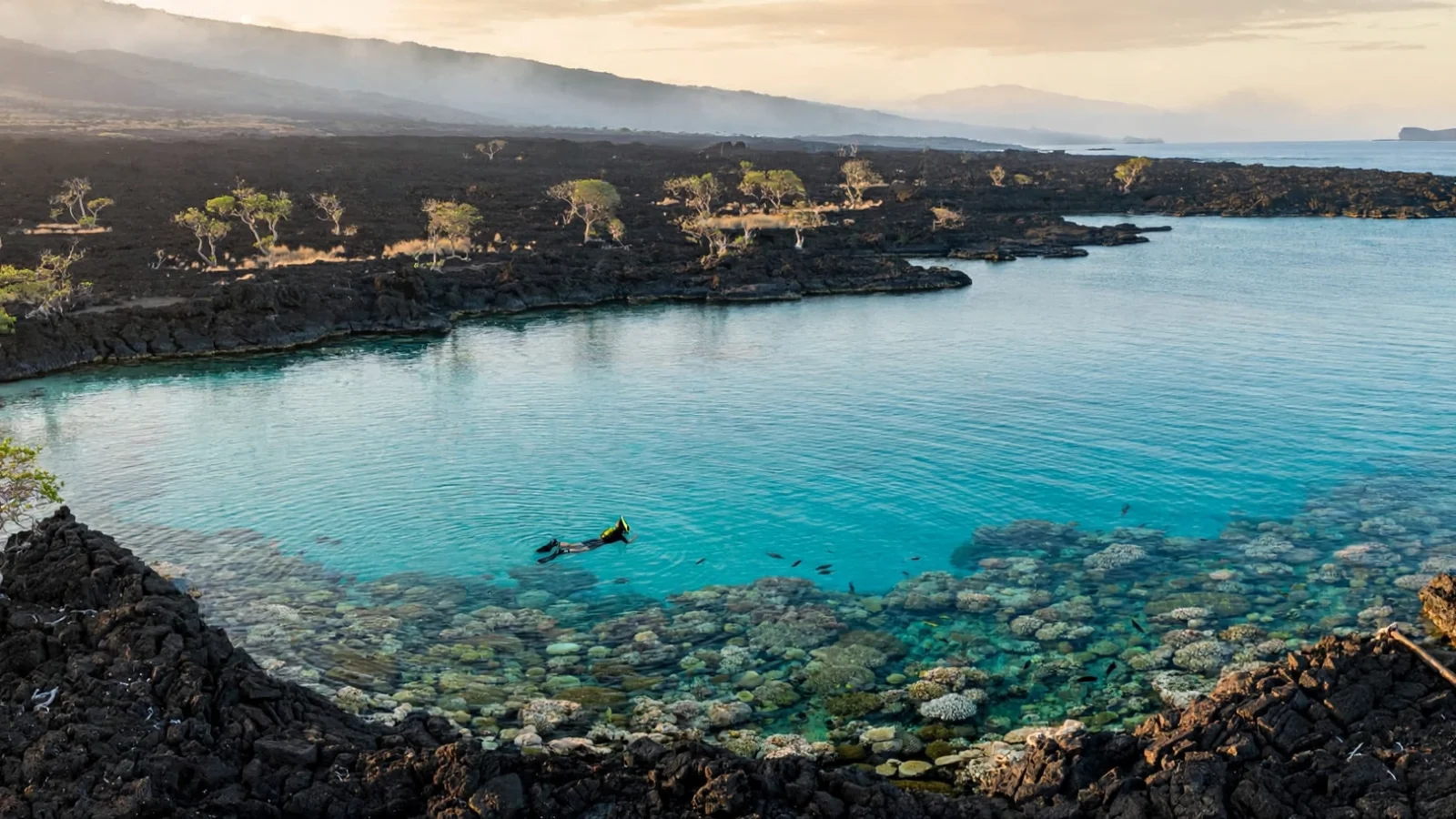
Every Maui snorkel guide eventually runs out of road, and this is where it ends. La Perouse Bay — Keoneʻōʻio — sits at the literal end of Makena Road, past the resorts, past Big Beach, past the last snorkel cove most visitors ever reach, in a black lava wilderness where Haleakalā’s youngest lava met the sea. The water here can be some of the clearest on Maui, the coral some of the healthiest in the main Hawaiian Islands, and the bay is a daytime resting home for spinner dolphins. It is also, without qualification, a snorkel for advanced swimmers only: the entry is over razor-sharp lava, the currents are real, there is no lifeguard, no water, no shade and no help nearby.
That combination is exactly why this guide exists. The pages that rank for La Perouse Bay today either bury snorkeling in a general hiking guide or — worse — sell it as a fun outing for the kids. It is not. Read this page as a filter: if you are a confident ocean swimmer who snorkels at first light, plans around the dolphins rather than through them, and treats a lava shoreline with respect, La Perouse can be the best shore snorkel on Maui. If any of that sounds like work, the island’s better answer for you is a few miles back up the road at Ahihi Cove — and there is no shame in that call. It is the call most people should make.
Quick facts
- Location: Keoneʻōʻio Bay, at the end of Makena Road, South Maui — about 3 miles past Makena State Park (Big Beach), on the ‘Ahihi-Kina’u reserve coastline
- Snorkeling verdict: Advanced only. Pristine, deeper coral gardens and exceptional clarity on calm mornings — earned through a sharp lava entry, possible strong currents and zero facilities
- Best zone: The main bay in front of and just beyond the parking area, over the deeper coral gardens; mornings only, in flat conditions
- Dolphins: Hawaiian spinner dolphins rest in the bay by day. Federal law: never swim with or approach a spinner dolphin within 50 yards. If dolphins are resting in the bay, watch from shore and stay out of their water
- Lifeguard: None. No water, no showers, no shops — portable toilets at the lot are the whole facility list
- Parking: Free, unmarked gravel lot at the end of the road; no fee and no reservation for this lot, but arrive early — it fills, and there is nowhere else to park
- Facilities: Portable toilets only. No drinking water. Limited cell service. No gas stations past Kihei — fuel up before you leave
- Signature hazards: Sharp ‘a’a lava entry and exit (the hardest part of the snorkel), currents that strengthen away from the bay, afternoon wind, extreme heat and sun on the lava with no shade
- Best beginner move: Don’t. Backtrack to Ahihi Cove inside the reserve for a shallow, calm, ranger-patrolled snorkel instead
The bay: Maui’s youngest coastline
La Perouse is what a coastline looks like before time softens it. The bay cuts into a vast field of ‘a’a lava from Haleakalā’s most recent eruption — dated to around 1790 by some accounts and earlier by others — so instead of a sand beach there is a narrow, rocky shore of black and rust-red rock, a few small coves, and water that drops into coral gardens rather than shelving gently off a beach. Inland, the lava plain runs up the mountain’s flank, dotted with kiawe trees and feral goats. There is almost no development, almost no runoff, and that is precisely the underwater point: with no streams, lawns or storm drains feeding this bay, the water stays exceptionally clear and the coral has recruited and grown here with a success scientists have noted across the main islands.
The bay is named for the French admiral Jean-François de Lapérouse, who landed here in May 1786 and became the first European to set foot on Maui, visiting the small villages that once stood around Keoneʻōʻio. The old King’s Trail — the Hoapili Trail, whose best-preserved section starts at the parking lot — still runs along this coast, a reminder that this “remote” shore was a travelled, lived-in place long before it became the end of a rental-car road.
The honest verdict: who should snorkel here — and who should not
Snorkel La Perouse if: you are a strong, experienced ocean swimmer; you are comfortable entering and exiting over rock in light surge; you go at sunrise on a forecast-calm day; you can read a bay and turn back when the surface tells you to; and you will happily cancel the whole swim if dolphins are resting in the water.
Skip La Perouse if: you are a beginner, a weak swimmer, or snorkeling with children; the wind is already up when you arrive; the entry rocks are being washed by surge; or your plan depends on facilities, shade or a lifeguard. Every one of those is a complete answer on its own. The most common La Perouse mistake in print is a vacation blog framing it as a great spot “for you or your kids” — the local consensus, from Maui snorkel guides to tour operators, is the opposite: this is one of the island’s advanced sites, full stop. For a first or family snorkel on this coast, use our beginners’ guide to snorkeling in Hawaii and pick Ahihi Cove or Makena Landing instead.
Where the snorkeling is
There is one practical snorkel zone for shore visitors, and it is the main bay itself, worked from the rocky shore near the parking area out over the coral gardens. What makes La Perouse feel different from almost every other Maui shore snorkel is the shape of the reef: in many places the coral does not climb to the surface, so instead of threading a shallow maze the way you do at Ahihi or Ulua, you float above deeper gardens with real space below you — coral heads, sand channels and reef slopes in water that, on a still morning, can be clear enough to read the bottom far below. Snorkelers describe it as soaring rather than weaving, and on the right day that is exact.
Work the bay conservatively. The further out and the further along the points you push, the more the bay’s shelter fades and the current — the same flow that sweeps this exposed southern tip — starts to own the plan. Set a turnaround point before you get in, keep the shore in easy reach, and treat the bay’s edges as the limit, not the warm-up. The little coves cut into the lava along the Hoapili Trail coast to the south look inviting from the path, but they are rougher, more remote and further from any help; they are a strong-swimmer expedition in dead-calm conditions, not a casual second spot, and most visitors are better served hiking them and snorkeling the main bay.
Boat snorkelers meet a different La Perouse — operators run to an offshore pinnacle in the bay that is, by their accounts, thick with fish. That site is a boat trip, not a shore swim; don’t try to fin out to open-water structure from the lava. Our Hawaii snorkeling tours guide covers how the Kanaio Coast and La Perouse boat trips run.
The entry: the hardest part of the snorkel
There is no sand entry at La Perouse. You pick your way across ‘a’a lava — rock sharp enough to cut skin through a careless step — to a low point on the shore, time what surge there is, and ease in over rock, keeping hands off the coral and the lava’s underwater edges. The exit is the same problem in reverse, with tired legs: choose your exit point while you are still in the water, approach it slowly, and never let a wave set you down on the rock.
Practical rules that make this manageable: wear sturdy footwear you can walk the lava in right up to the water’s edge (trail shoes, not slippers — the walk from the lot alone will punish thin soles); enter in the calmest water you can find along the shore, not the most convenient; put fins on in the water, not on the rocks; and abort without embarrassment if the entry is being washed. A snorkel that starts with cuts and a fight has already told you what the swim will be like. Reef shoes or booties inside your fins earn their space in the bag here more than at any other Maui spot — the full kit logic is in our snorkel gear checklist.
The dolphins: this bay is a bedroom
Spinner dolphins hunt offshore at night and come into calm, sandy bays to rest through the day — and La Perouse is one of their preferred Maui resting bays. You will often see them from shore in the morning, rolling slowly at the surface, occasionally leaping and spinning. Watch that show from land, with binoculars if you brought them, and understand the law before you understand the temptation: under the federal rule in force since 2021, it is illegal to swim with or approach a Hawaiian spinner dolphin within 50 yards — and if dolphins move toward you in the water, the obligation to move away is yours. These animals are trying to sleep; a swimmer following a resting pod is not a magical encounter, it is the disturbance the rule exists to stop, and DLNR officers patrol this coastline and do fine people.
So the La Perouse dolphin rule for snorkelers is simple: if dolphins are resting in the bay, the snorkel waits or moves — it does not share the water. Build the morning around it: arrive at dawn, check the bay from shore, and if the pod is in, enjoy the view, hike a stretch of the Hoapili Trail, and snorkel Ahihi Cove on the way back instead. No reef is worth a federal violation, and no honest guide will sell you one. The same distance-first ethics apply to turtles everywhere in Hawaii — stay at least 10 feet away and never follow or touch one; our snorkeling with turtles guide lays out the full picture.
What you might see
Come for the coral first. La Perouse’s gardens are the draw: healthy coral heads and reef structure in unusually clear water, worked by the full South Maui cast — yellow tangs and convict tangs in the shallower rock, saddle and ornate wrasses, butterflyfish in pairs over the coral, parrotfish grazing audibly, and Moorish idols and triggerfish along the deeper edges. Green sea turtles cruise this coast and rest around the reef; moray eels are part of the lava-reef furniture — look into the ledges rather than reaching into them. Eagle rays and the occasional reef shark are possible over the outer sand, as they are anywhere on this coast, and in winter humpback whales are part of the surface scenery between swims.
Set the expectation the reserve way: this is a wild reef, not an aquarium with opening hours. Fish density varies with the day, the light and how much of the bay the conditions let you cover. What La Perouse reliably offers, on a calm morning, is the combination South Maui does nowhere else — genuinely pristine coral, space and clarity, in a landscape that still looks like the island being built.
Conditions and the GO / NO-GO check
La Perouse has one window and it is early. Mornings bring the lightest wind, the flattest surface and the best visibility; the normal pattern is for wind to build across this exposed coast as the day warms, chopping the bay and clouding the entry. South swells — a summer pattern on this coast — wrap straight into the bay and can close it entirely; a big south day turns the rocky entry into a washing machine and the correct snorkel count is zero. Winter crowds the calendar less here than on the north shores, but rough, windy spells still shut the bay down for days at a time. Our best time to snorkel in Hawaii guide covers the island-wide seasonal logic.
Run this checklist at the shore before anyone gets wet:
- Wind: light or calm, and forecast to stay that way for your swim — not “already whitecapping at 8am.”
- Surface at the entry: no sets washing the rocks you plan to enter and exit over.
- Water colour: blue and clear from above. Murk here means runoff or churn you don’t need.
- Dolphins: none resting in the area you plan to swim — or the plan changes, not the dolphins.
- People check: everyone in the group is a strong swimmer, briefed on the exit point, and paired with a buddy.
Fail any line and the day becomes a lava-coast day — the Hoapili Trail, the views to Molokini and Kaho’olawe, and a snorkel at a sheltered spot on the drive back. That is a good day, not a lost one. The full hazard framework — currents, shorebreak, fatigue, the buddy rules — is in our Hawaii snorkeling safety guide; at a no-lifeguard site this remote, it is required reading, not a footnote.
Reserve rules: you are inside a protected coastline
La Perouse Bay lies on the ‘Ahihi-Kina’u Natural Area Reserve coastline, and the reserve’s ethic governs the visit whether or not a ranger is in sight: no fishing here, and nothing may be taken, touched or disturbed — not coral, not lava rock, not shells, not archaeological features. Park only in the gravel lot, stay on the trail and shore areas open to visitors, and pack out everything. Sunscreen matters doubly on a reef this valued: Maui County already bans the sale of non-mineral sunscreens, and the reserve asks for mineral protection — zinc oxide or titanium dioxide — in the water. Wear it, wear a rash guard to need less of it, and keep fins and hands off the coral itself; a pristine reef stays pristine one careful snorkeler at a time.
One fee warning, because sources blur it: the $5 non-resident vehicle fee and the 5:30am–7:30pm visiting hours you will see quoted for ‘Ahihi-Kina’u apply to the reserve’s main Ahihi Bay access and its lots further north — the La Perouse gravel lot at the end of the road is stated by Maui guides to be free parking. Pay what the signs at the lot you actually use ask for, and don’t let a blog’s blended fee claim put you off — or leave you unprepared at the reserve lot on the way back.
Access, parking and the end-of-the-road drive
Drive south from Kihei through Wailea and Makena on Makena Alanui Road, past Makena State Park, and keep going: the road narrows, winds along the lava coast through the reserve, and simply ends at the La Perouse gravel lot. There is no gas station past Kihei, no water and no shop — fuel, water, food and sunscreen are all bring-your-own, and “double the water you think you need” is the standard local advice for anything on this lava, in or out of the water. The lot is unmarked and stonier than it looks; park considerately, keep valuables out of the car entirely, and give yourself the early start — the lot fills, the light is best at dawn, and so is everything else about this place.
Facilities end at portable toilets by the lot. There is no lifeguard, limited cell reception, and the nearest regular services are back in Makena and Wailea. Tell someone your plan and your return time before you drive out of signal, and wear real shoes for the shore and the trail — the single most common La Perouse injury pattern starts with thin footwear on ‘a’a.
La Perouse vs the South Maui alternatives
La Perouse does not compete with the easy South Maui snorkels; it sits at the far end of a ladder, and knowing the rungs is the whole decision.
| Spot | Snorkeling quality | Who it’s for | Entry | Lifeguard |
|---|---|---|---|---|
| La Perouse Bay | Pristine deeper coral gardens, exceptional clarity | Advanced, strong swimmers only | Sharp lava, timed with surge | No |
| Ahihi Cove | Dense shallow reef, very fishy | Beginners to intermediates | Rocky but sheltered, marked entry | No (reserve staff/rangers in area) |
| Makena Landing | Rocky coves, caves, turtles | Intermediates | Small cove entry | No |
| Turtle Town (Maluaka) | Fringing reef, reliable turtles | Beginners to intermediates | Sandy beach entry | No |
If La Perouse’s checklist fails on the morning, the drive back is a ladder down through exactly these spots — Makena Landing and Ahihi Cove are minutes away, and Turtle Town rounds out a turtle-focused morning. The Maui snorkeling hub maps the whole island if you’re planning the week rather than the morning, and the Kihei guide covers the town-side bases most La Perouse visitors sleep in.
The land side: Hoapili Trail and the lava coast
Build the non-snorkel half of the morning deliberately. The Hoapili Trail — the old King’s Trail — leaves the parking lot and follows the coast through kiawe groves and lava desert, past small coves, toward the Hanamanioa lighthouse point: stark, beautiful walking with Molokini and Kaho’olawe offshore and Haleakalā at your back. It is also shadeless, waterless and paved in ankle-testing rock — sturdy shoes, a hat and carried water are the entry fee, and turning back early is a plan, not a failure. Feral goats work the lava fields, dolphins work the bay below the trail, and the whole coast makes the point the snorkel makes underwater: this is the youngest, rawest shoreline most Maui visitors will ever stand on.
FAQ
Can you snorkel at La Perouse Bay from shore?
Yes — strong, experienced snorkelers can shore-snorkel the main bay from the rocky shore by the parking area, over deeper coral gardens. The entry and exit cross sharp lava, currents strengthen beyond the bay’s shelter, and there is no lifeguard, so it is an advanced-only snorkel in flat, calm, early-morning conditions.
Is La Perouse Bay good for beginners or kids?
No. Local guides and operators consistently rate it advanced only, because of the sharp rocky entry, possible strong currents and total lack of facilities or lifeguards. Beginners and families should snorkel Ahihi Cove, a few miles back inside the reserve, which is shallow, sheltered and set up for first-timers.
Can you swim with the dolphins at La Perouse Bay?
No — it is illegal. Hawaiian spinner dolphins rest in the bay by day, and federal law prohibits swimming with or approaching them within 50 yards; if they approach you, you must move away. Watch them from shore, and if the pod is resting in the bay, keep your snorkel out of their water.
Where do you park at La Perouse Bay, and does it cost anything?
At the free, unmarked gravel lot where Makena Road ends, about 3 miles past Makena State Park. Maui guides state parking there is free; arrive early because the lot fills and there is no overflow. The $5 non-resident vehicle fee quoted for ‘Ahihi-Kina’u applies to the reserve’s Ahihi Bay lots to the north, not this lot — follow the signs where you park.
What is the best time of day to snorkel La Perouse Bay?
First light. Early morning brings the lightest winds, flattest water, best visibility, fewest people and the best chance of watching spinner dolphins from shore. Wind normally builds across this exposed coast later in the day and degrades both the entry and the visibility.
What facilities are at La Perouse Bay?
Almost none: portable toilets at the parking lot, and nothing else — no drinking water, showers, shops, rentals or lifeguard, and limited cell service. Bring all water, food, gear and mineral sunscreen with you, and fuel up in Kihei; there is no gas past it.
Is La Perouse Bay inside the ‘Ahihi-Kina’u reserve?
It lies on the reserve’s coastline at the southern end of the ‘Ahihi-Kina’u Natural Area Reserve, and reserve rules frame the visit: no fishing, and no taking or disturbing coral, rock, shells or archaeological features. Snorkel lightly, stay in areas open to visitors, and use mineral sunscreen only.
How does La Perouse Bay compare with Ahihi Cove?
Ahihi Cove is the sheltered, shallow, beginner-friendly face of the same reserve coastline — dense reef, a marked entry and reserve staff in the area. La Perouse is its wild sibling: deeper, clearer, emptier coral gardens, bought with a sharp lava entry, stronger currents and an advanced-only skill requirement. Many strong snorkelers do Ahihi on a normal morning and save La Perouse for a perfect one.