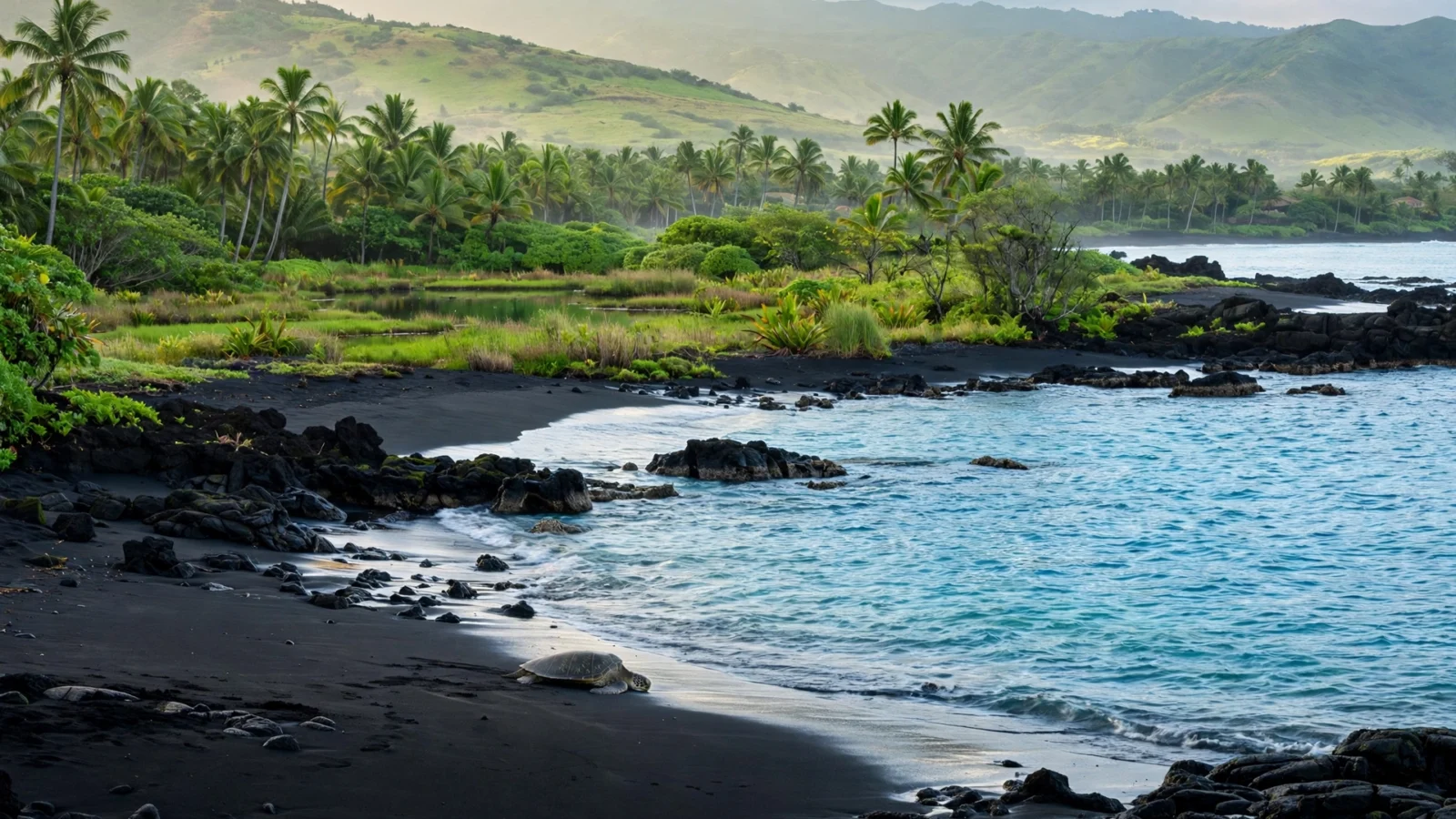
Punalu’u is the most famous black sand beach in Hawaii, and almost nobody comes here for the snorkeling. They come for the sand itself — a crescent of jet-black basalt under coconut palms — and for the turtles that haul out onto it to sleep in the sun. Then they stand at the waterline, mask in hand, and ask the question this guide exists to answer honestly: can you actually snorkel here?
Yes — on the right day, in the right place, with the right expectations. Punalu’u’s main beach is a calm-day-only, moderate-visibility snorkel over lava rock, where the prize is not coral but turtles feeding in the shallows. And five minutes’ walk south, sheltered Ninole Cove holds the snorkel the main beach promises and doesn’t deliver: sand-channel entry, real reef fish, and tide pools a child can explore. Get the day wrong, though — surf up, currents running — and Punalu’u is a beach you admire from the sand, full stop. This guide gives you the test that tells the two days apart.
Quick facts
- Location: Punalu’u Beach Park, Ninole Loop Road off Highway 11, Ka’u district, southeast Big Island — between Na’alehu and Pahala, about 55 miles and 1.5 hours from Hilo and about 30 miles from the Hawai’i Volcanoes National Park entrance
- Snorkeling verdict: Main beach = calm-day only, moderate visibility, turtles over reef fish. Ninole Cove, a 5-minute walk south = the better snorkel, experienced snorkelers on calm days
- The headline: Green sea turtles — feeding in the shallows and basking on the black sand in marked resting areas. Keep at least 10 feet away, on land and in the water
- Lifeguard: Yes — lifeguards are posted daily (local guides list roughly 8:30am–5pm; follow the tower’s signs on the day)
- Parking: Free, in two public lots — a north lot by the freshwater pond and a larger south lot by the restrooms. No entrance fee, no reservation
- Facilities: Restrooms, outdoor showers, picnic pavilions and tables, BBQ pits; a small concession stand by the palms may operate — bring supplies regardless
- Best beginner move: Skip the main-beach snorkel. Wade the Ninole Cove tide pools instead, and save the first real reef snorkel for Kahalu’u Beach Park
The beach: black sand, freshwater springs and a name that tells the story
Punalu’u’s sand is young lava, shattered. When molten basalt met the Pacific here it fragmented on contact into millions of black glassy grains, and the beach is still made of them: coarse black sand, pellet-sized pebbles and smooth ropy boulders of pahoehoe lava, especially toward the south end. It glitters in the sun, it photographs like nowhere else on the island — and it absorbs heat like a stovetop. By midday the sand is genuinely uncomfortable under bare feet. Water shoes earn their place in your bag twice at Punalu’u: once for the hot sand, once for the lava-rock entry.
The name tells the beach’s second story. Punalu’u means roughly “spring water to dive for”: in times of drought, ancient Hawaiians dove into the bay to fill gourds from the freshwater springs that well up through the seafloor. Those springs still run. Snorkel here and you will feel them — patches and layers of cold freshwater floating over the warmer salt water, shimmering where the two mix. Behind the coconut palms at the north end of the beach, the same groundwater surfaces as a large freshwater pond, covered in water hyacinths and worked by ducks and Hawaiian waterbirds. It is a lovely short wander; it is not a swimming hole.
One rule before anything else, because the beach depends on it: the black sand is protected, and removing it — even a souvenir handful — is illegal. Black sand is a finite, eroding resource that no current lava flow is replenishing at Punalu’u. Photograph it, sit on it (early, before it heats up), leave every grain.
The calm-day test: when Punalu’u is a snorkel and when it is not
Everything at Punalu’u turns on conditions, more than at almost any other beach on this site. The Ka’u coast faces open Pacific, the currents off this beach are strong and treacherous even on days that look manageable, and local guides at every level agree on the pattern: snorkeling here is a calm-day activity only. Run this test before your mask gets wet:
- Look at the surf, not the sky. If white water is breaking across the bay or waves are dumping on the lava shelf, the answer is no — visibility will be stirred to milk and the currents will be working. A flat, glassy morning is the green light.
- Ask the lifeguard. There is a tower at this beach and the guards know the day’s currents. Tell them you plan to snorkel and where; if they shake their heads, believe them.
- Stay close, always. Even on the calmest day, snorkel within easy reach of shore and never let the current make your decisions. If you feel a steady pull along or away from the beach, get out — conditions here change faster than a casual swim suggests.
- Morning wins. As at most Hawaiian beaches, the early hours bring the calmest surface and the clearest water; by afternoon the wind and the tour-stop crowds have both arrived.
Fail any line of that test and Punalu’u is still worth the stop — for the sand, the pond, the basking turtles and the picnic pavilions. It simply stops being a snorkel day, and no honest guide should pretend otherwise. Our Hawaii snorkeling safety guide covers the current and entry judgement calls in full.
Zone 1: The main beach — turtles over lava, not coral gardens
Enter the main beach and the first fact is underfoot: this is a lava entry, not a sand entry. The shore is a mix of black sand pockets, pebbles and lava rock, and getting in means picking your way over that rock in water shoes, ideally where the bottom is least broken. The north end of the beach has somewhat less rocky access, and the old boat ramp is widely described as the easiest entry point of all — use it if the lifeguard’s advice points that way on the day.
Underwater, set the expectation correctly. Visibility at Punalu’u is moderate at best — the two top local guides call it “quite poor” and “only moderate” respectively — because the freshwater springs shimmer the water column and any surf stirs the black sand and rock into the shallows. There is no coral garden here and the reef-fish cast is modest. What there is, reliably, is turtles. Green sea turtles (honu) graze the red seaweed and algae that coat the rocks, and they are seen in these shallows often and easily — this is one of the most dependable in-water turtle encounters on the island, precisely because the turtles are here to eat, not to pose. The much rarer hawksbill turtle (honu’ea) also uses these waters; treat any sighting as a privilege. Around the rocks you will also find helmet (shingle) urchins clinging to the lava — beautiful, sharp, and a good reason to keep hands off everything.
Work the shallows slowly, stay inside the bay’s sheltered water, and let the snorkel be what it is: a short, calm-morning turtle watch over black rock, unlike any snorkel on a white-sand reef — and honestly better for it, if turtles are what you came for. Our snorkeling with turtles guide covers the etiquette that matters most here.
Zone 2: Ninole Cove — the snorkel Punalu’u keeps five minutes south
The better snorkel is not on the postcard beach at all. From the main beach, an unmarked grassy trail runs south — right, as you face the ocean — for about five minutes to Ninole Cove, a smaller, sheltered bay tucked beyond the point. (You can also approach from the south by road, but the resort golf course that once marked the turn is no longer operating; the walk from the beach park is the surer route.)
Ninole fixes the main beach’s two problems. Its entry runs through sand channels between the rocks — a decent, wadeable way in instead of a clamber over lava — and its sheltered water holds the more colourful tropical fish the main beach lacks. Along its edges sit sheltered tide pools, shallow and easy, where kids and non-snorkelers can watch small reef life without entering the open bay at all; for many families, the tide pools are the best water at Punalu’u.
Hold the conditions line here too, though. Local guides describe Ninole’s snorkeling as one for experienced snorkelers on calm days — sheltered is relative on the Ka’u coast, and a cove that is gentle on a flat morning can pull on a surf day. Same test, same lifeguard logic where visible, same rule: if the ocean looks worked up from the trail, enjoy the pools from the rocks and walk back.
The turtles on land: basking honu and the 10-foot rule
Half of Punalu’u’s turtles never get wet while you watch them. Honu haul out onto the black sand to rest and warm up — the dark sand’s heat is part of the attraction — and their presence is so dependable that sections of the beach are marked off with rows of lava rocks as resting areas. You will likely see them from the parking lot side of the beach before you ever reach the water.
The rule is federal, simple and enforced: keep at least 10 feet (3 metres) from every turtle, on land and in the water. Never touch, crowd, feed or move a turtle, never position yourself between a resting turtle and the sea, and use a zoom lens instead of your feet for the photograph. These are protected, endangered animals resting in one of the few places they still do it in full view of a highway rest stop — the access exists because visitors, so far, have mostly behaved. Everything in our turtles guide applies double here.
Access and parking: two free lots on Ninole Loop Road
Punalu’u is the easiest famous black sand beach on the island to reach — no hike, no gate, no pass system. From Highway 11 (the Hawaii Belt Road), turn onto Ninole Loop Road between Na’alehu and Pahala and follow it down to the beach park. Drivers pair it with the volcano run: it sits about 30 miles (40–45 minutes) southwest of the Hawai’i Volcanoes National Park entrance, about 55 miles and roughly 1.5 hours from Hilo, and about 1.5 hours from Kailua-Kona the other way.
Parking is free in two lots that between them serve the whole small beach: a dirt lot at the north end, by the freshwater pond, the concession stand and the lifeguard tower — the lot for pond-and-turtles visits — and a larger lot at the south end by the restrooms, showers and picnic tables — the lot for Ninole Cove walkers and picnic days. There is no entrance fee and no reservation for day use. Camping in the beach park is by county permit only; check the County of Hawai’i parks system before planning any overnight. Facilities are complete for a day stop: restrooms, outdoor showers, covered picnic pavilions, tables and BBQ pits, with the Punalu’u Bake Shop in Na’alehu — famous for its malasadas — a short drive away, and very little else commercial nearby. Bring water and supplies; this is the rural Ka’u coast, not a resort strip. The full kit list lives in our snorkel gear checklist — at Punalu’u, water shoes move from optional to essential.
Best time and seasons
Early morning is Punalu’u’s hour, three times over. The water is at its calmest and clearest, which is the snorkeling window. The black sand is still walkable in bare feet, before the sun turns it into the beach’s midday hazard. And the beach is at its emptiest, before the volcano-tour loop delivers its midday crowds — turtles, pond and sand largely to yourself. Late afternoon runs a decent second: cooler sand, softer light, turtles still active.
Seasonally, the drier months from about April to October generally bring this coast its friendlier ocean, but hold that loosely — the Ka’u coast takes south swells in summer and heavy weather at any time of year, and the calm-day test on the morning itself always outranks the calendar. Year-round, treat Punalu’u as a conditions beach rather than a season beach; our best time to snorkel in Hawaii guide explains the island-wide pattern.
What you will see
In the main beach shallows: green sea turtles grazing the algae-coated rocks — the signature sighting — with the outside chance of a hawksbill, helmet urchins on the lava, and a modest cast of reef fish in the clearer pockets. At Ninole Cove: the fuller fish community — tangs, wrasses, butterflyfish among the rocks and sand channels — and small reef life concentrated in the tide pools. On the sand: basking honu in their marked resting areas, the islands’ most reliable out-of-water turtle view. At the pond: water hyacinths, ducks and Hawaiian waterbirds behind the palms. What you will not find anywhere at Punalu’u is a developed coral reef or Hanauma-grade fish density — for that, from this side of the island, the answer is Ho’okena up the South Kona coast or Kahalu’u and Kealakekua on the Kona side, all lined up in our Big Island snorkeling hub.
Punalu’u vs the other black sand — and vs a real reef
| Spot | Choose it when… | The trade-off |
|---|---|---|
| Punalu’u — main beach | You are on the Hilo–Volcanoes–Kona loop and want the famous black sand, basking turtles and a possible calm-morning turtle snorkel in one easy stop | Moderate visibility, lava entry, strong currents — calm days only, never a beginner snorkel |
| Punalu’u — Ninole Cove | You are an experienced snorkeler and the day is flat: the area’s best fish, sand-channel entry, tide pools for the kids | A 5-minute trail walk; still conditions-dependent; no lifeguard at the cove itself |
| 49 Black Sand Beach | You are on the Kona coast and want black sand with a clearer, reefier cove snorkel | Inside gated Mauna Lani: scarce public access passes, arrive early, a different coast entirely |
| Kahalu’u Beach Park | You want an actual beginner-friendly reef snorkel with turtles near Kona | White-sand bay, no black-sand drama; a 2-hour drive from Punalu’u |
| Ho’okena Beach | You want South-coast reef snorkeling with a proper entry-to-reef route | No lifeguard; dolphin-rest rules apply in the bay; further up the coast toward Kona |
The short version: Punalu’u is a turtle beach with a conditional snorkel attached; 49 Black Sand Beach is a snorkel cove with black sand attached. Know which one your day needs.
Frequently asked questions
Can you snorkel at Punalu’u Black Sand Beach?
Yes, on calm days only. The main beach offers a short snorkel over lava rock with moderate visibility, known for green turtles feeding in the shallows rather than reef fish. Ninole Cove, a 5-minute walk south, holds the better snorkeling — sand-channel entry and more fish — for experienced snorkelers when the ocean is flat. In surf or strong current, do not enter at either spot.
Is Punalu’u good for beginners?
No — not as a snorkel. The entry is over lava rock, visibility is moderate at best, and the currents off this beach are strong even on decent days. Beginners are better served by the Ninole Cove tide pools at Punalu’u itself, and by sheltered reef beaches like Kahalu’u near Kona for a first real snorkel — see our beginners’ guide to snorkeling in Hawaii.
Why is the visibility not great at Punalu’u?
Two local reasons. Freshwater springs well up through the bay floor — the springs the name Punalu’u refers to — and the mixing fresh and salt layers shimmer the water. And any surf stirs the black sand and rock shallows. On a flat, calm morning, early, visibility is at its workable best.
Where do the turtles rest at Punalu’u, and how close can I get?
Green turtles (honu) bask on the black sand, often inside resting areas marked with rows of lava rocks. Keep at least 10 feet (3 metres) away from every turtle, on the sand and in the water, by federal rule. Never touch or crowd one, and never stand between a resting turtle and the sea.
How do I get to Ninole Cove?
Walk south from the main beach — right as you face the ocean — on the unmarked grassy trail for about five minutes. The cove sits beyond the point, with sand channels for entry and tide pools along its edges. Driving in from the south is possible but the old golf-course landmark for the turn no longer operates, so the walk is the reliable route.
Are there lifeguards, restrooms and showers at Punalu’u?
Yes. Lifeguards are posted daily at the main beach (local guides list roughly 8:30am–5pm — follow the tower’s posted signs), and the beach park has restrooms, outdoor showers, picnic pavilions, tables and BBQ pits. Ninole Cove has no lifeguard and no facilities.
How much does Punalu’u cost, and where do I park?
Entry and parking are free, and no reservation is needed for day use. There are two lots on Ninole Loop Road: a north lot by the freshwater pond and lifeguard tower, and a larger south lot by the restrooms and picnic area. Camping is by county permit only.
Can I take black sand home from Punalu’u?
No. Removing black sand is illegal — the sand is a protected, finite resource formed from fragmented lava, and no active flow is replacing it at this beach. Take photographs instead, and leave the beach with exactly as much sand as it had when you arrived.
The bottom line
Punalu’u asks to be read the way Kailua does, at the opposite end of the honesty scale: a world-famous beach whose fame rests on sand and turtles, with a snorkel that is real but strictly conditional. Come on a flat morning, pass the calm-day test, snorkel the shallows for the grazing honu, walk five minutes south for the fish at Ninole — and on any other day, keep your feet on the black sand, watch the turtles sleep in the sun, and count the stop a success anyway. Start with our Big Island hub to line up the reefs that carry the rest of the island.