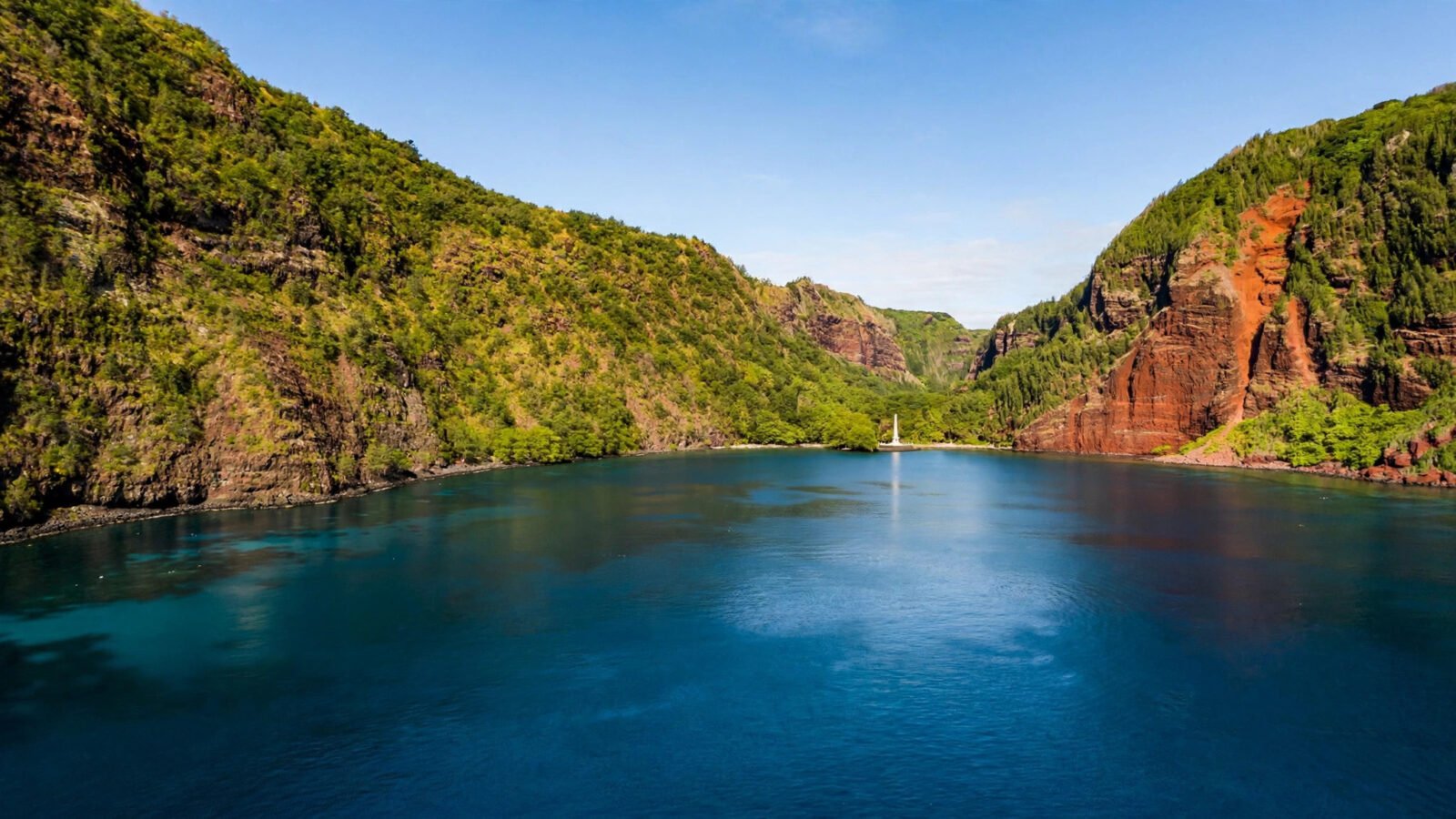
- Where
- Ka’awaloa Cove, Kealakekua Bay — South Kona, Big Island
- Access
- Boat tour, permitted kayak, or the Ka’awaloa Trail hike — no road to the cove
- Protection
- Marine Life Conservation District since 1969; every vessel on the bay needs a State Parks permit
- Best time
- Before 10 a.m. — the Kona breeze chops the surface by midday
- Wildlife rule
- Spinner dolphins rest in the bay: 50 yards minimum, by federal rule
Why this bay tops the rankings
Kealakekua has the combination nothing else in Hawaii quite matches: full conservation-district protection since 1969, a young lava coastline with almost no runoff, and access difficult enough to limit the crowds. Travel blogger Sarah at Lost in the Midlands described roughly 30 meters — about 100 feet — of clear water over abundant coral on her visit, and called it the best snorkeling in Hawaii; that verdict repeats across most of the firsthand reports we reviewed. The best coral and fish concentrate at Ka’awaloa Cove, directly below the white obelisk marking where Captain James Cook was killed in 1779.
It is the anchor stop in our Big Island snorkeling guide, and a big reason the Big Island places where it does in our comparison of the best Hawaiian island for snorkeling.
The three ways in — honestly compared
1. Boat tour (easiest, most people’s right answer)
Morning snorkel cruises run from Kailua-Kona and Keauhou, roughly $100–170 depending on boat and duration. You skip the hike, the paddle and the rocky entries; gear and instruction are included; and the ride down the Kona coast often adds dolphins. If you’re not a strong hiker or paddler, stop deliberating — book the boat.
2. Kayak (the adventurous middle path — permits required)
Every vessel on Kealakekua Bay — kayak, SUP, anything — requires a Hawaii State Parks permit; the bay was being loved to death, and the permit system is how the state stopped it. Practically you have two options: a guided kayak tour with a permitted operator (from roughly $99 adult / $55 child — the state lists authorized companies such as Adventures in Paradise, Aloha Kayak Co. and Kona Boys), or a permitted rental kayak, which lets you paddle and snorkel the cove but — important — does not allow you to land at Ka’awaloa. Only commercial groups with separate landing approval may go ashore. The paddle from Napo’opo’o landing takes 15–25 minutes each way.
3. The Ka’awaloa Trail hike (free, and it earns it)
Roughly 4 miles round trip (about 3.8 miles on most trackers) with about 1,300 feet of descent — which means 1,300 feet of climbing back out in full Kona sun. The unmarked trailhead sits just off Napo’opo’o Road near Highway 11, where a small pull-off marks the start; there is no big sign, water or shade anywhere on the route. Hikers can swim and snorkel at the cove without any permit. Fit hikers call it one of the best mornings on the island; unfit hikers call it something else. Two liters of water per person minimum, sturdy shoes, early start.
Costs and effort at a glance
Every route trades money for effort. This table pulls the figures from the sections above together — treat them as rough planning numbers, as operator prices change by season and boat.
| Way in | Rough cost | Effort | Land at Ka’awaloa? | Best for |
|---|---|---|---|---|
| Boat tour | From roughly $100–170 | Easiest — ride in, gear included | No — you snorkel from the boat | Beginners, kids, most visitors |
| Guided kayak tour | From roughly $99 | Moderate — 15–25 minute paddle each way | Yes, with a permitted commercial group | Confident paddlers |
| Permitted rental kayak | Roughly $70/day | Moderate — same paddle, self-guided | No — landing is not allowed | Experienced paddlers |
| Ka’awaloa Trail hike | Free | Hard — ~4 miles round trip, ~1,300 ft climb out | Yes — you arrive on foot | Fit hikers |
| Napo’opo’o shore entry | Free | Easiest shore option — drive-up | No — opposite side of the bay | A gentle backup plan |
The Ka’awaloa Trail to the monument: the hike in full
The Ka’awaloa Trail — also called the Captain Cook Monument Trail — is the only way to reach Ka’awaloa Cove on foot, and the only free way to snorkel the monument reef. It is an out-and-back trail: 3.8 miles round trip with 1,256 feet of elevation gain, rated Hard on AllTrails (4.7 out of 5 from roughly 5,000 reviews). Plan 2.5 to 3 hours for the hike alone, plus your snorkel time at the bottom. Fit hikers in firsthand reports do the round trip in about 2 hours, but most people take longer — and the climb out is the part that surprises everyone.
The trailhead is an unmarked pull-off on Napo’opo’o Road, just below its junction with the Mamalahoa Highway (Highway 11). There is no big sign, and the small pull-off fills early, so arrive before the morning crowd or expect to park further up the road and walk in. The park is open 7 a.m. to 8 p.m. (Hawaii DLNR, Kealakua Bay State Historical Park). There is no water, no shade and no restroom anywhere on the trail — restrooms are only at the Napo’opo’o section of the park — so carry at least 2 liters of water per person, wear a hat and sturdy closed shoes, and pack out everything you bring in.
The trail starts in green forest and then opens onto a craggy lava field: roughly a mile of it is fully exposed, with dusty, loose rock underfoot and heat radiating off the ground. Numbered markers line the route — hikers consistently call the stretch between markers 6 and 4 the toughest on the way back up, when the climb is steady and the sun is high. The descent takes most people around 45 minutes; the climb back out takes an hour to an hour and a half. Goats roam the hillside — give them space. AllTrails lists the trail as dog-friendly, but the heat, loose rock and long exposed climb make it a poor choice for most dogs on a hot day.
At the bottom you reach Ka’awaloa Flats and the 27-foot white obelisk marking where Captain James Cook was killed in 1779. The monument stands on flat ground beside the cove, and the snorkeling starts right off the rocks below it. Across the bay you can see Hikiau Heiau, the restored temple platform at Napo’opo’o — a sacred site, so look from the shore and do not go onto it. There is no shade at the cove either, so the smart pattern is: hike down early, snorkel the calm morning water, and be walking back up before the midday heat peaks.
If the hike sounds like too much for your group, the boat tour is the right call — the comparison at the top of this guide still holds. And if you want the free shore option without the climb, the Napo’opo’o entry in the next section is the backup.
Snorkeling from shore at Napo’opo’o (the no-tour option)
If you drive to the end of Napo’opo’o Road, you reach the village side of the bay, opposite the monument. This is the only part of Kealakekua you can reach by car, and it works as a genuine shore snorkel — as long as you set expectations below Ka’awaloa. No permit is needed to swim or snorkel here, and entry is from the old dock and rocky shoreline beside the parking area.
Be honest about the first stretch: the water by the dock is shallow, the bottom is mostly rock and rubble, and there is little coral at first. It improves as you work south along the shore toward Manini Beach Point, where coral cover picks up and reef fish become more plentiful. In genuinely calm conditions, the north-eastern side of the bay along the pali (cliff) can also be good, in water around 5 feet deep — but only attempt that side when there is no surge pushing you toward the rocks. Keep the dock area as your entry and exit, watch for boats launching, and remember the small lot holds roughly 20–30 cars and fills by mid-morning, so this plan works best early.
What you’ll see
Dense, healthy lobe and cauliflower coral, huge schools of yellow tang and other reef fish sometimes just feet from the rocks, moray eels, and — many mornings — resting spinner dolphins in the middle of the bay. Since October 2021, federal rules require staying 50 yards from the dolphins, in the water or on a kayak; a resting pod is not an invitation.
The underwater layout explains the clarity. At Ka’awaloa the coral starts in just a few feet of water beside the rocks, then the reef slopes steadily deeper across the cove, so you can stay over bright coral in the shallows or follow the slope down as visibility allows. That slope is why beginners can enjoy the edge while stronger swimmers find more below. Look for yellow tang grazing the coral heads, moray eels tucked into crevices, and mixed schools of reef fish moving along the drop. In winter, listen as well as look: humpback whale song carries underwater here from December to March.
Timing your visit
Get in the water before 10 a.m. — mornings are glassy, and the Kona breeze reliably textures the surface by midday. The bay works year-round; this coast is sheltered from the winter north swell that shuts down other Hawaiian shores. During whale season (November–April), boat tours here regularly double as whale watches.
Season by season: summer is usually the calmest, with the flattest mornings and the clearest water, which makes it the safest bet for the hike and kayak routes. Water temperature stays warm year-round at roughly 75–80°F, so cold is rarely the issue — sun and wind are. Winter brings the whale bonus (peak song and sightings roughly December to March, tailing into April) and occasional Kona storms, but the bay stays swimmable on many days when exposed shores do not. Whatever the month, the daily rule beats the seasonal one: early, before 10 a.m., is not close. Our guide to the best time to snorkel in Hawaii explains the wider pattern.
Reading Kealakekua Bay before you go: when it turns rough, and what to do instead
Kealakekua Bay is calm enough to snorkel most mornings, but it is not a sheltered swimming beach. It is a mile-wide bay open to the Pacific, and whether the water at the monument is glassy or choppy comes down to wind and swell direction. The bay is sheltered from the winter north swell that hits other Big Island shores, yet it is exposed when wind or swell comes out of the south or west, and on those days the water at the Ka’awaloa Cove can be too rough to snorkel. The rocky shoreline makes a rough day a poor day to try: there is no sand to walk in on, and surge against rock is unforgiving.
The practical rule is the morning rule this guide keeps coming back to: be in the water before 10 a.m. Mornings are the calm window; by midday the Kona breeze chops the surface, the east side of the bay feels it first. Summer is the calmest season, while winter brings storms that can stir the bay up. Before you drive down, check the wind and swell for the Kona coast and look at the direction, not just the size. A forecast showing wind or swell from the south or west is your signal to expect rough water at the monument, even on a sunny day.
If you arrive and the cove is already choppy, do not try to force an entry at the monument rocks. You have two good options. The first is the shore entry at Napo’opo’o, described above: the water by the dock is shallow and sheltered enough to salvage the morning, and the reef improves as you swim south toward Manini Beach Point. The second is to come back another morning. The hike and the paddle are the same effort either way, and a calm morning at the monument is worth waiting a day for. If your schedule only allows an afternoon, pair the bay with Two Step at Honaunau Bay instead, the protected entry we compare with Kealakekua above, and save the monument for a morning. For the wider picture, see our Big Island snorkeling guide.
Is Kealakekua good for beginners and kids?
Yes — with the right route. For beginners and families, the boat tour is the clear verdict: the crew provides gear and flotation, helps you in and out of the water, and watches the group, so a first-timer can simply float over the coral at Ka’awaloa. Confident older kids usually love it. The Napo’opo’o shore entry is the gentle free alternative, with an easy entry and shallow water near the dock, though the reef there is thinner.
What we would not choose for young kids: the Ka’awaloa Trail, where the climb back out in full sun defeats many adults, and the kayak routes, which add a real paddle, open-bay conditions and the no-landing rule for rentals. Save those for fit teens and adults.
Safety and rules that actually matter here
- No lifeguard. There is no lifeguard at Ka’awaloa or Napo’opo’o. Enter only in conditions you can handle, and never snorkel alone.
- Give dolphins 50 yards. Spinner dolphins rest in the bay by day. Since October 2021, federal rules require staying 50 yards away in the water, on a kayak or on a boat. Do not follow, chase or swim toward a pod.
- Do not touch or stand on coral. Coral is living, protected in this conservation district, and sharp enough to cut. Float over it; if you need a rest, return to your entry point or hold your flotation.
- Respect the kayak landing rule. Rental kayaks may not land at Ka’awaloa. Only permitted commercial groups with landing approval can go ashore there.
- Use reef-safe sunscreen. Apply it before you arrive, choose a mineral, reef-safe formula, and consider a rash guard so you need less of it.
- Heat is the hike’s real hazard. The Ka’awaloa Trail has no shade and no water. Carry at least 2 liters per person, start early, wear a hat and sturdy shoes, and turn back if anyone feels dizzy.
- Watch entries and exits. Rocky shorelines at Napo’opo’o and the cove can have surge even on calm-looking days. Time your entry between sets and keep clear of boat traffic.
What to bring
- Mask, snorkel and fins (included on boat tours; bring your own for hike, kayak and shore routes)
- Reef-safe sunscreen and a rash guard for sun cover
- At least 2 liters of water per person if hiking, plus a hat
- Sturdy closed shoes for the Ka’awaloa Trail — change into water shoes at the cove
- A dry bag for keys, phone and a small towel
- Flotation or a snorkel vest if you are a new swimmer
- A light layer for the boat ride home, when the breeze picks up
Kealakekua vs Two Step vs Kahalu’u
South Kona gives you three strong options within a short drive, and they suit different days. Kealakekua Bay has the best coral, the clearest water and the wildest feel — but the hardest access, with no drive-up entry to the good cove. Two Step at Honaunau Bay is the easy-access rival: free, straight off a lava shelf, excellent fish and a similar South Kona setting, though entries get busy and there is no sand. Kahalu’u Beach Park is the beginner and family pick — shallow, sheltered and the most reliable of the three for turtles; if turtles are your main goal, start with our guide to snorkeling with turtles in Hawaii. Its coral is less pristine and it gets crowded, but nobody has to hike or paddle to reach it.
Our honest order: Kealakekua for the best single snorkel, Two Step for the best free shore snorkel, Kahalu’u for first-timers and young kids. On a longer Big Island stay, pair a morning here with the manta ray night snorkel in Kona the same evening, and save the sheltered east-side lagoon at Carlsmith Beach Park for a Hilo day.
Field reports we drew from
- Lost in the Midlands — firsthand visibility and coral observations at Ka’awaloa.
- Love Big Island — access logistics, permit detail, paddle times and the Napo’opo’o fallback.
- Hawaii DLNR — Kealakekua Bay State Historical Park — the official vessel-permit rules and authorized kayak operators.
- Tropical Snorkeling — kayak history and the 50-yard spinner dolphin rule.
- AllTrails, “Ka’awaloa – Captain Cook Monument Trail” — trail stats (3.8 miles, 1,256 feet, 2.5–3 hours, Hard, 4.7/5 from ~5,000 reviews) and hiker reports.
- Hawaii DLNR, Kealakekua Bay State Historical Park — park hours 7 a.m.–8 p.m., no entrance fee, no restrooms on the trail, pack-out rule, Hikiau Heiau guidance.
FAQ
Do I need a permit to snorkel Kealakekua Bay?
Not to swim or snorkel — only vessels need permits. Hike in, or arrive on a permitted boat or kayak, and you’re covered. The same applies at the Napo’opo’o shore entry, where anyone can swim.
Do I need a permit to kayak, and can I land at Ka’awaloa?
Yes — every kayak on the bay needs a Hawaii State Parks permit, which is why most visitors use a permitted guided tour. Landing is stricter: rental kayaks cannot land at Ka’awaloa at all. Only permitted commercial groups with separate landing approval may go ashore.
Can you snorkel Kealakekua Bay without a tour?
Yes, two ways. Fit hikers can walk the Ka’awaloa Trail to the monument cove for free, and anyone can snorkel from shore at Napo’opo’o, where the road ends. The Napo’opo’o reef is thinner than Ka’awaloa, but it is a real snorkel, not just a swim.
How hard is the Captain Cook hike, really?
The descent is easy to underestimate; the climb out is the test — about 1,300 feet on loose rock with no shade, over roughly 3.8–4 miles round trip. Fit hikers manage the round trip in 2–4 hours plus snorkel time. Carry at least 2 liters of water.
What is the best time of day and year to go?
Before 10 a.m., in any month — the Kona breeze chops the surface by midday. For the calmest water, summer is best; for a whale bonus on boat trips, go December to March. Water stays around 75–80°F year-round.
Can you swim with the dolphins at Kealakekua?
No. Spinner dolphins use the bay to rest, and since October 2021 federal rules require staying 50 yards away — swimming, kayaking or boating closer is not allowed. Watch them from a distance and let them rest.
Is Kealakekua Bay good for beginners and kids?
On a boat tour, yes — gear, flotation and crew help make Ka’awaloa accessible to first-timers and older kids. The hike and kayak routes are not suitable for young kids. Beginners on a budget can use the gentle Napo’opo’o shore entry instead.
How much does Captain Cook snorkeling cost?
It ranges from free to roughly $170. The hike and the Napo’opo’o shore entry are free, a permitted rental kayak is roughly $70/day, guided kayak tours start from roughly $99, and boat tours run roughly $100–170 depending on the boat and trip length.
How long is the Ka’awaloa Trail?
3.8 miles round trip with 1,256 feet of elevation gain, rated Hard. AllTrails lists 2.5 to 3 hours for the hike alone; firsthand reports run about 45 minutes down and an hour to an hour and a half back up, plus snorkel time at the cove. Allow 2 to 4 hours for the round trip including your swim, and carry at least 2 liters of water per person.
Where do you park for the Ka’awaloa Trail?
In the small unmarked pull-off on Napo’opo’o Road, just below the Mamalahoa Highway junction. It holds only a few cars and fills early, so arrive before the morning crowd. There are no facilities at the trailhead — no water, no shade, no restroom — and the park is open 7 a.m. to 8 p.m.
How do I know if Kealakekua Bay is calm enough to snorkel today?
Check the wind and swell forecast for the Kona coast before you drive down, and look at the direction: wind or swell from the south or west usually means rough water at the monument, while a calm morning before 10 a.m. is the window this bay is known for. If the forecast shows south or west wind or swell, expect choppy water at Ka’awaloa Cove and plan on the Napo’opo’o shore entry or another morning instead.
What should I do if I get to the monument and the water is too rough to snorkel?
Do not enter at the monument rocks: the shoreline is rock, and surge makes a rough entry dangerous. Snorkel from the shore at Napo’opo’o instead, where the water by the dock is shallow and sheltered, or come back on a calmer morning. If you only have the afternoon, head to Two Step at Honaunau Bay, the protected entry we compare with Kealakekua above.
The bottom line
Kealakekua Bay rewards a little planning more than any other snorkel spot on the Big Island. Pick your route the night before — boat booked, kayak permit confirmed, or alarm set for the trail — and aim to be in the water before 10 a.m. while the surface is still glassy. Do that, keep your distance from the dolphins, stay off the coral, and you will see why Captain Cook snorkeling sits at the top of so many Hawaii lists: clear water, living coral and a bay that still feels wild because getting here takes effort.
Captain Cook Bay: the monument, the park, and the conservation district
Most searches for “hawaii captain cook bay” — and for “captain cook bay hawaii” — are not really asking about a beach. They are asking about a place: Kealakekua Bay, a roughly mile-wide bay on the South Kona coast of the Big Island, near the town of Captain Cook. The snorkeling is the draw, but the bay is also a state historical park, a Marine Life Conservation District, and the site of the Captain Cook Monument. Understanding those three layers explains why the snorkeling here is so good, and why the rules are stricter than at an ordinary beach.
The Captain Cook Monument at Kealakekua Bay
Captain James Cook first landed on Hawaii Island at Kealakekua Bay in 1778, and he was killed on the bay’s shore in 1779. The white obelisk that marks the spot — the Captain Cook Monument — is 27 feet tall, was built in 1878, and stands on Ka’awaloa Flats on the northern side of the bay, across the water from Napo’opo’o. There is no road to it: you reach the monument only by boat, by permitted kayak, or on foot down the Ka’awaloa Trail, which is why the snorkeling at Ka’awaloa Cove, right below the monument, stays so clear. The monument is the reason many boat tours and kayak tours use “Captain Cook” in their name, and why “hawaii captain cook monument kealakekua bay” is one of the most searched variations of this keyword.
Kealakekua Bay Marine Life Conservation District
Kealakekua Bay has been a Marine Life Conservation District since 1969, and it is one of 11 such districts in Hawaii — five of them on the Big Island. The district is split into two subzones, divided by a line running from Cook Point to the north end of Napo’opo’o Beach. In both subzones, you may not take or injure marine life, and you may not take or alter sand, coral, or other geological features. That protection is the main reason the reef at Ka’awaloa is so dense and the fish so unafraid: nothing has been taken from it for more than fifty years. It also means the usual snorkeling rules carry real weight here — look, do not touch, do not stand on coral, and do not feed the fish. The Hawaii DLNR publishes the full district rules; if you are unsure whether something is allowed, check them before you go.
Kealakekua Bay State Historical Park and getting there
The bay’s shoreline is protected as Kealakekua Bay State Historical Park, except for the south-eastern stretch. The park includes Napo’opo’o Beach — a small, rocky beach whose sand was stripped away by Hurricane Iniki in 1992 — and Hikiau Heiau, a well-preserved ancient temple dedicated to the Hawaiian god Lono. The park is open from 7 a.m. to 8 p.m., with no entrance fee and no reservations. To get there, take Napo’opo’o Road off Highway 11 near mile marker 111 and follow it to the end. The parking lot at Napo’opo’o holds roughly 20 to 30 cars and fills by mid-morning on weekends, so arrive early — the same early start that gives you the calmest snorkeling also gets you a parking space.
Nearby: Two Step, Ho’okena Beach, and the Place of Refuge
Kealakekua Bay is a good base for a South Kona snorkeling day, because the next stops are close. Pu’uhonua o Honaunau National Historical Park — the Place of Refuge — is about 3.7 miles from Kealakekua Bay State Historical Park, and Two Step at Honaunau Bay is a two-minute walk from the park entrance, making it the easiest free shore snorkel to pair with a morning at Kealakekua. Also in South Kona, Ho’okena Beach Park offers easy shore-entry snorkeling on healthy reef at both ends of its bay, with regular green sea turtle sightings. If you only have one day in South Kona, snorkel Kealakekua in the morning, then drive south to Two Step for the afternoon.
More questions about Captain Cook Bay
Where is Captain Cook Bay in Hawaii?
Captain Cook Bay is Kealakekua Bay, on the South Kona coast of the Big Island of Hawaii, near the town of Captain Cook. The bay is reached from Napo’opo’o Road off Highway 11 near mile marker 111. The Captain Cook Monument itself is on the bay’s northern side, at Ka’awaloa Flats, and is reachable only by boat, permitted kayak, or the Ka’awaloa Trail hike — there is no road to the monument.
What is the Captain Cook Monument, and why is it at Kealakekua Bay?
The Captain Cook Monument is a 27-foot white obelisk built in 1878 to mark the place where Captain James Cook was killed in 1779. Cook had first landed on Hawaii Island at Kealakekua Bay in 1778. The monument stands on Ka’awaloa Flats on the northern side of the bay, above the cove where the best snorkeling in the bay is found.
Is Kealakekua Bay a Marine Life Conservation District, and what is not allowed there?
Yes. Kealakekua Bay has been a Marine Life Conservation District since 1969, one of 11 in Hawaii and five on the Big Island. The district is split into two subzones by a line from Cook Point to the north end of Napo’opo’o Beach. In both subzones you may not take or injure marine life, and you may not take or alter sand, coral, or other geological features. Snorkeling and swimming are allowed; taking, touching, or standing on coral is not.