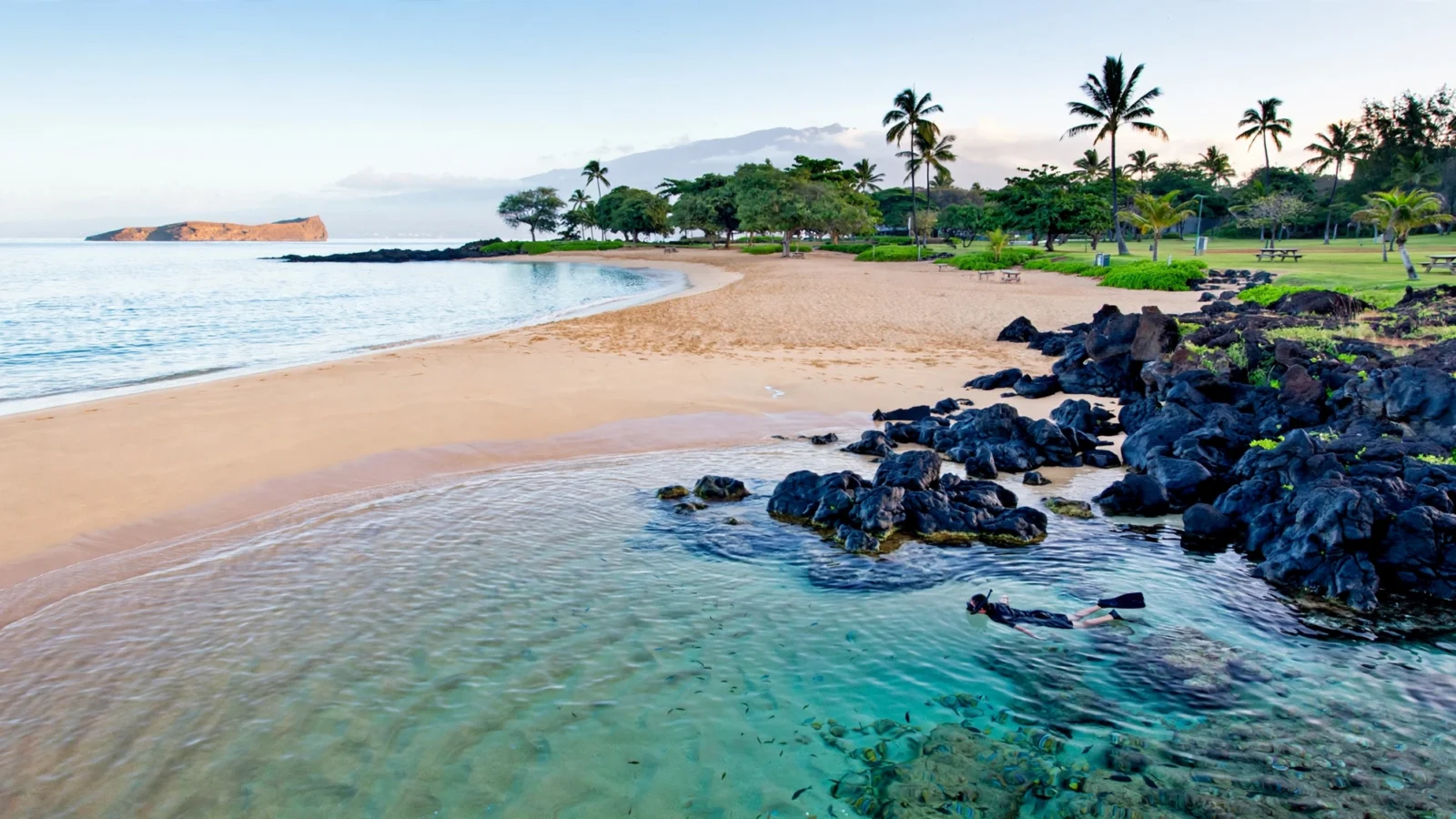
Polo Beach is the snorkel spot Wailea’s resort crowds mostly walk past. At the southern end of the Wailea strip, a pair of golden crescents curve between the Fairmont Kea Lani and the Polo Beach Club condos, and at each end of the sand a dark lava point reaches into the water — and that is where the reef is. Most beachgoers see a pretty, quiet resort beach. Snorkelers who get here early see something better: two rocky points holding coral, turtles and schools of reef fish, a fraction of Wailea Beach’s crowds, and a south point that keeps going, around into Palauea, for anyone who wants the longer swim.
This is a snorkeling-first guide to Polo Beach: which of the two points to swim and why they are not equal, the entry warning hidden in the beach’s own Hawaiian name, when the water is actually snorkelable here — and when the shorebreak and rips say stay out — plus the parking reality, the beach-path walk-in alternative, and how Polo honestly compares with Wailea Beach and Ulua nearby.
Quick facts
| Detail | What to know |
|---|---|
| Where | Polo Beach (Polo Beach Park), southern Wailea, South Maui — between the Fairmont Kea Lani (north) and Polo Beach Club (south) |
| Park hours | 7:00 AM–7:00 PM daily (Maui County listing for Polo Beach Park; park phone (808) 879-4364) |
| Parking | Free public lot off Kaukahi Street — fills early (by about 8:30am on weekends); also walkable via the Wailea Beach Path from Wailea Beach |
| Lifeguard | None — no lifeguard station at Polo Beach; assess conditions yourself |
| Facilities | Restrooms and outdoor showers at the grassy Polo Beach Park, picnic tables, BBQ grills, some shade |
| Cost | Free — public beach access; no reservation. Resort pools, loungers and amenities are for hotel guests only |
| Best conditions | Calm mornings before the trade winds build; the earlier the better |
| Snorkeling style | Two lava points — quieter, better reef at the south point; busier, sandier entry at the north point |
| Watch for | Thin sand over sharp lava near the points, shorebreak and rip currents in swell, afternoon wind and offshore current |
| Name note | Ke One o Polo means “the sand is not thick” — sharp lava lies just under the surface |
Getting there and parking
Polo Beach sits at the south end of Wailea Alanui Drive in Wailea, South Maui. The public access is off Kaukahi Street: follow the signs toward the Fairmont Kea Lani, and the public beach parking lot sits on the mauka (inland) side near the resort entrance, a short walk from the small grassy Polo Beach Park and the sand.
Be honest with yourself about the timing. The public lot is free, and several guides describe parking here as plentiful — but it still fills early, by around 8:30am on weekends according to local guides. That is not really a problem for snorkelers, because Polo’s snorkeling is a morning activity anyway: arrive before 8am and you get both a parking stall and the calm water. Arrive at 11am and you may get neither.
The alternative most visitors miss is the Wailea Beach Path. The paved coastal path runs the length of the Wailea shore, and you can walk south from Wailea Beach to Polo in an easy stroll — which also makes Polo the natural second snorkel of a Wailea morning if you started further north. All Hawaii beaches are public, including the sand in front of the resorts; what is not public is the resorts’ pools, cabanas, loungers and restrooms, which are for registered guests. The public restrooms and showers are at Polo Beach Park by the access point.
How to get to Polo Beach: the turn-by-turn
The beach itself is easy to miss if you only follow the resort signs, so here is the exact route. From Kahului Airport or Kihei, take the Piilani Highway (Route 31) south toward Wailea. Turn left onto Wailea Alanui Drive and drive 0.2 miles, then turn right just past the Fairmont Kea Lani grounds onto Kaukahi Street. Look for the “Polo Beach” parking sign at the bottom of the hill on the right — the public lot sits on the mauka (inland) side near the resort entrance, a short walk from the small grassy Polo Beach Park and the sand. The beach access path starts from the corner of the lot nearest the Kea Lani.
If you are staying up the coast, you do not need the car at all. The paved Wailea Beach Path runs about 1.5 miles along the shore from Wailea Beach, in front of the Marriott, all the way south to Polo Beach — an easy flat walk or jog, and the most pleasant way to arrive if your hotel is on the path. What to type into Google Maps: search for “Polo Beach Park” — the county listing pins it at 20.6754, -156.4434, at the south end of Wailea Alanui Drive.
One timing note carries over from the parking section: the lot fills early, by around 8:30 a.m. on weekends. If you arrive to a full lot, the path walk-in from Wailea Beach is the fallback, not a second lap around the resort streets.
The snorkeling: two points, two different swims
Polo is really two crescents of sand joined in the middle, and the snorkeling lives at the lava peninsulas that frame the ends. The middle of the beach is sand — pleasant swimming on a calm morning, not much to look at underneath. Everything in this section is about choosing your end.
The south point: the quieter, better reef
Walk to the left (south) end of the beach, in front of the Polo Beach Club. The lava point here is the snorkel most locals would pick: quieter than the north end, with a beautiful reef running along the rocks — coral on the lava, turtles working the edges, and schools of tropical fish over the reef flat. Work slowly along the point, staying over the reef rather than pushing out into open water, and let the fish come to you; this reef rewards patience over distance.
The south point is also the start of the longer option. The rocks continue south and connect toward the northern point of Palauea Beach (White Rock), the next beach along the coast. On a flat, clear morning, confident snorkelers extend the swim around into Palauea’s cove — see the extension section below — but treat that as one continuous point swim with no sandy exit in between, not as two casual snorkels joined together.
The north point: sandy entry, busier water
The right (north) end, in front of the Fairmont Kea Lani, has the softest sandy bottom at Polo and its own lava outcrop holding coral and fish — one old Hawaiian name for this beach, Kahamanini, means “place of the surgeon fish”, after the fish found at a rocky outcrop here. The trade-off is people: this end fills with resort guests, cabanas and beach umbrellas, and the water is correspondingly busier. If you are staying at the Kea Lani or snorkeling with kids who need the gentlest entry, the north end is the practical choice. If you came specifically to snorkel, walk south.
The middle: swim, don’t snorkel
Between the points the bottom is sand with the occasional rock. It is fine for a swim and a cool-down float, but do not judge Polo’s snorkeling by the middle of the beach — visitors regularly do exactly that, call the snorkeling “average”, and leave without ever reaching the reef at either end.
How to enter — the warning in the name
Polo Beach’s Hawaiian name is a safety briefing. Ke One o Polo means “the sand is not thick”: a thin layer of sand lies over sharp lava, especially as you move toward the points where the reef is. That one fact shapes the whole entry technique here:
- Enter on the sand, in the middle of each crescent, where the bottom is softest — not by climbing over the rocks at the points.
- Never walk barefoot across exposed lava to reach deeper water. The rock is sharp enough to cut, and waves make it worse. Swim out over the sand, then angle toward the reef once you are floating.
- Time your entry between wave sets. Watch the water for a few minutes first; even on a calm morning a small shorebreak runs at Polo, and in any swell it builds fast (see the safety section).
- Exit the same way you entered, over sand, in a lull. If the shorebreak has built while you were out, stay patient outside the break zone and come in behind a set, not on top of one.
Water shoes are for the sand and the path. On the reef itself, keep your feet up and never stand on coral or rock to adjust your mask — float on your back over sand instead. Our Hawaii snorkeling safety guide covers the full routine.
What you will see
Polo’s points hold the classic South Maui inshore reef community. Green sea turtles (honu) are the headline — they feed and rest around both points and are seen here regularly; give them at least 10 feet (3 metres) at all times, never touch or crowd them, and let them surface and pass on their own terms. Around the coral you will find large schools of tropical fish moving over the reef flat, surgeonfish grazing the rocks (the fish this beach was once named for), and the usual Wailea cast of reef fish working the lava edges and coral heads.
Expect a good, lively inshore reef rather than a vast one. Polo’s reef is compact — two points, not a bay-wide system — and visibility is conditions-dependent: glassy and clear on a calm morning, murky after swell or wind. If you want the biggest reef systems on this coast, that is Ulua Beach and Makena Landing’s reef further south; Polo’s appeal is the combination of a real reef, a quiet beach and a resort-strip location you can walk to.
In winter, watch from the sand between swims: humpback whales pass this coast, and Polo has a clear view across the channel toward Molokini and Kaho’olawe.
Best time to snorkel Polo Beach
Morning is not a preference here, it is the whole game. Polo faces the afternoon trade winds, and the pattern local guides describe is consistent: calm, clear water early; by afternoon the wind builds, waves pick up, and a strong current can develop offshore. The snorkeling, the parking and the quiet all peak before about 9am and decline together.
Season: South Maui’s leeward coast is snorkelable much of the year, but Polo’s exposure shows in swell. When a south swell is running, shorebreak builds on the sand and the points become dangerous — those are beach-walk and sunset days, not snorkel days. Winter brings the whale season and generally bigger surf days mixed in; summer typically offers the longest runs of flat mornings. Either way, the daily call matters more than the seasonal one: check the surf and wind forecast for the Wailea coast before you drive down.
Before you go: if the lot is empty at 9am on a Saturday, that is information, not luck — locals have looked at the water and stayed out. Take the hint. Our best time to snorkel in Hawaii guide explains the seasonal pattern coast by coast.
Safety at Polo Beach
- No lifeguard. There is no lifeguard station at Polo Beach. You make the conditions call, and the honest default on a rough day is not to go.
- Rip currents in swell. Dangerous rip currents are known to form near this beach when the surf is up, and snorkelers near the points can be tossed into the rocks. If waves are breaking over the points, the snorkeling is closed for the day — no exceptions.
- Shorebreak. Even moderate swell turns the sandy entry into a shorebreak. Enter and exit in lulls, and never turn your back on the ocean while standing in the wash zone.
- Afternoon current. Trade winds build through the day and a strong current can develop offshore. Snorkel in the morning, stay along the points rather than out in open water, and always keep energy for the swim back.
- Sharp lava under thin sand. See the entry section — the beach’s name is the warning. Cut feet are the most common Polo injury and the most avoidable.
- Resort crowds at the north end. Snorkel away from swim areas and boat activity, wear something visible, and be predictable in the water.
Is Polo Beach good for beginners and kids?
With the right end and the right morning, yes — with honest limits. The north end’s soft sandy bottom and gentle entry on a flat morning make Polo one of Wailea’s easier first snorkels, and the grassy park, restrooms and showers make it an easy family base. Our beginners’ guide to snorkeling in Hawaii covers the first-snorkel routine.
The limits: there is no lifeguard, the reef sits at the points rather than in the sheltered middle, and the thin-sand-over-lava bottom punishes anyone who tries to walk the reef. Beginners should snorkel the north point on a calm morning, stay close to shore, wear a flotation vest if they are not strong swimmers, and treat the south point and any extension swim as a later trip. On a day with shorebreak, Polo is a picnic beach, not a snorkel beach, for every level.
The Palauea extension: Polo’s south point, continued
Just south of Polo, reachable on foot by a short dirt path through the trees or — on the right morning — by continuing the south-point swim, lies Palauea Beach, known locally as White Rock. It is the anti-resort beach: no facilities, no lifeguards, no parking lot, just a broad sandy cove with lava-rock points at both ends and a fraction of Polo’s people.
As a snorkel extension it works like this: snorkel Polo’s south point first. If the water is flat, clear and current-free, the rocky shore continues south and the reef carries on toward Palauea’s northern point, where coral and fish sit just off the beach. It is a genuinely good swim — and a committing one, with no sandy exit along the rocks between the two beaches. Only strong, experienced snorkelers should link the two, only early, and only on the calmest mornings; everyone else should walk the path and snorkel Palauea from its own sand. If conditions are anything less than calm, Polo’s south point on its own is the whole snorkel, and it is enough.
Polo vs Wailea Beach vs Ulua: which Wailea snorkel?
| Polo Beach | Wailea Beach | Ulua Beach | |
|---|---|---|---|
| Reef | Two lava points; south point the better reef | Rocky ends of a big resort crescent; patchy reef | The fullest reef system of the three, off the south point |
| Entry | Sandy in each crescent; thin sand over sharp lava near points | Sandy, gentle when calm | Sandy entry, then reef close in |
| Crowds | Quietest of the three; resort guests at the north end | Busiest — the classic Wailea resort beach | Popular with snorkelers; busy mid-morning |
| Parking | Free public lot off Kaukahi St — fills early | Public access parking, also competitive | Shares public parking with Mokapu — fills early |
| Best for | A quiet reef snorkel you can walk to on the Wailea path | A classic beach day with some snorkeling at the ends | A dedicated reef snorkel as the main event |
| Guide | This page | Wailea Beach snorkeling guide | Ulua Beach snorkeling guide |
The short version: choose Ulua for the reef itself, Wailea Beach for the beach day, and Polo when you want a real snorkel without the scene — especially if you are already on the Wailea path. And if Polo’s quiet suits you, the next beach north on the path, Keawakapu, is quieter still — our Keawakapu Beach snorkeling guide covers its two reef ends. Snorkeling all three across a morning, point to point, is a legitimate local-style plan for strong snorkelers; see the Maui snorkeling hub for the full coast.
Facilities and what to bring
Polo Beach Park, the small grassy area at the main access, has the public restrooms, outdoor showers, picnic tables and BBQ grills, with some shade — a genuinely pleasant base for a morning snorkel followed by breakfast on the grass. There is no shop, rental stand or food service at the beach itself; the resorts’ restaurants are the nearby option, and their beach amenities remain guests-only.
Bring your own snorkel gear (rentals are in Kihei and at resort activity desks, not at Polo), reef-safe sunscreen, water, and footwear for hot sand and the path. If you are building a full South Maui snorkel day, Polo pairs naturally with Makena Landing and Turtle Town to the south, or the Kihei coast to the north — our Kihei snorkeling guide covers that stretch. Check our snorkel gear checklist before you pack, and our guide to snorkeling with turtles for the wildlife etiquette that applies at every point on this coast.
Polo Beach beyond the snorkel
Polo Beach earns its keep even on a day the water says no. On small-surf mornings the sandy entry and gentle slope make the shore good for swimming and boogie boarding, and the rest of the time it is one of Wailea’s quietest places to simply sit: a wide golden crescent, far fewer people than Wailea Beach, and the Fairmont’s umbrellas at the north end rather than a crowd. The grassy park behind the sand — picnic tables, BBQ grills, restrooms and outdoor showers — makes it a proper beach-day base, not just a snorkel stop.
The walk is the other reason to come. The paved Wailea Beach Path starts here and runs about 1.5 miles north along the coast to Wailea Beach, past the resort fronts — flat, scenic, and the best sunset stroll on this stretch of coast. Photographers rate Polo’s sunset views among the best in South Maui, and in winter you can watch for whales from the sand. On calm mornings the water is also kind to paddleboards. One photographer’s note worth keeping: at high tide, waves can wash right up to the rocks at one end of the beach and cut off the walk along the sand, so check the tide before a sunset visit.
A little history, because the name on the map is newer than the beach. The land here was once part of ‘Ulupalakua Ranch, and local histories say the beach was then known as “Dead Horse Beach” — the name Polo Beach came later, with the Polo Beach Club condos at the south end. The beach’s older Hawaiian name, Ke One o Polo, is explained in the entry section above — it is the name that describes the sand best. The sand itself shifts with the seasons: one recent visitor report from October 2026 mentions noticeable beach erosion after a strong storm about a month earlier, so do not be surprised if the shoreline looks different from older photos. If you are here in the winter months, our Snorkeling in Hawaii in December guide covers which side of each island stays calm — and when the whales are in.
What visitors say: Polo Beach reviews
Review sites rate Polo Beach well for a Wailea beach: TripAdvisor lists it at 4.5 out of 5 from about 327 reviews, where it ranks #8 of 25 things to do in Wailea (ratings checked November 2026; they move as new reviews arrive), and Maui Guidebook gives it 4.5 out of 5. The praise repeats the same three things — the quiet, uncrowded south end, the good snorkeling on calm mornings, and the easy walk-in along the Wailea Beach Path. The complaints repeat too, and they match what this guide says: the north end fills with resort guests, cabanas and lounge chairs; the sand is thin over sharp lava near the points; the lot fills early on sunny weekends; and there is no lifeguard. Read together, the reviews describe exactly the beach this guide describes: a quiet, local-feeling crescent at the south end of resort Wailea, best on a calm weekday morning.
Frequently asked questions
Is Polo Beach good for snorkeling?
Yes — at the lava points, not the middle of the beach. The south point in front of the Polo Beach Club is quieter and has the better reef; the north point by the Fairmont Kea Lani has a sandier entry and its own reef but more people. On a calm morning both hold coral, turtles and schools of reef fish. In swell, neither is snorkelable.
Where is the best snorkeling at Polo Beach?
At the south point. Enter over the sand in the southern crescent, swim out until you are floating, then work slowly along the lava point’s reef. The rocks continue south toward Palauea Beach for strong snorkelers on flat mornings. The middle of the beach is sand and holds very little to see.
Where do you park for Polo Beach?
In the free public beach lot off Kaukahi Street, near the Fairmont Kea Lani entrance. It fills early — by about 8:30am on weekends — so arrive before 8am, which is also when the snorkeling is best. You can also walk in on the Wailea Beach Path from Wailea Beach.
Is there a lifeguard at Polo Beach?
No. There is no lifeguard station at Polo Beach, so conditions assessment is on you: watch the water before entering, avoid the points entirely in swell, and stay out when shorebreak is breaking on the sand.
When is the best time to snorkel Polo Beach?
Early morning, before the trade winds build — ideally in the water before 9am. Afternoons bring wind, waves and a current that can develop offshore. Flat summer mornings are the most reliable; in any season, skip days with a south swell running.
Can beginners snorkel at Polo Beach?
Yes, at the north point on a calm morning: the entry is sandy and gentle, and the reef is close. Beginners should stay near shore, use flotation if they are not strong swimmers, and avoid the points in any surf. The south point and the Palauea extension are for confident snorkelers.
Is Polo Beach public?
Yes. All beaches in Hawaii are public, including the sand fronting the Fairmont Kea Lani and the Polo Beach Club. The public access, parking lot, restrooms and showers are at Polo Beach Park. Resort pools, loungers, cabanas and guest restrooms are private.
How does Polo Beach compare with Wailea Beach for snorkeling?
Polo is quieter and its south point is the better single reef swim; Wailea Beach is the grander resort beach, with patchy reef at its rocky ends and a bigger beach-day scene. They are a short walk apart on the Wailea Beach Path, so on a calm morning many snorkelers do both — Polo first, while the water is at its calmest.
What are Polo Beach Park’s hours?
Polo Beach Park is open 7:00 a.m. to 7:00 p.m. daily, according to the Maui County listing for the park. The park phone is (808) 879-4364. There is no entry fee and no reservation — it is a free public beach park.
Can you walk to Polo Beach from Wailea Beach?
Yes. The paved Wailea Beach Path runs about 1.5 miles along the shore from Wailea Beach, in front of the Marriott, all the way south to Polo Beach. It is flat and easy, and it is the best fallback if the Polo Beach parking lot is full — park up the coast and walk in.
Is Polo Beach the same as Polo Beach Park?
Effectively, yes. Polo Beach is the beach itself — the pair of golden crescents between the Fairmont Kea Lani and the Polo Beach Club. Polo Beach Park is the county park listing for the same place: the small grassy area set back from the sand with the restrooms, outdoor showers, picnic tables, BBQ grills and the public parking lot. When maps and the county site say “Polo Beach Park,” they mean this beach.
A few minutes further south toward Makena, our Po’olenalena Beach snorkeling guide covers the next long, quiet stretch of sand-and-reef coast.