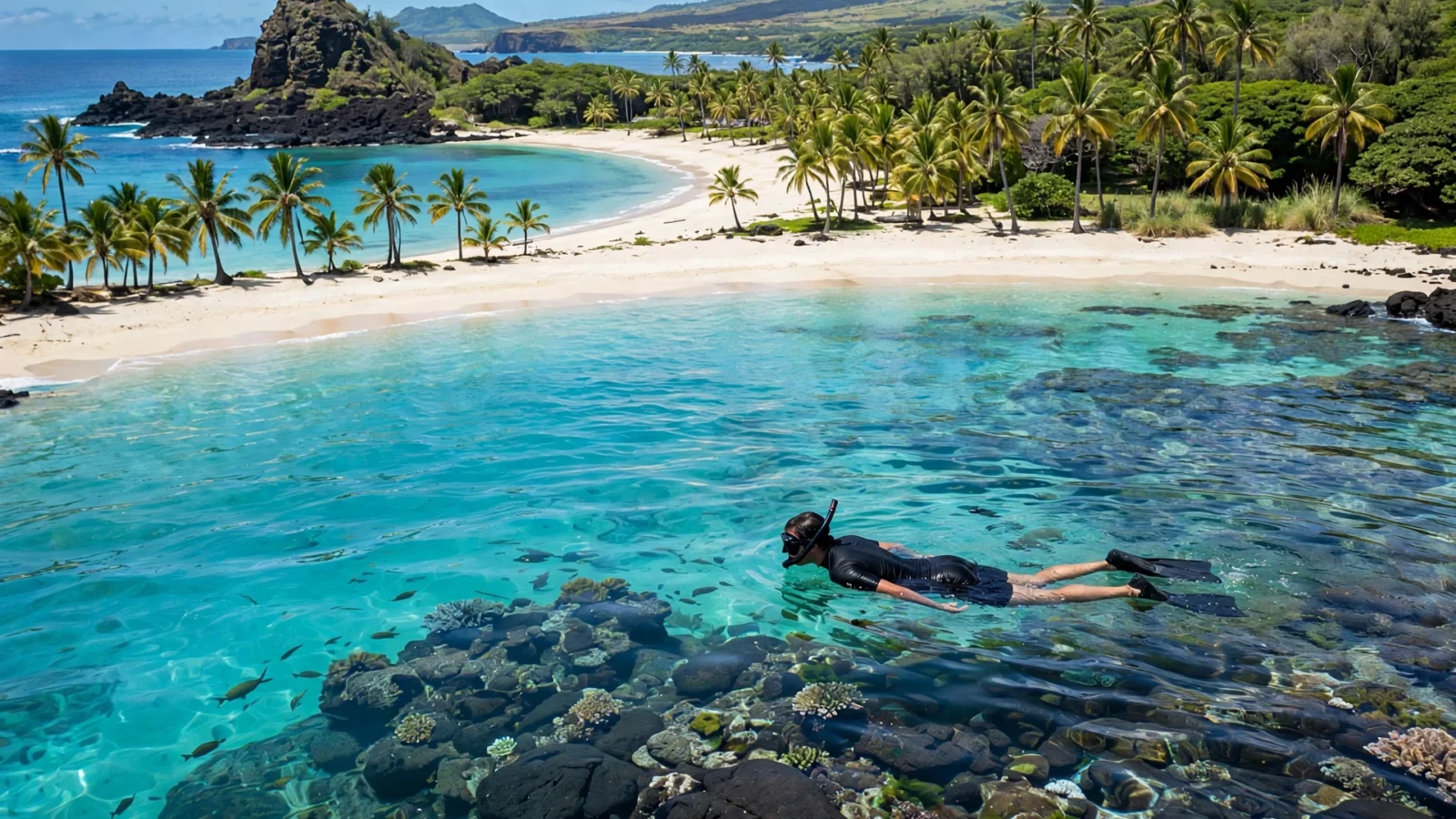
Mauna Kea Beach — Kauna’oa Bay — is the beach other Big Island beaches get compared to: a half-mile crescent of white sand and palms on the Kohala Coast, regularly ranked among the best beaches in America. It is also a genuinely good snorkel spot, with a reef at each end of the bay. But almost nobody visits it by accident. The beach is public, yet it sits in front of the Mauna Kea Beach Hotel, and the only way in is through the resort gate, where a limited number of public parking passes decides whether your snorkel day happens at all.
This guide covers Kauna’oa purely as a snorkeling spot: the south and north reefs compared honestly, exactly how the gate-pass system works (and what to do when the lot is full), the season when you should not get in at all, and who this beach suits — because the snorkeling is real, but so is the planning.
Quick answer: is Mauna Kea Beach good for snorkeling?
Yes — on a calm day, and if you get a parking pass. The snorkeling is at the rocky ends of the bay, not over the sand in the middle: the south end is the easier, more beginner-friendly reef, and the north end rewards a longer swim with more extensive reef. Expect plenty of reef fish and a good chance of turtles, coral in patches rather than gardens, and visibility that drops fast whenever the swell picks up. The beach itself is one of the finest in Hawaii; the snorkeling is a strong second act, not a Kealakekua Bay-class reef. If you want the full honest picture before you drive up the coast, read the reef comparison and the access section below.
Where to snorkel at Kauna’oa: the two ends compared
The middle of the bay is a gently sloping sand flat — lovely for swimming, and where turtles sometimes rest in the shallows, but there is nothing to snorkel over. All of the reef life is at the two rocky ends.
| South end | North end | |
|---|---|---|
| Entry | Sandy entry beside the rocks — the easiest in the bay | Sandy entry, then a swim along the rock wall |
| Reef | Coral patches and fish along the southern rocks | More extensive reef running out toward the point |
| Best for | Beginners, kids, a relaxed first snorkel | Confident swimmers who want the bigger reef |
| Depth | Shallow, mostly wading-to-swimming depth | Deepens toward the point; past it, coral canyons around 20–30 ft |
| Watch for | Other snorkelers — this end gets found first | Currents past the point; stay inside the bay unless experienced |
The south end
The south end is where most snorkeling at Kauna’oa happens, and for good reason: the entry is the easiest in the bay, the water stays shallow, and the rocks hold coral patches with the bay’s most reliable fish life. This is the pick for beginners, for kids who are steady swimmers, and for anyone who wants a short swim rather than an expedition. A small sandy-bottomed cove at this end is also where younger children splash — keep snorkel traffic courteous around it.
The north end
Follow the rock wall on the north side out toward the point and the reef gets more extensive the further you go, with coral formations running into deeper water. Experienced snorkelers rate this the better reef in the bay — but it is a real swim, fins are close to essential, and the water past the point drops into coral canyons in the 20–30 ft range with currents that do not belong in a beginner’s day. The standard local advice applies: stay inside the bay unless you are genuinely comfortable in open water.
An honest word on the coral
Sources disagree about Kauna’oa’s coral, so here is the balanced version: you will find live coral in patches, concentrated at the two ends — some guides describe healthy coral fields at the south end, while dedicated snorkel writers rate the coral as modest and the fish and topography as the real draw. Go for the fish life, the turtles, and the setting, and treat good coral as a bonus rather than the promise.
What you will see
The regular cast at both ends includes yellow tang, raccoon butterflyfish, wrasses (look for the long-snouted bird wrasse), goatfish working the sand edges, and parrotfish around the rocks. Green sea turtles are the bay’s quiet stars — they feed along the reef and are often seen resting in the shallow sandy areas, which is exactly why you give anything turtle-shaped a wide berth: keep at least 10 feet away, never touch or crowd them, and let a resting turtle rest. Occasional rays pass over the sand. For the full etiquette, see our guide to snorkeling with turtles in Hawaii.
Access and parking: the gate-pass system
This is the section that decides your day, so here it is step by step.
- Drive Highway 19 north from Kona or Waikoloa and turn at Mile Marker 68, where the resort name sits on a lava-rock wall. Follow Kaunaoa Drive in.
- Stop at the gatehouse just inside the entrance — do not drive on toward the hotel. Tell the attendant you are here for public beach access and ask for a beach parking pass.
- The hotel sets aside a limited number of stalls for day visitors — most sources put it at around 40. They are first-come, they go early, and on weekends and holidays they can be gone well before mid-morning. Arrive before about 9 am if Kauna’oa is the plan.
- If a stall is free, you get a pass/ticket that opens the barrier at the public lot. From the lot it is roughly a five-minute walk — about 1,100 feet, paved and slightly downhill — to the sand. Restrooms and showers sit on this path just before the beach. Pack light or bring a backpack: everything you carry goes down that hill and back up it.
The beach itself is public — every beach in Hawaii is — and there is no charge to be on the sand. What is rationed is the parking, and the pass system is simply how the rationing works.
When the lot is full: four backup plans
- Wait it out. When a day visitor leaves, a pass frees up. If you are close to the front of the wait and the morning is young, this can work — bring a book.
- Come back around lunchtime. The early crowd starts leaving and stalls open up. The trade-off: afternoon wind often roughens the bay, so a lunchtime arrival is a beach day first and a snorkel second.
- Use the hotel valet. Reported at around $40, with a credit back if you spend at the resort — expensive parking that makes sense only if lunch at the resort was already tempting you.
- Park at Hapuna and walk. Hapuna Beach is about a mile south (a state park, so non-residents pay entry and parking there), and the Ala Kahakai coastal trail runs from Hapuna back up to Kauna’oa in roughly 15–20 minutes on foot. On a calm day this is a genuinely pleasant Plan B.
Best time to snorkel Mauna Kea Beach
Season matters more here than at Kona’s sheltered bays. Kauna’oa faces the open coast, so:
- Summer is the calm season — flat mornings, the clearest water, and the only reliably snorkelable months for the north end.
- Winter brings north and northwest swell, and with it a pounding shorebreak and strong rip currents that can make simply getting in and out of the water dangerous. On a winter swell day, admire this beach from the sand.
- Time of day: mornings, before the trades build. This bay is exposed, so any wind or swell shows up first as reduced visibility, then as surge over the reef.
- There are no lifeguards at Kauna’oa. That single fact should shape every decision above — if the entry looks pushy, it is a no, whatever the calendar says. Our best time to snorkel in Hawaii guide explains the seasonal pattern island by island.
Facilities, food and gear — the non-guest reality
Day visitors get a well-kept beach: the hotel maintains the public restrooms and showers near the beach path, and the setting is manicured in a way no county park matches. Beyond that, be self-sufficient:
- Gear: bring your own. The beach club hands out snorkel sets, boards and kayaks free — to hotel guests, club members and authorised residents only. The nearest paid rental counter is at the resort above Hapuna Beach. If you are building a kit instead, our snorkeling gear checklist covers what is actually worth packing.
- Food: the hotel’s beachfront restaurant sits a few steps off the sand and welcomes diners at resort prices; otherwise, pack food and water. There is no snack bar for the public beach crowd.
- Shade: palms fringe the back of the beach, but the prime shade is contested — arrive with a hat and reef-safe sunscreen regardless.
Mauna Kea vs Hapuna vs Waikoloa (A-Bay): which Kohala snorkel?
| Mauna Kea (Kauna’oa) | Hapuna | Waikoloa (A-Bay) | |
|---|---|---|---|
| Snorkeling | Good at both ends; fish + turtles; coral in patches | Decent at the two rocky points when calm | Modest; murky lagoon, reef a long swim out |
| Access | Free pass, but ~40 stalls — arrive early or miss out | State park: $5 entry + $10 parking for visitors, big lot | Free entry, free public lot, easiest of the three |
| Lifeguards | None | Yes | None |
| Best for | A premium beach day with a real snorkel attached | Families who want lifeguards + a big beach | Convenience: facilities, rentals on the sand, calm shallows |
Our dedicated guides go deeper on Hapuna Beach snorkeling and Waikoloa Beach snorkeling. And if snorkeling — not the beach — is the whole point of a Kohala day, the honest answer is that the island’s best reefs are south: Two Step and Kahalu’u Beach Park beat all three. See the full Big Island snorkeling hub for the ranked picture.
After dark: the manta question
Kauna’oa has a famous night trick: the hotel shines lights onto the water, plankton gathers in the beams, and manta rays come in to feed. There is a lookout — Manta Ray Point — but access to it is limited to resort guests and people dining that evening at the resort’s Manta restaurant. Day visitors should not roll up after dark expecting a spot on the rail: book the dinner, or better, book the in-water version — our manta ray night snorkel guide covers the Kona sites where you float above the rays instead of watching from shore.
Safety summary
- No lifeguards — self-assessment is the whole safety system.
- Winter swell = shorebreak + rip currents; when in doubt, stay out.
- Stay inside the bay; currents past either point are for the experienced only.
- Fins recommended for the north end; never stand on coral; keep 10 ft from turtles.
- The walk back to the lot is uphill in the sun — save water and energy for it.
- New to this? Start with our beginners’ snorkeling guide and the Hawaii snorkeling safety guide before a no-lifeguard beach.
FAQ
Can anyone go to Mauna Kea Beach, or is it hotel guests only?
Anyone. The beach is public, like every beach in Hawaii. What is limited is parking: day visitors stop at the resort gatehouse and receive a public beach parking pass while stalls last.
How many public parking passes are there at Mauna Kea Beach?
The hotel holds a limited number of stalls for day visitors — most sources say around 40. They are first-come, first-served, and they fill early, especially on weekends and holidays.
Is there a fee for the Mauna Kea Beach public pass?
The beach itself is free, and the public pass is issued at the gatehouse while stalls are available. The realistic cost of this beach is not money but timing — arrive early. Paid fallbacks exist (resort valet, or Hapuna’s state-park fees if you walk the coastal trail in).
What do I do if the Mauna Kea parking lot is full?
Wait for a departing visitor to free a pass, return around lunchtime when stalls open up, use the hotel valet, or park at Hapuna Beach and walk the Ala Kahakai coastal trail (about 15–20 minutes) to Kauna’oa.
Which end of Mauna Kea Beach is better for snorkeling?
The south end for most people — easier entry, shallower water, reliable fish and coral patches. The north end has the more extensive reef but needs a longer swim along the rock wall, and the deep water past the point is for experienced snorkelers only.
Is Mauna Kea Beach good for beginner snorkelers?
On a calm summer morning, the south end is a reasonable beginner snorkel — with two caveats: there are no lifeguards, and winter or swell days are a hard no. Beginners who want lifeguards and easier conditions should start at Hapuna or Kahalu’u instead.
Can I rent snorkel gear at Mauna Kea Beach?
Not as a day visitor. The beach club’s free gear is for hotel guests, members and authorised residents. Bring your own, or rent at the counter by Hapuna Beach before you come.
Are there lifeguards at Mauna Kea Beach?
No. There is no lifeguard at Kauna’oa. Swim and snorkel conservatively, never alone, and treat winter shorebreak and rip currents as a reason to stay on the sand.