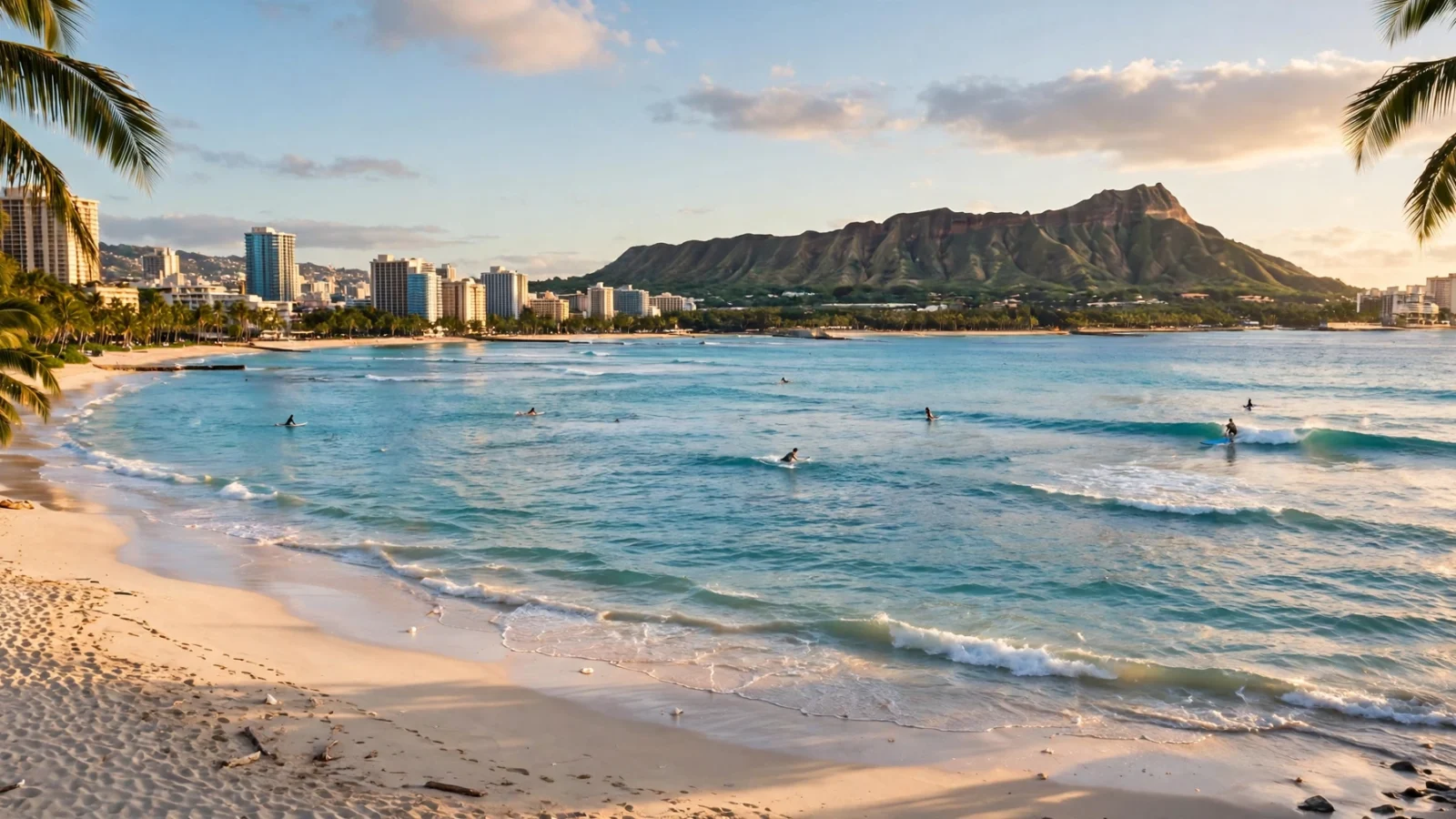
Waikiki is the two-mile stretch of sand where most first trips to Hawaii begin — a walkable beach neighborhood in Honolulu, on Oahu’s sunny south shore, with Diamond Head anchoring one end and a wall of hotels along Kalakaua Avenue. You can learn to surf in the morning, hike a volcanic crater before lunch, snorkel with turtles in the afternoon, and watch a free hula show as the sun goes down, all without getting in a car.
This guide covers the best things to do in Waikiki, in the order that makes sense for a first trip, with the practical detail other lists skip: what it costs, whether you need a reservation, and the best time to go. Where snorkeling is involved, we go deeper than the listicles — the reef locations, entry points and conditions — because that is what this site is for. For the full snorkeling map, see our Waikiki snorkeling guide.
If Waikiki is your base for the whole island, pair this guide with our things to do in Oahu guide and the best things to do in Hawaii hub.
Things to do in Waikiki at a glance
| If you want… | Do this first |
|---|---|
| The single best morning | Surf lesson at Canoes, then snorkel Queen’s Beach |
| The classic photo | Diamond Head summit at sunrise |
| The best free evening | Kuhio Beach Hula Show, Saturday 6:30 p.m. |
| The best family day | Duke Kahanamoku Lagoon, Waikiki Aquarium, Honolulu Zoo |
| The best sunset | Sunset catamaran sail, or the Friday fireworks from the sand |
| The best food crawl | Poke at Sato Seafood, malasadas at Leonard’s, mai tai at the Royal Hawaiian |
| The best day trip | Hanauma Bay (book ahead) or Pearl Harbor (full morning) |
1. Snorkel Waikiki Beach — the reef is better than the listicles say
Waikiki is not just a swimming beach. The reef off Queen’s Beach, at the Diamond Head end, and Sans Souci Beach, past the Waikiki Aquarium, holds real snorkeling — reef fish, the occasional turtle, and on calm mornings visibility that surprises first-timers. The catch is that the good water is not in front of the big hotels in the middle of the beach, where the sand is churned up. Walk to the ends.
Queen’s Beach is the best shore snorkeling in Waikiki: enter at the far Diamond Head end, swim out past the surf break, and work along the reef edge. Sans Souci is the best for beginners and kids — shallow, sheltered, and calm on most mornings. For the full map, entry points, depths and conditions, read our Waikiki snorkeling guide. Go early: the water is calmest and clearest before the afternoon trade winds pick up, and the beach is far less crowded.
2. Learn to surf where modern surfing was born
Waikiki is the birthplace of modern surfing, and the long, slow rolling waves at Canoes, Queens and Populars are the easiest place on earth for a first lesson. Instructors have been teaching beginners on this beach for decades, and the waves are gentle enough that most people stand up on their first session.
Group lessons run about 90 minutes to two hours and cost roughly $89–$100 per person as of late 2026, board included. Book for your first or second morning — the waves are smallest and the beach is quietest early, and you will want the rest of the day free once you are hooked. If you would rather watch first, the surf break between the Royal Hawaiian and the Moana Surfrider is the classic place to sit on the sand and see how it works.
3. Hike Diamond Head at sunrise
Diamond Head is the volcanic crater at the eastern end of Waikiki, and the 0.8-mile trail to its summit is the single most popular hike on Oahu. It takes about 30 minutes up — all uphill, with a long staircase at the end — and the payoff is a 360-degree view over Waikiki’s curved coastline, Honolulu, and the Pacific running to the horizon. Allow about 90 minutes round trip.
Book ahead: non-residents need a timed reservation, released up to 30 days in advance, in two-hour windows starting at 6 a.m., and you are expected to arrive within the first 30 minutes of your slot. Entry is $5 per person plus $10 per vehicle as of late 2026; Hawaii residents with ID enter free. Go at the first slot of the day — sunrise from the summit is the best light, and the trail gets hot and crowded by late morning. Bring water; there is no shade on the crater rim.
4. Swim the calm lagoon at Duke Kahanamoku Beach
Fronting the Hilton Hawaiian Village at the western end of Waikiki, Duke Kahanamoku Beach has the calmest water in the neighborhood — a protected lagoon that is perfect for families with young children, paddleboarding, and an easy swim. It is also the best place to watch the Friday night fireworks, which go off right behind the hotel.
Named after Hawaii’s legendary surfer, the beach is wide, sandy, and far less crowded than the hotel strip in the middle of Waikiki. The lagoon is the easiest place in Waikiki to try a paddleboard or kayak, and the shallow, clear water makes it a good first swim for kids who are not ready for the open ocean.
5. Watch the free hula show at Kuhio Beach
The Kuhio Beach Hula Show is the best free thing to do in Waikiki, and it is also the most authentically Hawaiian. Real hula halau (dance troupes) from around the island perform on the grass mound near the Duke Kahanamoku statue on Saturday evenings, 6:30–7:30 p.m., weather permitting. There are no tickets and no cost — just show up, sit on the grass, and watch.
Come early for a good spot, and stay after the show for the evening walk along the beach. If you miss Saturday, the International Marketplace hosts free hula and music on Monday, Wednesday and Friday evenings at 6 p.m., and Ala Moana Center runs a daily hula show at 5 p.m.
6. Watch the Friday fireworks from the sand
Every Friday night, the Hilton Hawaiian Village sets off a fireworks show over the water at 7:45 p.m. It lasts only about four minutes, but it is free, and the whole beach turns out for it. The best viewing is from the sand between Fort DeRussy Beach Park and Duke Kahanamoku Beach, or from a catamaran offshore if you want to be under the show instead of behind the crowd.
Arrive by 7 p.m. for a spot on the sand, and bring a towel — the beach fills up fast on Friday evenings. The show runs year-round, weather permitting.
7. Take a sunset catamaran sail
The sunset sail is the standout Waikiki experience for couples, and one of the best ways to see the coastline. Catamarans load right off Waikiki Beach and sail out for about 90 minutes as the sun drops, with Diamond Head going sharp against an orange sky. Most boats include two drinks and pupus (appetizers). Book the 5:30 p.m. departure for the best sunset views. Prices run roughly $47–$65 per person as of late 2026 for a 90-minute sail; two-hour sails with food included run a little more.
8. Ride an outrigger canoe with the Waikiki Beach Boys
The outrigger canoe ride is the oldest Waikiki tradition still running — the Beach Boys have been taking visitors out on the same canoes for generations. The ride is short, usually 15–20 minutes, and it catches a wave back to shore, so you get a small taste of surfing without standing up. Book on the beach in front of the Royal Hawaiian and Moana Surfrider hotels; rides run throughout the day when the surf is up.
9. Snorkel with turtles at Turtle Canyon
Turtle Canyon is the reef just off Waikiki where green sea turtles gather at a cleaning station, and it is the one Waikiki snorkel that is best done by boat — the reef sits too far out for a comfortable shore swim. Tour boats from Waikiki Beach run morning trips to the canyon, and on a good day you will see several turtles along with reef fish.
For the shore alternative, and the honest comparison of boat vs. shore entry, see our Turtle Canyon snorkeling guide. Book the earliest trip of the day: the water is calmest in the morning, and the turtles are most active before the afternoon boats arrive.
10. Spend a morning at the Waikiki Aquarium and Kapiolani Park
The Waikiki Aquarium, run by the University of Hawaii, is one of the most underrated family stops in the neighborhood. It is small, walkable, air-conditioned, and entirely focused on Hawaiian and Pacific marine life — reef sharks, Hawaiian monk seals, and rare coral species in outdoor exhibits lit by natural light. It sits at the Diamond Head end of Waikiki, right next to Kapiolani Park, which makes the two a natural pair: do the aquarium first, then a picnic or a morning walk in the park, with Diamond Head as the backdrop.
11. Visit the Honolulu Zoo
The Honolulu Zoo sits inside Kapiolani Park at 151 Kapahulu Avenue, two blocks from the sand, and it is a solid half-day for kids of any age. It is the only zoo within a 2,383-mile radius, and it is open daily from 10 a.m. to 4 p.m. — no reservation needed. Pair it with the aquarium next door and Kapiolani Park, and you have a full family morning without leaving the neighborhood.
12. Walk Kalakaua Avenue and shop the strip
Kalakaua Avenue is Waikiki’s main drag, and walking it is an activity in itself — high-end shops, local boutiques, street performers, and the constant hum of the neighborhood. The Royal Hawaiian Center, in the heart of Waikiki, is the place for Hawaiian-made goods and free cultural programs. The International Marketplace, rebuilt as an open-air center, hosts free hula and live music in the evenings.
For serious shopping, the Ala Moana Center — a short walk west of Waikiki — is the largest open-air mall in the Pacific Islands, with designer shops, galleries, specialty vendors, and the largest food court on Oahu. It is also where the daily 5 p.m. hula show happens.
13. Eat your way through Waikiki
Waikiki’s food scene is the part most guides rush past, and it is worth a day of its own. Start with fresh poke at Sato Seafood, a local favorite for poke bowls. Get malasadas — Portuguese-style fried dough, hot and sugared — from Leonard’s Bakery, a short drive from the beach. Cool off with an acai bowl at Tropical Tribe. And finish with a mai tai at the Mai Tai Bar of the Royal Hawaiian Hotel, or sunset mai tais at House Without a Key in the Halekulani Hotel, at the quiet, older end of Waikiki, where live Hawaiian music plays nightly.
For a sit-down splurge, Duke’s Waikiki — named after Duke Kahanamoku — is the classic beachfront dinner, and the Moana Surfrider’s Veranda is the place for afternoon tea. If you want the local experience rather than the hotel one, walk a few blocks inland from the beach: the food trucks and hole-in-the-wall spots off Kalakaua are where Honolulu eats.
14. Go to a luau
A luau sounds touristy right up until you are actually there — at which point most people are glad they went. General seating typically starts around $100 per person as of late 2026, and the evening runs several hours: the imu (underground oven) ceremony, hula and fire-knife dancing, a buffet, and an open bar at most venues. Book at least a few days ahead; the popular luaus sell out, especially on weekends. If you are staying in Waikiki, the beachfront luaus mean you do not need a car.
15. Catch live Hawaiian music — free, most nights
Waikiki has more free live music than anywhere else in Hawaii. The Kani Ka Pila Grille at the Outrigger Reef Waikiki Beach Resort hosts live Hawaiian music nightly from 6–9 p.m., and the legendary Henry Kapono performs from 4–6 p.m. on the beach-level Barefoot Bar stage. The International Marketplace runs free hula and music on Monday, Wednesday and Friday at 6 p.m. None of it needs a ticket — just show up, order a drink, and listen.
16. Day trip: snorkel Hanauma Bay (book ahead)
Hanauma Bay is the best beginner snorkeling on Oahu — a protected marine bay 20 minutes east of Waikiki — and it is the day trip most Waikiki visitors get wrong, because they do not book ahead. Non-residents need an advance reservation, and the bay sells out, especially on weekends. The bay is closed on Mondays and Tuesdays to let the reef rest, and is open 6:45 a.m.–4 p.m. otherwise, with last entry at 1:30 p.m.
Go on a weekday morning if you can: the water is calmest, the reef is least crowded, and the light is best for snorkeling. Check the current entry fee and reservation rules when you book — they change — and read the reservation details in our things to do in Oahu guide before you plan around it.
17. Day trip: Pearl Harbor — give it a full morning
Pearl Harbor is a 30-minute drive from Waikiki, and it deserves a full morning. The USS Arizona Memorial visit itself is free, but it requires a reserved ticket through recreation.gov (a $1 booking fee). Reserve as early as you can — the memorial slots go first, and the rest of the site (the USS Missouri, the Aviation Museum, the submarine Bowfin) fills the morning after it. The Aviation Museum’s Top of the Tower tour, which takes you up an original air traffic control tower, is the add-on worth paying for.
18. Day trip: hike Manoa Falls and visit Lyon Arboretum
If Diamond Head is the postcard hike, Manoa Falls is the rainforest one. The trail runs through a lush valley to a 150-foot waterfall, and the Lyon Arboretum next door is a quiet botanical garden most visitors never find. It is a 20-minute drive from Waikiki, it rains often in the valley — bring a light rain jacket — and it is the best half-day escape from the beach crowds.
19. See a show: Cirque du Soleil ‘Auana
Hawaii’s first Cirque du Soleil residency, ‘Auana, plays at the Outrigger Waikiki Beachcomber Hotel’s theatre, almost opposite the Moana Surfrider, and is scheduled to run through 2027. It is the one big-ticket evening show in Waikiki, and it books up on weekends — reserve ahead if you want a Saturday seat.
Free things to do in Waikiki
Waikiki can be done cheaply if you know where the free things are. The beach itself is free, always. The Saturday Kuhio Beach Hula Show (6:30 p.m.) and the Friday fireworks (7:45 p.m.) are both free from the sand. Kapiolani Park, the Duke Kahanamoku statue, the walk along Kalakaua Avenue, the free hula at the International Marketplace, the daily 5 p.m. hula show at Ala Moana Center, and the live music at Kani Ka Pila Grille all cost nothing. The Aloha Stadium Swap Meet, a short drive away, is the cheapest souvenir shopping on the island.
Things to do in Waikiki with kids
Waikiki is one of the easiest Hawaii bases for families because everything is walkable. The calm lagoon at Duke Kahanamoku Beach is the safest swim for young children. The Waikiki Aquarium and the Honolulu Zoo are both small enough for a half-day each and sit next to each other in Kapiolani Park. The Kuhio Beach Hula Show and the Friday fireworks are free evening entertainment that kids actually enjoy. For snorkeling with kids, Sans Souci Beach is the calmest entry — see our Waikiki snorkeling guide for the entry point and conditions. And if the kids need a break from the beach, the Children’s Discovery Center downtown is built for them.
Things to do in Waikiki at night
Waikiki after dark is a different neighborhood. The two free shows anchor the weekend: fireworks on Friday, hula on Saturday. Any night, take a sunset sail, walk Kalakaua Avenue, or head to the bars on Lewers Street and Kuhio Avenue — Blue Note Hawaii is the live-music room, and House Without a Key is the old-Hawaii cocktail spot. For something completely different, the Atlantis submarine runs night dives, and the Friday fireworks catamaran puts you under the show. Waikiki is safe to walk at night along the beachfront and Kalakaua, but stay on the lit main streets after midnight.
A 1-day Waikiki itinerary (first trip)
- 7:00 a.m. — Surf lesson at Canoes, or an early snorkel at Queen’s Beach while the water is calm.
- 9:30 a.m. — Breakfast and a walk down Kalakaua Avenue.
- 11:00 a.m. — Diamond Head hike (booked for the first slot) or the Waikiki Aquarium and Kapiolani Park.
- 2:00 p.m. — Beach time at Duke Kahanamoku Lagoon, paddleboard or kayak.
- 5:30 p.m. — Sunset catamaran sail, or mai tais at House Without a Key.
- 6:30 p.m. — Saturday: Kuhio Beach Hula Show. Friday: fireworks at 7:45 p.m.
- 8:00 p.m. — Dinner at Duke’s, then a walk along the beachfront.
Best time to visit Waikiki
Waikiki is good year-round — the south shore stays warm and the water is swimmable in every month. For snorkeling, summer (May–September) brings the calmest water and the best visibility; winter (December–February) brings bigger surf on the south shore and the best waves for watching surfers, but rougher snorkeling conditions. For crowds and prices, the sweet spots are late spring (April–May) and fall (September–October), between the winter holiday peak and the summer rush. Whatever month you pick, book Diamond Head, Hanauma Bay and Pearl Harbor before you leave home — all three sell out.
Frequently asked questions
What is the best thing to do in Waikiki?
If you only do one thing, learn to surf at Waikiki Beach — it is the birthplace of modern surfing, the waves are gentle, and the lesson is the experience you will remember. If you only do one free thing, watch the Saturday Kuhio Beach Hula Show. And if you only hike once, make it Diamond Head at sunrise.
What can I do in Waikiki for free?
The beach itself, the Saturday Kuhio Beach Hula Show (6:30 p.m.), the Friday fireworks (7:45 p.m.), Kapiolani Park, the Duke Kahanamoku statue, the walk along Kalakaua Avenue, free hula at the International Marketplace, the daily 5 p.m. hula show at Ala Moana Center, and the live music at Kani Ka Pila Grille.
How many days do I need in Waikiki?
Three to five days gives you enough time to explore the beaches, hike Diamond Head, enjoy the food, and take a day trip or two — Hanauma Bay and Pearl Harbor each take a half-day to a full morning. A single day covers the beach, one hike, and one evening show if you plan it tightly.
Do I need reservations for things in Waikiki?
Yes, for the three big ones: Diamond Head (timed entry, 30 days out), Hanauma Bay (advance reservation for non-residents, closed Mon–Tue), and the USS Arizona Memorial at Pearl Harbor (recreation.gov). Surf lessons, luaus, sunset sails and the Cirque du Soleil show should also be booked ahead, especially on weekends.
What is there to do in Waikiki with kids?
Duke Kahanamoku Lagoon for calm swimming, the Waikiki Aquarium and Honolulu Zoo in Kapiolani Park, Sans Souci Beach for beginner snorkeling, the free hula show and Friday fireworks in the evening, and a surf lesson for older kids. Everything is walkable, which is half the battle with children.
What is there to do in Waikiki at night?
The Friday fireworks and Saturday hula show are free. Beyond that: a sunset catamaran sail, mai tais at House Without a Key, live music at Blue Note Hawaii or Kani Ka Pila Grille, the bars on Lewers Street, and the Cirque du Soleil ‘Auana show. The beachfront and Kalakaua Avenue stay lively and walkable well into the evening.
Is Waikiki good for snorkeling?
Yes, if you go to the right spots. Queen’s Beach (Diamond Head end) has the best reef snorkeling in Waikiki, and Sans Souci Beach is the best for beginners and kids. The middle of the beach in front of the hotels is not good snorkeling. Go in the morning for the calmest, clearest water. Our Waikiki snorkeling guide has the full map, entry points and conditions.
The bottom line
Waikiki works as a base because everything is close together: a world-class beach, the easiest surf lessons in Hawaii, a volcanic crater hike, free hula and fireworks, and enough food and music to fill a week — all walkable from your hotel. The mistake is treating it as just a beach. Book the three reservations (Diamond Head, Hanauma Bay, Pearl Harbor) before you fly, do the water in the morning, and save the evenings for the free shows.
For the rest of the island, see our things to do in Oahu guide, the best beaches in Oahu (snorkeling-angled), and the best things to do in Hawaii hub. And for the snorkeling detail — the reef, the entry points, the conditions — start with our Waikiki snorkeling guide and the Turtle Canyon guide.