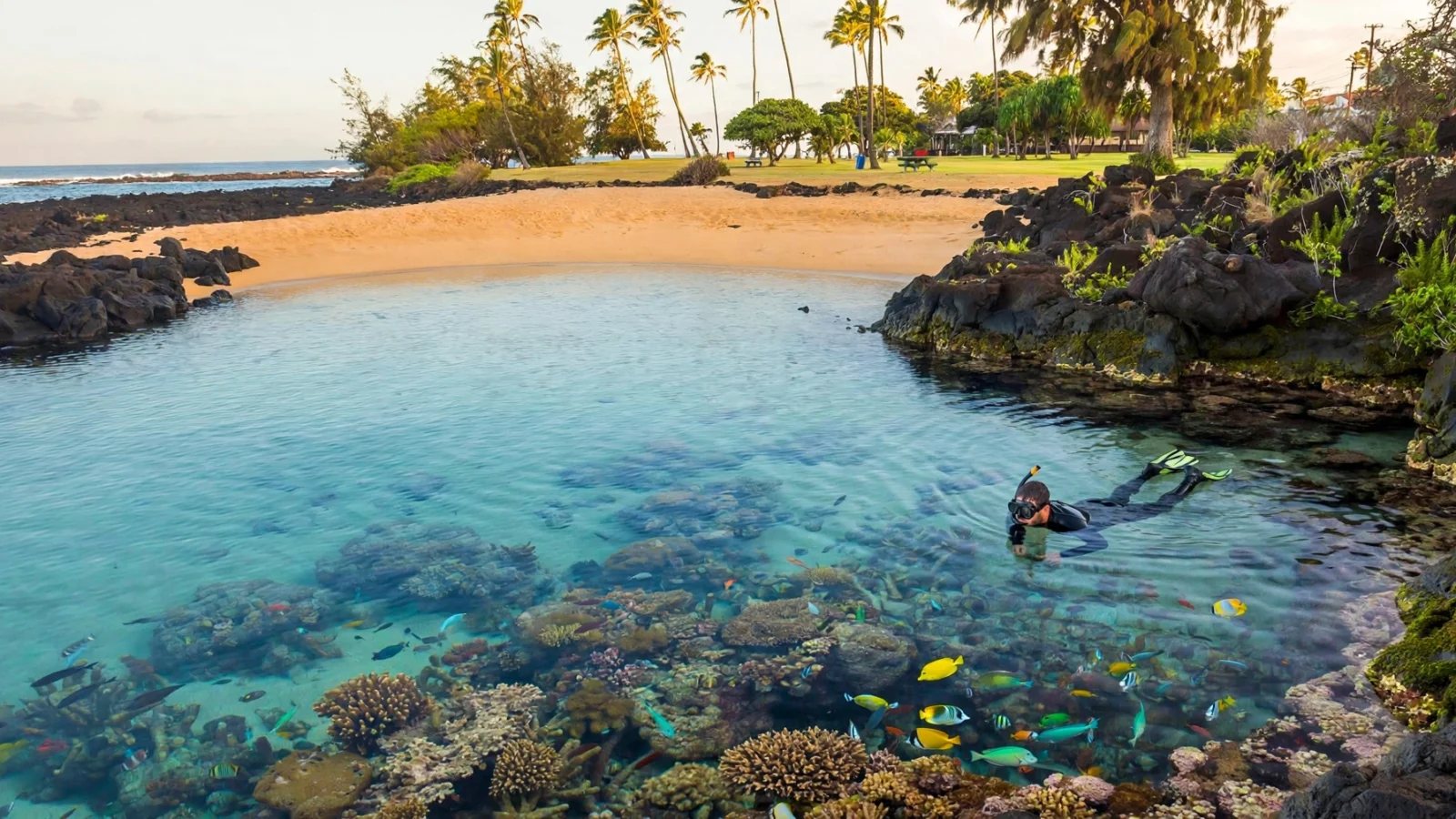
Short answer: Brennecke’s Beach is Poipu’s bodyboarding beach first and a snorkel spot second — and the snorkeling only works on the beach’s own terms. The reef sits along the rocky east side of this small crescent cove, and it is snorkelable only on flat, calm mornings, which on Kauai’s south shore usually means winter, not summer. Summer south swell turns the cove into a shorebreak with a real injury history, and on those days the correct snorkel is the one at Poipu Beach Park, a few minutes’ walk west. For a strong, confident swimmer who catches a glassy winter morning, though, Brennecke’s offers a quiet, uncrowded reef with turtles — without the Poipu crowds. This guide explains exactly when to go, where the reef is, and when to walk away.
Brennecke’s sits at the far eastern end of Poipu Beach Park, off Hoone Road in Poipu. It is so small that most visitors walk past it on their way to the main beach — a narrow crescent of golden sand pinched between two lava rock points, facing straight into the south swell. Locals know it as one of Hawaii’s classic bodysurfing and bodyboarding waves: short, powerful, barrel-shaped shorebreak that has hosted generations of Kauai riders. Almost everything written about Brennecke’s online is written for them. This guide is written for snorkelers — honestly, because at this beach honesty is the whole product. If you want the full picture of the area first, start with our Kauai snorkeling guide.
Brennecke’s Beach snorkeling at a glance
| Brennecke’s Beach | |
|---|---|
| Best for | Strong, confident swimmers on flat calm mornings; an uncrowded alternative to Poipu |
| What it is | Small crescent cove at the east end of Poipu Beach Park; reef along the rocky east side |
| Snorkel season | Roughly October to April, calm mornings only — summer south swell closes it down |
| Entry | Sandy centre of the cove, only when the shorebreak is flat; never beside the rock points in surf |
| Headline life | Yellow and convict tangs, triggerfish, butterflyfish, green sea turtles |
| Facilities | Restrooms, showers and picnic tables at Poipu Beach Park, a short walk west |
| Lifeguard | None stationed at Brennecke’s itself — the nearest tower is at Poipu Beach Park and the cove is out of its direct line of sight |
| Watch out for | Shorebreak with a neck-and-spinal injury history, a rip current through the narrow middle of the cove, rock points in any surf |
The season inversion: why winter is snorkel season here
Most of Hawaii snorkeling runs on a simple rule: north shores are for summer, and winter belongs to the big-wave surf season. Brennecke’s runs the same logic in mirror image. It faces south, so its enemy is the summer south swell — the long-period energy that rolls in roughly from May through September and detonates on this shallow cove as heavy shorebreak. Local and visitor guides agree: swimming and snorkeling at Brennecke’s in summer are simply too dangerous, and the beach belongs to experienced bodyboarders who know exactly what that shorebreak does.
Winter flips it. While Kauai’s north shore is taking the big winter swells, the south shore often goes calm — on still mornings, regulars describe Brennecke’s as almost lake-like, especially early in the day before any breeze or local windswell stands up. That is the snorkel window: roughly October through April, on mornings when the surf report is flat and the cove itself looks like a pond. Treat both halves of that sentence as binding. Winter does not make Brennecke’s safe; flat conditions make Brennecke’s snorkelable, and flat conditions happen to be a winter pattern here. A winter Kona storm or an out-of-season south swell closes the beach just as completely as July does. Our best time to snorkel in Hawaii guide explains the swell seasons island by island if you are planning around them.
Where the reef is — and where it is not
The middle of the cove is a sandy, mostly rock-free bowl. That is the bodyboarding zone, and it is not the snorkel zone: there is little structure on the sand, little life beyond the occasional cruising fish, and the narrow middle of the cove is exactly where the rip current runs when any surf is moving water in and looking for a way out.
The reef is on the sides — principally along the rocky east side of the cove, where the lava rock point shelves into the water and coral, algae and reef fish take over from the sand. On a flat morning, work slowly along that rocky edge in the shallows, staying parallel to shore and well inside the point. The fish list reported by snorkelers here is the classic south-Kauai reef cast: yellow tangs and convict tangs grazing the rock, triggerfish and butterflyfish in the structure, and green sea turtles cruising through or feeding along the reef. Turtles also haul out to rest on the sand at Poipu and Brennecke’s, often in the evening — admire them from at least 10 feet away, never touch or crowd them, and give monk seals even more room (50 feet is the standard guidance). Our guide to snorkeling with turtles in Hawaii covers the etiquette and the law in full.
What Brennecke’s is not: a coral garden. The reef here is a rocky-edge reef, patchy and surf-swept, with visibility that swings with conditions — genuinely pretty on a still, clear morning, and murky after swell or rain. If a dense, sheltered reef is what you came to Kauai for, the south shore has better addresses, starting with Lawai Beach and the entry at Koloa Landing, both a short drive west. Brennecke’s reward is different: a real reef with almost nobody on it, steps from one of the most crowded beaches in Hawaii.
The go / no-go checklist
Because this beach changes character completely with the swell, decide from the sand, every time, before any gear comes out of the bag:
- Surf report first. Any south swell of consequence forecast or running = no-go. You want a flat or near-flat south shore.
- Watch the cove for ten minutes. If sets are breaking as shorebreak in the middle of the cove — dumping waves that fold straight onto the sand — it is a no-go, even if the water between sets looks calm. Shorebreak arrives in sets with lulls that lie to you.
- Morning only. The calm window is early. Afternoon breeze and local chop end it, and summer afternoons add the swell on top.
- Water clarity check. Brown or milky water after rain means runoff and poor visibility — skip it; the reef will still be there tomorrow.
- Honest swim check. This is a strong-swimmer snorkel. You should be able to swim comfortably in the ocean without a flotation aid, handle a fin-powered exit through small moving water, and stay calm if a rip takes hold. If that is not you, snorkel Poipu Beach instead — it is genuinely good, lifeguarded, and five minutes away. There is no version of Brennecke’s that is a beginner beach; our Hawaii snorkeling guide for beginners lists the beaches that actually are.
Entry, exit, and the two hazards that matter
Enter at the sandy centre of the cove, on a flat morning, walking in slowly and getting horizontal and finning as soon as the water is deep enough — then angle across to the rocky east side and snorkel the edge. Fins are not optional here: every local account of snorkeling Brennecke’s makes the same point, because you need real propulsion in reserve if the conditions shift. Keep the whole snorkel in the shallows along the rock, and stay out of the surf zone at the points entirely — in any swell, the rocky coastline on both sides is where waves pound hardest and where a snorkeler has no business being.
The two hazards to respect are the shorebreak and the rip. The shorebreak is the beach’s fame and its injury record: this cove has seen numerous neck and spinal injuries, mostly among bodyboarders and bodysurfers riding waves that dump onto shallow sand — but the same mechanics are why you never stand in the impact zone, never turn your back on the water while entering or leaving, and never let children play at the waterline here when surf is up. The rip runs through the narrow middle: if you feel it, do not fight it — float, signal, and swim parallel to shore out of the current before coming in, the standard drill in our Hawaii snorkeling safety guide. Exit the way you came in, at the sandy centre, timing any small lull — and if the exit looks worse than the entry did, move west along the shore toward Poipu Beach Park rather than forcing the cove.
Parking, access, and facilities
Brennecke’s fronts Hoone Road, a couple of blocks east of the main Poipu Beach Park entrance (take Poipu Road to Hoowili Road for the park). There is no entry fee and no reservation. Roadside parking on Hoone Road is extremely limited and rarely available — the working plan is the free public lot at Poipu Beach Park, then a short walk east along Hoone Road or through the park’s grassy area to the cove. Restrooms, outdoor showers and picnic tables are at Poipu Beach Park, a few minutes’ walk west; there are no facilities on Brennecke’s sand itself. Brennecke’s Beach Broiler, the long-running restaurant across Hoone Road, is the obvious post-snorkel lunch. On snorkel mornings, arrive early anyway: the calm window is a morning window, and the park fills as the day warms up. Pack per our Hawaii snorkeling gear checklist — mask, snorkel, and above all fins, plus reef-safe sunscreen applied before you get in.
Brennecke’s vs Poipu Beach: which one should you snorkel?
| Brennecke’s Beach | Poipu Beach Park | |
|---|---|---|
| The water | Exposed crescent cove; shorebreak beach with a rocky reef edge | Sheltered bays either side of the Nukumoi Point tombolo |
| Snorkel window | Flat winter mornings, roughly Oct–Apr | Year-round in normal conditions |
| Who it suits | Strong, confident ocean swimmers only | Beginners, families, first snorkels |
| Lifeguard | None at the cove | Yes |
| Crowds | A handful of locals; often near-empty on a weekday morning | One of Kauai’s most popular beaches |
| The trade | Quiet and wild, with real conditions attached | Easy, social, reliable — the default choice |
The honest summary: Poipu is the better snorkel for almost everybody, almost every day. Brennecke’s is for the strong swimmer who has already done Poipu, reads a flat morning correctly, and wants the wilder, emptier version of the same coastline. Both days are good days — they are just different sports.
Nearby snorkeling
The south shore strings its spots west to east within a short drive. Shipwreck Beach, east of Poipu past the Grand Hyatt, is another experts-only, flat-days-only proposition — read its honest guide before treating it as a plan. East along the coast road, Mahaulepu Beach is the wild heritage-coast option with its own strict conditions. West from Poipu, Lawai Beach and Koloa Landing are the reliable reef snorkels, and families who need a lifeguarded, enclosed option should look at Lydgate Beach on the east side. The Kauai hub ranks the whole island in one place.
FAQ
Can you snorkel at Brennecke’s Beach?
Yes — conditionally. The reef along the rocky east side of the cove is snorkelable on flat, calm mornings, which on Kauai’s south shore usually means winter (roughly October to April). In summer south swell the cove is a dangerous shorebreak and snorkeling is off the table. Strong swimmers only, fins essential.
Why is Brennecke’s better in winter when other Hawaii beaches are worse?
Direction. Brennecke’s faces south, so it takes the summer south swell head-on and is sheltered from the big winter north swells that close the north shore. Winter is when the south shore gets its calm, sometimes almost lake-like, mornings.
Is Brennecke’s Beach good for beginners?
No. There is no lifeguard stationed at the cove, the shorebreak has a neck-and-spinal injury history, and a rip runs through the middle of the cove. Beginners should snorkel at Poipu Beach Park next door — sheltered, lifeguarded, and genuinely good — or at Lydgate Beach.
Are there lifeguards at Brennecke’s Beach?
No lifeguard is stationed at Brennecke’s itself. The nearest lifeguard tower is at Poipu Beach Park, a short walk west, and the cove sits outside its direct line of sight — which is one more reason this is a confident-swimmers-only snorkel.
Where do you park for Brennecke’s Beach?
Use the free public parking lot at Poipu Beach Park and walk a few minutes east along Hoone Road or through the park. Roadside parking on Hoone Road itself is very limited. No entry fee and no reservation are required.
What will you see snorkeling at Brennecke’s?
A classic south-Kauai rocky reef cast: yellow tangs, convict tangs, triggerfish, butterflyfish and green sea turtles along the rocky east side. Visibility is best on still, clear mornings and drops after swell or rain. Turtles and monk seals also rest on the sand here — watch from a respectful distance (at least 10 feet for turtles, 50 feet for monk seals) and never touch them.
What is the difference between Brennecke’s Beach and Poipu Beach?
They are neighbours at the same park. Poipu Beach is the sheltered, lifeguarded main beach with year-round snorkeling either side of its tombolo. Brennecke’s, at the park’s east end, is a small exposed cove famous for bodyboarding — its reef is a flat-winter-morning snorkel for strong swimmers who want to escape the crowds.
When is the best time of day to snorkel Brennecke’s?
Early morning, before the breeze and local chop pick up — and only on a morning when the south shore surf is flat. If the shorebreak is dumping in the middle of the cove, the answer for that day is Poipu instead, whatever the time.