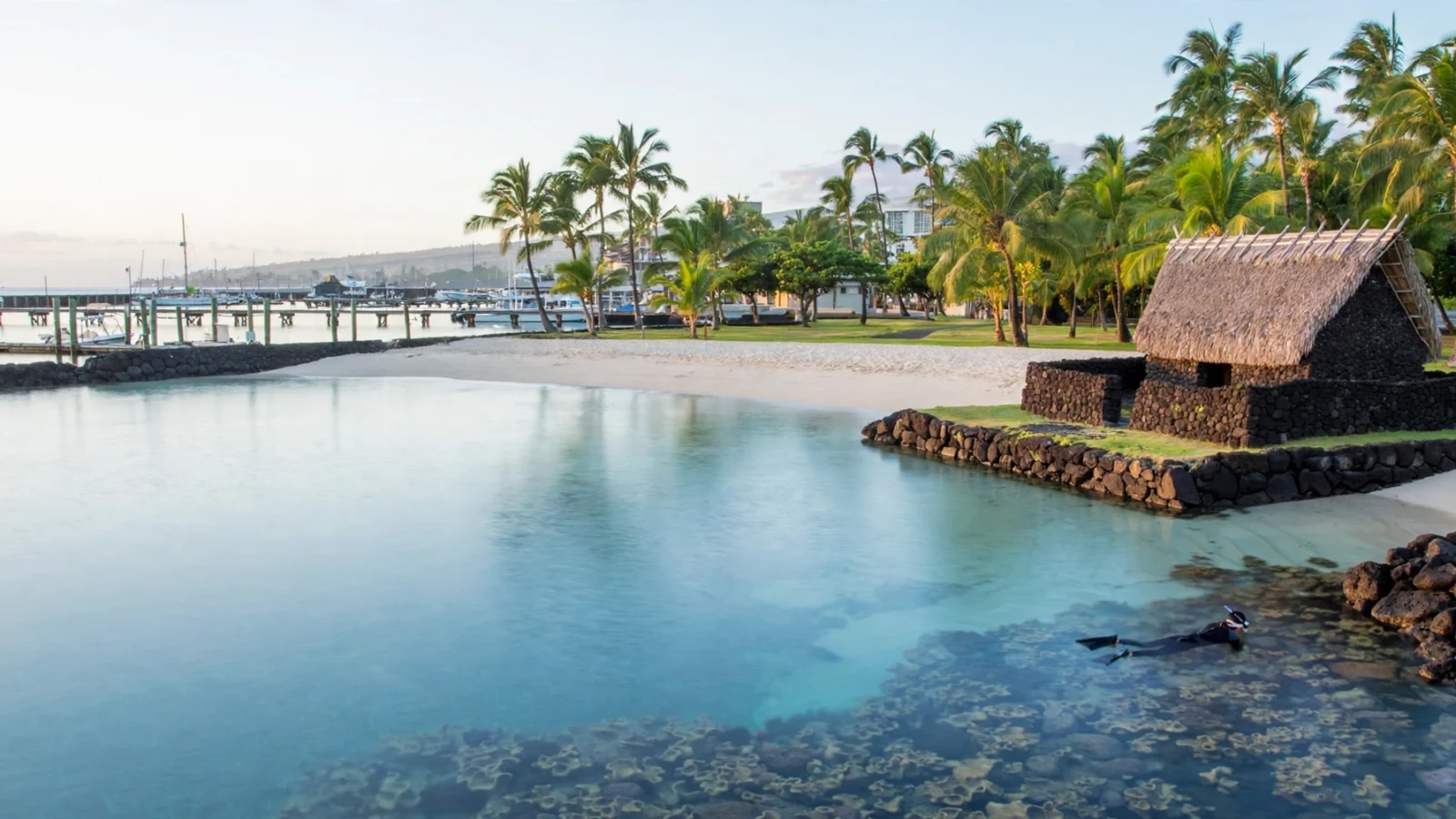
Every other snorkel guide for the Kona coast starts with a drive. This one starts with a walk. Kamakahonu Beach — King Kam Beach to everyone in town — is the small white-sand cove wedged between Kailua Pier and the King Kamehameha hotel in the middle of downtown Kailua-Kona, and it holds the calmest water on this coast: a protected little lagoon where the surface stays almost flat while beaches a few miles south are already chopping up. People staying in town can be floating over reef fish ten minutes after leaving their hotel lobby, with no car, no tour and no boat.
Honesty first, because this beach invites exaggeration in both directions. Kamakahonu is not one of the Big Island’s great reefs — the coral here is modest, and nobody should drive past Kahalu’u or Two Step to reach it. What it is, uniquely, is the easiest snorkel in Kona: the gentlest entry, the calmest learning water, a real (if small) reef a short swim outside the cove, rentals on the sand, restrooms at the pier, and the royal history of Hawaii sitting on the point above you. This guide covers the one navigation rule that keeps the snorkel safe — out of the cove and turn right, never left — the second entry across the pier that most visitors never find, and the early-morning window that makes the whole thing work. For more ideas beyond the beach, see our guide to Things to Do in Kailua-Kona.
Kamakahonu Beach snorkeling at a glance
| Question | Answer |
|---|---|
| Where is it? | Downtown Kailua-Kona, Big Island — the north end of Kailua Bay, between Kailua Pier and the Courtyard King Kamehameha Kona Beach Hotel on Ali’i Drive |
| Address | 75-5660 Palani Road, Kailua-Kona, HI 96740 — the beach fronts the Courtyard King Kamehameha hotel, directly behind Kailua Pier |
| The draw | The calmest water in Kona — a protected cove in the middle of town, walkable from any downtown hotel, no car or tour needed |
| The zones | The inner cove (flat, sandy, for learning) and the reef outside the cove to the RIGHT (north) — never left, toward pier boat traffic |
| What you see | Reef fish including yellow tang and red sea urchins over the rock and reef outside the cove; an occasional turtle — a modest reef, honestly rated |
| Best time | First light / early morning, before boat traffic and wind build — the calmest water of the day |
| Parking | No beach lot — limited street parking; the paid hotel lot is the closest fallback (check the posted rates first) |
| Lifeguards | Plan as unguarded — no lifeguard service is promoted for this beach; the calm cove is the safety feature, not supervision |
| Facilities | Restrooms and a cold shower at the pier building, picnic lawn, and the Kona Boys shack on the sand renting snorkel gear |
| Shade | Almost none — one large palm tree and no shade structures; rent an umbrella at the Kona Boys shack |
| Reviews | TripAdvisor 4 out of 5 from 21 reviews — praised for easy access and calm water, marked down for crowds and murk on busy days |
| Entry fee | Free — a public beach; only parking is paid |
| Who it suits | Beginners, kids and anyone staying in town who wants a quick, calm dip — not reef connoisseurs chasing the island’s best coral |
Start with the island picture in our Big Island snorkeling hub, and if this is a first-ever snorkel, read our beginner’s guide to snorkeling in Hawaii on the walk down — this is exactly the kind of water it was written for.
The one rule: out of the cove, turn right — never left
Kamakahonu’s snorkeling splits cleanly by one turn, and getting it right is the whole safety system of the beach:
- Inside the cove is the lagoon itself — shallow, sandy and almost flat, sheltered by the pier on one side and lava rock on the other. This is the learning water: first masks, first kicks, kids finding their confidence. There is sand more than reef here, so expectations should match — you are practising, not reef-touring.
- Outside the cove, turn RIGHT (north, around the outside of the cove) is where the snorkeling actually lives: rock and reef with the fish on it, in water that is still sheltered by the bay but finally has structure. Local guidance is consistent on this route.
- Never turn LEFT. Left is the pier side, where boats come and go all day. That water belongs to boat traffic, not snorkelers, at every hour and every skill level.
The second part of the rule is timing. The water here is calmest at first light, before the pier wakes up and boat traffic picks up — and before the afternoon wind puts a chop on Kailua Bay. A Kamakahonu snorkel is a morning snorkel. Arrive at nine to a different, busier bay than the one the early swimmers got at seven. Stay aware of boats whenever you are outside the cove at any hour, keep your head up at intervals, and read our snorkeling safety guide for the boat-awareness habits that apply at every pier-adjacent spot.
The snorkel zones
The inner cove — the learning lagoon
Two hundred feet of waterfront, give or take, is the whole beach — white sand backed by a grassy lawn, with the hotel behind and the heiau point at the north edge. The entry is as gentle as Hawaii offers: walk in over sand, float when you are ready. Inside, the bottom stays sandy and the depth builds gradually — the bay as a whole is reported around 5 to 20 feet, with the cove itself at the shallow end of that. For a nervous first-timer or a child with a mask, this graduated, wave-free shallows is the point of the place; locals call it Keiki Beach — children’s beach — and the nickname is earned. Put a beginner in here for twenty minutes and they will be ready for the reef edge. Leave them in surf at a famous beach and they may never snorkel again.
The right-hand reef — outside the cove, to the north
When you are comfortable, swim out of the cove mouth and turn right, working along the rock and reef outside the protected water. This is where the modest but real reef life holds: reef fish grazing the structure — yellow tang are the signature flash of colour — red sea urchins in the rock, and the general working cast of a Kona shoreline. An occasional turtle passes along this coast; enjoy it at the 10-foot distance our snorkeling with turtles guide sets out if you are lucky, but do not come counting on one — this is not a turtle beach.
Rate the reef honestly and you will enjoy it: the coral here is not the Big Island’s healthiest, and the patch is small. What redeems it is the combination — real fish, over real structure, in calm water, in the middle of town, before breakfast. For the island’s serious reef days, build up to Kahalu’u Beach Park for turtles and shallows or the Two Step reef when your confidence is there. Kamakahonu is where those days start, not where they peak — and our Hawaii coral reef snorkeling guide explains what healthy coral looks like so you can judge every reef, this one included, with your own eyes.
The bonus entry: Kaiakeakua, across the pier
Thirty feet south of King Kam Beach, on the far side of Kailua Pier, a patch of sand most visitors walk straight past is the locals’ second entry: Kaiakeakua Beach. It is barely a beach — more an entry point into Kailua Bay — but the snorkeling from it is rated better than from King Kam itself, precisely because it starts away from the pier’s immediate traffic. The governing rule here is the buoy line: buoys out in the bay mark a boat channel that is off-limits to swimmers, because the larger boats use the pier. Stay between the shore and the buoys at all times. There are no facilities on this side — use the pier restrooms before you cross — and the same first-light logic applies double, since you are sharing a bay with a working pier. Confident snorkelers who have done the right-hand reef once should try Kaiakeakua on their second morning; beginners should stay in the cove system until the first route feels easy.
| Zone | Best for | The water | The limit |
|---|---|---|---|
| Inner cove | First snorkels, kids, confidence-building | Almost flat, sandy, shallow — the calmest water in Kona | Sand more than reef — practice water, fish are outside |
| Right-hand (north) reef | The actual snorkel | Sheltered bay water over rock and reef outside the cove | Never turn left toward the pier; stay boat-aware, mornings best |
| Kaiakeakua (across the pier) | A better second snorkel | Open Kailua Bay entry, rated better snorkeling | Buoys mark an off-limits boat channel — stay shore-side of them, no facilities |
What you will see
Set the expectation the beach deserves: a town reef, not a destination reef. Outside the cove, over the rock and reef to the right, expect yellow tang, the usual Kona reef fish holding on structure, and red sea urchins tucked into the rock — enough colour and movement to delight a beginner and to give an experienced snorkeler a pleasant half-hour, not enough to rival the south Kona sites. Visibility follows the Kona pattern: best in the still of early morning, degraded whenever wind chop or boat churn stirs the bay, and generally clearer outside the cove than in the sandy shallows.
Two inflations to ignore. First, the name: Kamakahonu means “the turtle eye”, for a turtle-shaped rock that once marked this shore and now sits buried under the pier — it is a name about a rock, not a promise of turtles, and sightings here are occasional only. For reliable honu, Kahalu’u is the Kona answer. Second, the bay beyond is famous water — dolphins are sometimes seen farther out in Kailua Bay by kayakers and paddlers — but that is open-bay wildlife, not a snorkeler’s expectation at the reef edge, and no honest guide will sell it as one.
What visitors actually say: Kamakahonu Beach reviews
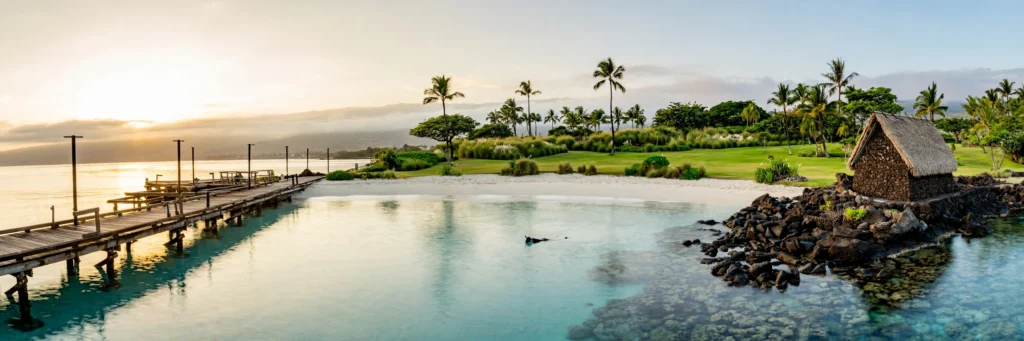
TripAdvisor rates Kamakahonu Beach 4 out of 5 from 21 reviews (checked November 2026), placing it #40 of 118 things to do in Kailua-Kona. The split behind that score is 8 five-bubble, 8 four-bubble, 4 three-bubble, no two-bubble and 1 one-bubble review — a beach most visitors like and almost nobody hates. The separate National Historic Landmark listing scores a little higher, at 4.2 out of 5.
What reviewers praise is exactly what this guide promises: super easy access to basic snorkeling, no waves so it is great for small children, and enough fish to talk an anxious first-time snorkeler through their nerves. What they complain about is also consistent, and worth knowing before you go: on busy days the shallow water turns murky — one December reviewer could not see their feet at waist depth, with a visible film of sunscreen on the surface — the small beach feels crowded at peak season, and a January 2025 reviewer found the facilities rundown. The one-star pattern is a visitor who came for a beach day and judged it as one; the five-star pattern is a snorkeler who came for the calm cove and judged it as that.
That split is the honest read on the place, and it matches this guide’s verdict: come to snorkel the calm water in the morning, not to claim a full-day beach. Review counts move, so treat the 4-out-of-5 as a November 2026 snapshot rather than a permanent grade.
Conditions: why mornings rule, and when to skip
Kamakahonu’s protection makes it one of the most forgiving snorkels in Hawaii — the pier and lava breakwater take the ocean’s energy out before it reaches the cove, which is why this beach stays usable when exposed coasts are not. Forgiving is not the same as unconditional:
- Time of day is the main variable. First light to mid-morning is the window: flattest water, fewest boats, clearest visibility. By afternoon, wind chop on the bay and a busy pier have both taken their share.
- Boat traffic is the standing hazard, not surf. The left/pier side is always a no, and outside the cove you share water with a working harbour’s comings and goings — early, brief and head-up is the discipline.
- Winter and Kona storms. This leeward coast is sheltered from the trade-wind swell pattern, but a strong Kona storm or a large swell wrapping into Kailua Bay can roughen even this cove. If the lagoon itself is not flat on the morning you arrive, believe it and make it a history-and-coffee morning instead — the heiau and the town are a genuinely good plan B.
- After heavy rain, town runoff can dull the bay’s clarity. Wait a day for the best of the little reef.
The best time to snorkel in Hawaii guide generalises the morning rule; here it is simply stricter than anywhere else, because the pier’s working day is the clock you are racing.
Parking, access and facilities
Downtown is both the convenience and the catch. If you are staying anywhere in Kailua Village, walk — Kamakahonu sits at the north end of Kailua Bay, a short stroll up Ali’i Drive with the ocean on your left until the pier; the beach is directly behind it, fronting the King Kamehameha hotel. The beach is public — you do not need to be a hotel guest to use it.
Arriving by car, know before you set out that there is no dedicated beach parking lot:
- Street parking near the beach is limited and goes early.
- The paid lot at the Courtyard King Kamehameha’s Kona Beach Hotel is the closest fallback — rates are posted at the entrance, so read the board before you pull in; we do not quote a figure because it changes.
- A lot up Palani Road, a few minutes’ walk away, is the other option visitors use.
Facilities, for a beach this small, are unusually complete: restrooms in the toilet building at the start of the pier, between the two water entry points (listed hours 7:00 a.m. to 6:45 p.m.), a cold outdoor shower beside that building, a picnic-friendly grass lawn behind the sand, and — the feature no other downtown beach matches — the Kona Boys beach shack right on the sand, renting snorkel gear (listed at $24 at last check; confirm current prices at the shack), chairs, boards and kayaks, and running outrigger canoe rides in the bay. In practical terms: you can land in Kona with nothing, rent a mask on this sand, and be snorkeling within the hour. Bring the rest of your kit list from our snorkel gear checklist if you have it; rent here if you do not.
The shade problem: bring your own umbrella
Kamakahonu has one flaw the snorkeling guides rarely mention and every visitor review does: there is almost no shade. One large palm tree is the whole of the natural cover, there are no shade structures on the sand, and the cove faces full sun for most of the day. Plan for it the way you plan for the water — it is the difference between a comfortable morning and a sunburned one.
The fix is on the sand. The Kona Boys shack rents umbrellas and beach chairs alongside the snorkel gear, so you can set up shade in the same stop where you rent a mask. If you would rather bring your own, pack a small beach umbrella in the car — but note the umbrellas already planted on the sand are generally the hotel’s or other visitors’ rentals, not free to use, so rent your own rather than assuming.
Two habits make the sun manageable here. First, snorkel in the early-morning window this guide is built around — the water is calmest then and the sun is lowest — and treat the late morning as lawn-and-coffee time under whatever shade you have set up. Second, wear reef-safe sunscreen; our reef-safe sunscreen guide explains what Hawaii’s sunscreen law actually bans and what to buy instead, because the sunscreen washing off a hundred swimmers in a small cove is exactly where the reef-safe choice matters.
Ironman week: when the pier takes over
Once a year this quiet cove becomes the centre of the triathlon world. The Ironman World Championship has been anchored in Kailua-Kona since 1981, and its swim start, transition area and finish line all sit on Kailua Pier — the same pier your snorkel route is built around. The race runs each October (check the year’s dates before you travel), and the build-up takes over the waterfront for most of race week: organisers start securing the pier from the Wednesday before the race, the Ironman Village expo occupies the hotel’s beachfront lawn and the promenade along the bay, and on race morning the Coast Guard closes the swim-course waters in Kailua Bay.
For a snorkeler that week, the practical rule is simple: do not plan your Kamakahonu snorkel for race morning, and expect the pier, the lawn and the parking to be an event site rather than a beach for several days around it. The cove itself does not close, and the morning before or after the race can still be a fine dip — but the flat, empty, first-light water this guide describes is not what race week looks like. If your trip lands on Ironman week, snorkel Kamakahonu on a non-race morning, or take the short drive south to Kahalu’u instead and watch the race from the seawall.
How to get to Kamakahonu Beach
Kamakahonu is the rare Kona snorkel you reach on foot. If you are staying anywhere in downtown Kailua-Kona, walk north up Aliʻi Drive with the ocean on your left until you reach Kailua Pier — the beach is directly behind the pier, fronting the Courtyard King Kamehameha hotel, at 75-5660 Palani Road. Most town hotels are within an easy stroll, and that walk is the whole point of this beach: no drive, no lot hunt, no boat to book. Our guide to where to stay in Hawaii for snorkeling covers the downtown bases if you are still choosing a hotel.
Driving in, the one friction is parking, covered in the section above: no dedicated beach lot, limited street parking, the paid hotel lot as the closest fallback, and a lot up Palani Road a few minutes’ walk away. Arrive early on weekends and cruise-ship days, when the town fills first.
Cruise passengers get the easiest version of all. Kailua-Kona is a tender port — ships anchor out in Kailua Bay and run passengers ashore by tender boat to Kailua Pier, a ride of roughly ten to fifteen minutes — and the beach is steps from where the tender lands. Get a tender ticket as soon as they are handed out, join the return tender line at least an hour before all-aboard, and treat the morning snorkel window as the plan: first light to mid-morning is when this cove is at its best, and it fits a port call far better than an afternoon attempt. One honest caveat: tendering can be suspended in rough weather, so a Kona call is never guaranteed — check the ship’s daily schedule before counting on it.
Kamakahonu Beach beyond the snorkel: swimming, paddling and a beach morning
The snorkeling is the reason this guide exists, but it is not the only reason to come to this sand. The cove itself is a genuine swim beach: flat, sandy, sheltered water where families swim, kids paddle at the edge, and an early-morning dip before the day heats up is one of the better small pleasures in Kona. Locals call it Keiki Beach for a reason, and the white sand, grassy lawn and picnic space behind it make it an easy base for a slow morning even if nobody puts a mask on.
The calm water also makes this one of the better places in Kona to learn stand-up paddleboarding, and kayaks launch from the cove too. The Kona Boys shack on the sand rents paddleboards and kayaks alongside the snorkel gear, and runs outrigger canoe rides out into Kailua Bay — listed at $75 per person with a two-person minimum at last check, so confirm the current price at the shack. Boat and snorkel cruises and dinner cruises also leave from Kailua Pier, a few steps away, for anyone who wants the bay from the water rather than under it.
What Kamakahonu is not, honestly, is a full-day beach. It is small — about two hundred feet of sand — with no surf to watch and no long walk to take, and most visitors treat it as a quick dip between activities: a pre-breakfast snorkel, a swim, a look at the heiau, then on to the town. That is the right way to use it. The shops, coffee spots and restaurants of Aliʻi Drive are a short walk in either direction, and if your visit falls on the third Sunday of the month, the Kokua Kailua village stroll brings local artisans, food trucks and free entertainment to the same streets.
The history on the point: Kamakahonu and ‘Ahu’ena Heiau
No other snorkel in Hawaii starts under a king’s house. Kamakahonu was the royal residence of Kamehameha I from 1812 until his death here in 1819 — the last home of the king who unified the islands, and the place his son Liholiho succeeded him. At the north edge of the beach stands ‘Ahu’ena Heiau, the “temple of the burning altar”, his personal temple dedicated to Lono, reconstructed in the 1970s on its original footprint at the water’s edge. You can look at it from the outside — the grounds are off limits and held in reverence, so view, photograph respectfully from the beach side, and do not enter. The hotel lobby displays artifacts tied to the temple, including a feather cloak and a mahiole — a feathered helmet — if you want the indoor half of the story. The whole complex is a National Historic Landmark, and the correct snorkeler’s posture is guest: this cove was a seat of government before it was ever a beach break, and a year after the king’s death the first missionaries were granted permission to come ashore at this same shore.
The whole compound carries formal recognition to match its history: Kamakahonu was designated a National Historic Landmark on December 29, 1962 — the National Park Service lists it as ‘Kamakahonu, Residence of King Kamehameha I’ — and added to the National Register of Historic Places in 1966. The structures you see today, including the thatched ‘Ahu’ena Heiau, were reconstructed in 1975–77 on their original footprints. You will also see the beach written as King Kam Beach — the name everyone in town uses — and occasionally as Kamehameha Beach; all three names are the same small cove behind Kailua Pier, fronting the Courtyard King Kamehameha Kona Beach Hotel.
Kamakahonu vs Kona’s other snorkels
| Kamakahonu (King Kam) | Kahalu’u Beach Park | Magic Sands (La’aloa) | Old Kona Airport | |
|---|---|---|---|---|
| The draw | Calmest cove in town, walk-to snorkel, royal history | Turtles and fish in a shallow protected bay | White sand, quick Ali’i Drive dip when calm | Long tidepool-and-reef shoreline north of town |
| Snorkeling quality | Modest — real reef fish outside the cove, small patch | Good and consistent, turtle-reliable | Patchy, conditions decide | Good along the reef on calm days |
| Entry | Sand, the gentlest in Kona | Sand to shallow reef | Sand, shore break when surf is up | Rocky / tidepool entries |
| Lifeguards | Plan as unguarded | Yes, typically | Yes, typically | No |
| Facilities | Pier restrooms + shower, rentals on the sand | Full beach park | Beach park basics | Restrooms at the park |
| Parking | No beach lot — street / paid hotel lot | Beach park lot | Small park lot | Large park area |
| Beginners | The best learning water in Kona | Yes, in the shallows | Only on calm days | Confident beginners on calm days |
| Best pick when | You are staying in town, learning, or want a pre-breakfast snorkel | You want turtles + easy logistics | You want sand + a swim on Ali’i Drive | You want a longer, quieter reef walk-snorkel |
The Kona ladder, honestly climbed: learn here, then Magic Sands and the Old Kona Airport shoreline nearby, Kahalu’u for the turtle day, Kealakekua Bay and Captain Cook for the flagship reef, and the Manta Ray night snorkel — run from this same waterfront after dark — for the finale. The working-harbour snorkel at Keauhou Bay is the other Ali’i Drive option when you want mantas’ daytime harbour without the night boat.
Frequently asked questions
Is Kamakahonu Beach good for snorkeling?
Yes — for what it is: the easiest, calmest snorkel in Kona, not the island’s best reef. Inside the cove is flat, sandy learning water; the real snorkeling is a short swim outside the cove to the right (north), over rock and reef with yellow tang, reef fish and sea urchins. Rate it as a convenient beginner and quick-dip snorkel with a modest reef, and it will exceed expectations; rate it against Kahalu’u or Kealakekua and it will not — those are different days.
Where exactly do you snorkel at King Kam Beach?
Enter in the cove in front of the King Kamehameha hotel, get comfortable in the sheltered shallows, then swim out of the cove and turn RIGHT, along the reef outside it. Never turn left — that side is Kailua Pier’s boat traffic. The second option is Kaiakeakua, the small sand entry just across (south of) the pier, where the snorkeling is rated better; there, stay between the shore and the buoys, because the buoys mark a boat channel that is off-limits.
Is Kamakahonu Beach safe for beginners and kids?
It is Kona’s signature beginner beach — locals call it Keiki (children’s) Beach for its protected, almost flat water and sandy entry, and it is one of the better places in Hawaii to learn. Two limits: plan it as unguarded, so your own supervision is the safety system, and beginners belong in the cove — the reef outside it, and any water near the pier side, is for confident swimmers with a buddy, in the morning.
When is the best time to snorkel Kamakahonu Beach?
Early morning, ideally first light. The water is calmest then, visibility is at its best, and — decisively at this beach — boat traffic from the pier has not built up yet. By afternoon, wind chop on Kailua Bay and a busy pier make it a lesser and less relaxed snorkel. It is a pre-breakfast snorkel by design.
Do you have to be a hotel guest to use Kamakahonu Beach?
No. Kamakahonu is a public beach — there are no private beaches in Hawaii — and the fact that it fronts the Courtyard King Kamehameha Kona Beach Hotel does not make it the hotel’s. Anyone can walk in, swim and snorkel. Only the hotel’s parking lot is paid, and its rates are posted at the entrance.
Where do you park for King Kam Beach?
There is no dedicated beach lot, which is the one real friction of the place. Street parking nearby is limited and fills early; the closest fallback is the paid lot at the King Kamehameha hotel (check the posted rates before pulling in), and there is a lot up Palani Road a few minutes’ walk away. If you are staying in downtown Kailua-Kona, skip the problem entirely and walk — most town hotels are within an easy stroll.
Can you rent snorkel gear at Kamakahonu Beach?
Yes — the Kona Boys beach shack sits right on the sand and rents snorkel gear (listed at $24 at last check — confirm the current price at the shack), along with chairs, boards and kayaks, plus outrigger canoe rides in Kailua Bay. It is what makes Kamakahonu a genuine arrive-and-snorkel beach for travellers who packed no gear at all.
What does Kamakahonu mean, and what is the temple on the beach?
Kamakahonu means “the turtle eye”, named for a turtle-shaped rock that once marked this shore and now lies buried under Kailua Pier — a name about a rock, not a promise of turtles. The thatched temple at the beach’s north edge is ‘Ahu’ena Heiau, King Kamehameha I’s personal temple, on the grounds of Kamakahonu, his royal residence from 1812 until his death in 1819. View it from outside only — the grounds are off limits — and see the related feather cloak and helmet displayed in the hotel lobby.
How do I get to Kamakahonu Beach?
Walk north up Aliʻi Drive in downtown Kailua-Kona with the ocean on your left until you reach Kailua Pier — the beach is directly behind it, fronting the Courtyard King Kamehameha hotel, at 75-5660 Palani Road, Kailua-Kona, HI 96740. Driving, there is no dedicated beach lot: street parking is limited, the paid hotel lot is the closest fallback, and there is a lot up Palani Road a few minutes’ walk away.
Can cruise ship passengers visit Kamakahonu Beach?
Yes — it is one of the easiest snorkels from a cruise ship in Hawaii. Kailua-Kona is a tender port: ships anchor in Kailua Bay and tender passengers to Kailua Pier, and the beach is steps from the pier. Rent gear at the Kona Boys shack on the sand, snorkel the early-morning window, and join the return tender line at least an hour before all-aboard. Tendering can be suspended in rough weather, so check the ship’s schedule on the day.
Is there free parking at Kamakahonu Beach?
There is no dedicated beach lot, free or paid, and street parking near the beach is limited and fills early. The closest fallback is the paid lot at the King Kamehameha hotel, with rates posted at the entrance, and there is a lot up Palani Road a few minutes’ walk away. Downtown Kona parking has largely moved to paid systems, so read the signs and the posted rates on the day rather than trusting an older guide.
Is there shade at Kamakahonu Beach?
Almost none. There is one large palm tree and no shade structures, so the sand is in full sun for most of the day. Rent an umbrella and chairs at the Kona Boys shack on the sand, or bring your own — and wear reef-safe sunscreen, because a small cove full of swimmers is where the reef-safe choice matters most.
Can you swim at Kamakahonu Beach?
Yes — the cove is a genuine swim beach, not just a snorkel entry. The water is flat, sandy and sheltered, which is why locals call it Keiki Beach and families swim here with small children. It is a short swim-and-sun beach rather than a full-day one: most visitors swim, look at the heiau, and move on to the town.
Can you snorkel at Kamakahonu Beach during Ironman week?
You can, but not on race morning — the Coast Guard closes the Kailua Bay swim-course waters while the race is on, and the pier area is an event site for most of race week. Snorkel on a non-race morning that week, or drive south to Kahalu’u instead and watch the race from the seawall.
Where is Kamakahonu Beach located?
Downtown Kailua-Kona at the north end of Kailua Bay, directly behind Kailua Pier and fronting the Courtyard King Kamehameha Kona Beach Hotel, at 75-5660 Palani Road, Kailua-Kona, HI 96740.
Is Kamakahonu Beach free to visit?
Yes. Kamakahonu is a public beach with no entry fee — there are no private beaches in Hawaii. The only cost is parking: street parking is limited and the hotel lot is paid, with rates posted at the entrance.
Is Kamakahonu Beach the same as King Kam Beach?
Yes — King Kam Beach is the local name for the same cove, and it is also written as Kamehameha Beach. All three names mean the small white-sand beach behind Kailua Pier in downtown Kailua-Kona.
What do reviews say about Kamakahonu Beach?
TripAdvisor rates it 4 out of 5 from 21 reviews (checked November 2026): praised for easy-access snorkeling and calm water for kids, marked down for peak-season crowds and occasional murky water. The separate National Historic Landmark listing scores 4.2 out of 5.
Is Kamakahonu Beach a National Historic Landmark?
Yes. The Kamakahonu compound — the royal residence of Kamehameha I, including ‘Ahu’ena Heiau — was designated a National Historic Landmark on December 29, 1962. View the heiau from outside only; the grounds are off limits.
The verdict
Kamakahonu will never win a best-reef argument, and this guide has not entered it in one. It wins a different argument outright: no snorkel in Hawaii asks less of you. No drive, no lot hunt if you walk, no surf to read, no boat to book — just a flat little cove in the middle of town, a reef a right-turn away, a rental shack on the sand, and a king’s temple watching over the entry. Learn here, dip here before breakfast, bring your kids here first — then go and climb the Kona ladder to Kahalu’u, Two Step and Kealakekua with the confidence this cove gave you. That is not a consolation prize. That is a beach doing the first job of snorkeling better than anywhere else on the island.