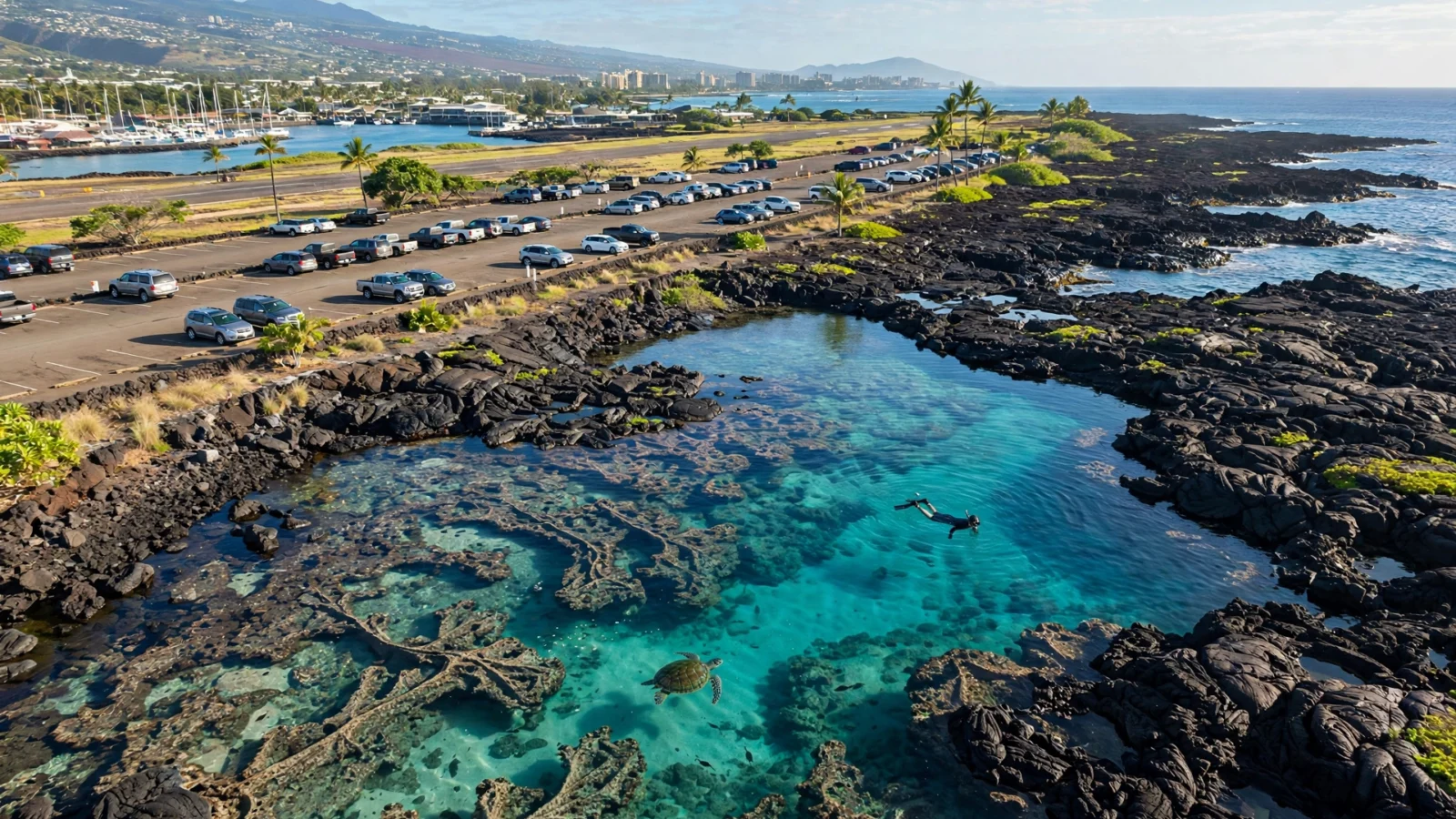
Every other good snorkel in Kona asks something of you first. Kahalu’u asks for an early arrival before its lot fills. Kealakekua asks for a boat, a kayak permit dance or a long hot hike. Kua Bay asks for a drive up the coast. Old Kona Airport asks for nothing: you drive to the end of Kuakini Highway, park on a mile of empty runway five minutes from downtown Kailua-Kona, walk a few yards over the lava, and slip into a Marine Life Conservation District that has been protected since 1992 — substantial coral, dense reef fish, turtles and rays cruising a reef of lava fingers that runs from ankle-deep shallows to a 50-foot drop-off.
And yet almost nobody snorkels it, because the shoreline does not look like a snorkeling beach. It looks like a runway next to some rocks. The sand here is patchy, the entry is over lava, there is no lifeguard tower and no rental stand, and the general beach guides give the snorkeling two sentences and move on to the picnic pavilions. That is exactly why the reef is in the shape it is in.
This guide does the job those guides skip: the Old Kona Airport MLCD rules in plain English, every entry point and what each one is actually for, the zone-by-zone reef route along the park frontage, the advanced walk north to Pawai Bay that local divers talk about, and an honest go/no-go checklist — because this is a calm-day reef, and on the wrong day the same shoreline is a surge channel you should not touch.
Old Kona Airport snorkeling at a glance
| Question | Answer |
|---|---|
| Where is it? | Old Kona Airport State Recreation Area (“Old Airport” / “Old A”), at the end of Kuakini Highway just west of Kailua-Kona town, Big Island — the town’s original airstrip, closed in 1970 |
| Protected status | Old Kona Airport Marine Life Conservation District (MLCD), 217 acres, established 1992 (HAR 13-37) — essentially no-take for snorkelers: look, never touch or collect |
| Best entries | The partially protected cove at the northwestern end (the entry the DLNR names for snorkelers and divers) and the sandy inlets along the frontage; a southern inlet is the easiest swimming entry |
| The reef | Low lava “fingers” running offshore to about 50 feet, then a quick drop into deep water; the DLNR’s guidance is that snorkeling is good within about 50 yards of shore |
| What you see | Substantial coral cover, diverse reef fish, green sea turtles and rays often seen (DLNR) |
| Parking | Free and ample — along the full length of the old runway (as of October 2026) |
| Park hours | 7am–8pm daily |
| Lifeguards | None stationed here — snorkel with a buddy and check posted signs |
| Facilities | Restrooms, outdoor showers, picnic pavilions and tables; no gear rentals at the park — rent in Kailua-Kona town first |
| Who it suits | Confident beginners on flat mornings at the cove and inlets; the southeast basin and the Pawai Bay walk are for experienced snorkelers and divers only |
New to snorkeling? Read our beginner’s guide to snorkeling in Hawaii first, then pick a flat morning and start at the northwest cove — and if the water is anything but calm, choose Kahalu’u Beach Park instead, where a lifeguard tower and a sheltered bay forgive a lot more.
The MLCD rules, in plain English
The water fronting the park is the Old Kona Airport Marine Life Conservation District — 217 acres of protected reef established in 1992, administered under Hawaii Administrative Rules chapter 13-37. The district runs along the park and the adjacent private properties, bounded by lines running 500 yards seaward from the western end of the park and from the Kailua lighthouse. Inside it, a marked No Boating Zone covers the water off the park, and the district’s single day-use mooring sits offshore of Shark Rock toward the northwestern boundary, in about 40 feet of water, for up to three hours per boat per day — which is why you will sometimes see a tour boat sitting off the north end while you snorkel from shore for free.
For a snorkeler, the rules reduce to one sentence: nothing comes out of this water. The DLNR prohibits taking, injuring or removing any marine life in the district — including live shells, ‘opihi, live coral and algae — except under a short list of narrow traditional and shore-fishing exceptions (things like akule by handline at night, or finfish for home consumption by throw net or pole-and-line from shore). None of those exceptions is a snorkeling activity. You also may not take or alter sand, shell, coral or rock, and you may not feed fish to attract them.
Practically, that means:
- Look, photograph, float — do not touch coral, pick up shells with anything alive in them, or chase turtles. Stay at least 10 feet from turtles; our snorkeling with turtles guide covers the full etiquette.
- Never stand on the reef. Apart from being illegal to damage here, the lava and coral are sharp along the entire frontage — the DLNR’s own safety note for this district — so wear water shoes or your fins from the water’s edge and float as soon as you can.
- If you see a boat inside the nearshore zone or someone collecting, that is what the rules are for; report it to the DLNR rather than confronting anyone yourself.
The payoff for all this restraint is the point of the place: three decades of protection is a large part of why a reef you can reach from a parking lot still carries the coral cover and fish density the DLNR describes. Our Hawaii coral reef snorkeling guide explains how to read a protected reef like this one once you are over it.
The entries: four ways in, and what each is for
There is no single “beach entry” at Old Airport, and picking the wrong one is the main way people have a bad day here. The DLNR names two snorkel/dive entries, the beach guides name a third, and the shoreline itself offers a fourth option in flat calm. They are not interchangeable.
The northwest cove: the main snorkel entry
At the northwestern end of the beach, a partially protected cove is where the DLNR says snorkelers and shore SCUBA divers usually enter. “Partially protected” is the honest phrase — the cove takes the edge off the open-ocean swell without pretending to be a lagoon — but it puts you straight onto the best structure: this is the Shark Rock end of the reef, the deepest and most developed section of the park frontage, with the day-use mooring sitting offshore in about 40 feet. If you snorkel one spot at Old Airport, snorkel this one, on a morning when the cove itself is calm. If waves are breaking into the cove, the protection is not enough — that is your answer for the day.
The southern inlet: the easiest swim entry
Beach guides consistently point to an inlet at the southern end of the park, near the old terminal building (now a pavilion), as the best spot for swimming — an easy water entry with a few more inlets and sand channels scattered along the length of the beach. This is the gentlest way into the water at Old Airport and the right choice for a first look or a family swim on a calm day. Be honest with yourself about what it is, though: the southern shoreline is the shallower, patchier end of the reef. Use the inlet to get comfortable, then work north along the frontage toward the better structure as your confidence allows — staying within that roughly 50-yards-of-shore band the DLNR recommends.
The frontage inlets: pick your channel
Between the two ends, a few inlets and sand channels cut through the lava frontage and give swimming and snorkeling entry in calm water. These are scout-from-the-rocks entries: walk the shoreline first, find a sand channel rather than a coral head to enter over, watch a full set of waves come through, and only then commit. On a flat morning they are perfectly good entries and often completely empty. In any swell, surge funnels through exactly these channels — they are the first places to skip.
The southeast basin: divers’ entry, not yours
At the southeastern end of the old airstrip, the lava shoreline forms a semiprotected basin where divers jump in, usable in calm to moderate water per the DLNR. A jump entry into a lava basin, with a climb-out over rock as the exit, is a shore-diver’s tool. Unless you are a strong, experienced water person who has watched the basin through a full wave cycle and knows exactly where you will exit, leave this one to the divers and use the cove.
| Entry | Best for | Entry style | Skip it when |
|---|---|---|---|
| Northwest cove (Shark Rock end) | The main snorkel — best reef | Sheltered cove over lava/sand pockets | Waves are breaking into the cove |
| Southern inlet (by the old terminal pavilion) | Easiest swim, families, first look | Sandy inlet | Surf is up park-wide (it is exposed too) |
| Frontage inlets & sand channels | Quiet mid-park snorkeling in flat calm | Scouted sand channel | Any swell — surge funnels through them |
| Southeast basin | Shore divers | Jump entry, rock climb-out | You are snorkeling, in almost all cases |
The reef route: lava fingers to the drop-off
The reef fronting the park is built from numerous low-profile fingers of lava running offshore, per the DLNR’s survey of the district, reaching depths of up to about 50 feet before the bottom drops off quickly into very deep water. That structure writes the snorkel route for you:
- Start over the fingers, close in. In the first band of water, the lava fingers and the sand channels between them hold the grazing and sheltering life — reef fish working the coral, turtles over the shallows, the small stuff in the cracks. This is where the DLNR’s “snorkeling is good within about 50 yards of the shoreline” guidance points you, and for most snorkelers it is the whole outing, happily.
- Follow a finger, not the open water. Working along a lava finger gives you a navigation line, a leeward side to rest on, and a depth gradient you can choose from — shallower toward shore, deeper toward the tip. Crossing open sand between fingers is safe enough but empty; the life is on the structure.
- Treat the drop-off as the boundary, not the destination. Out at around 50 feet the reef falls away into blue water. Rays and larger fish cruise that edge, and the view into the deep is the drama of this site — but it is also where current, boat traffic beyond the No Boating Zone, and your own depth enthusiasm all increase at once. Experienced snorkelers in flat calm can peek over the edge; everyone else should enjoy it from a few yards back. If you cannot see the bottom clearly, you have gone far enough.
What you see, per the DLNR and consistent local accounts: substantial coral cover, a diverse population of reef fish, and turtles and rays often seen. Add the usual Kona cast over hard bottom — tangs and surgeonfish grazing the fingers, wrasses and butterflyfish on the coral heads, moray eels tucked into the lava — and the occasional winter whale soundtrack while your head is underwater. Nothing is guaranteed on any given morning, but a protected reef this size, five minutes from town, with this few snorkelers on it, stacks the odds in your favour like nowhere else in Kailua-Kona. The best time to snorkel in Hawaii guide will help you pick the season and hour; here, the short version is early, before the afternoon wind textures the surface.
The tidepool at Kuka’ilimoku Point: for the smallest snorkelers
Between the eastern end of the park frontage and Kuka’ilimoku Point sits a large sandy tidepool, just inland of the rocky shore, where the DLNR notes families often take children to swim. This is the Old Airport answer for toddlers and nervous first-timers: sand bottom, no swimming required, and small fish and marine invertebrates visible in the clear shallow water at low tide. It is a wading pool built by lava, not a snorkel — bring the kids’ masks anyway, because a face-down float in six inches of water over sand is how a lot of Hawaii snorkelers start. Check it at lower tide, wear water shoes on the surrounding rock, and leave every shell and creature exactly where you found it: the MLCD rules apply to the tidepool wildlife too. For a bigger family day with lifeguards, Kahalu’u remains the better plan — this pool is a bonus, not a destination.
The Pawai Bay walk: the advanced extension
North of the park, the lava coastline continues to Pawai Bay — a small, brilliant bay of caves, sea arches and dense reef that boat tours and shore divers rate among Kona’s best, and that almost no snorkeling guide explains honestly. Two independent local accounts agree on the shape of it; here it is with the warnings attached, because this extension is for advanced snorkelers only.
- The walk: park at the end of the old runway and walk north onto the little beach, then continue north across the lava flow for about 20 minutes, with some scrambling. Do it at low tide and stay on the shoreline route — land past the shore is posted private/Kapu in places, and trespassing to reach water is never the plan.
- Do not enter the lagoon, and do not use the beach at the end. The walk ends near a murky lagoon fronted by a private beach. The lagoon is not the entry — its outflow channel can carry a huge flow of water, and if the tide turned while you were out, you might not be able to get back against it.
- The entry is a cleft in the lava, just to the left of where the lagoon empties to the sea. Check the surf before you commit: if the lava is taking a pounding, you do not go. The water does not need to be flat — but you must be able to climb back up out of it without being crushed against the rock.
- The exit is the test. There is no ladder and no sand. If you do not have the strength to pull yourself out of the water onto lava, this snorkel is not for you — that is precisely what the tour boats anchored offshore are selling, and on this one they are worth it. Our Hawaii snorkeling tours guide covers how to pick one.
- In the water: snorkel close — local dive accounts put the best of Pawai within about 30–40 feet of shore, with the bottom falling to around 60 feet beyond, which is diving. Expect exceptional clarity, hundreds of species reported by dive operators, turtles and moray eels, and surge around the caves and arches. Swim clear of the channel leading into the bay.
If any line of that list gives you pause, your snorkel is the park frontage — which, to be clear, is a genuinely good reef in its own right, not a consolation prize.
Conditions: the go / no-go checklist
Old Airport is an exposed lava shoreline on the open Kona coast, and the DLNR’s warning for the district is blunt: dangerous swells and currents accompany storms in summer or winter — this coast does not have a safe season, it has safe days. Run this checklist at the shoreline, not from the parking lot:
- GO when the cove water is visibly calm, no white water is breaking on the outer fingers, and you can see the bottom from the rocks. Mornings, before the wind, are the reliable window.
- GO SLOWLY when there is a small texture on the water: stay in the northwest cove or the southern inlet, stay close to shore, and skip the frontage channels.
- NO-GO when sets are rolling across the reef, the lava at your entry is getting washed, or a storm system is anywhere near the islands — even a distant one sending swell. Surge at a lava entry is how snorkelers get hurt in Hawaii; our snorkeling safety guide covers the full picture, including why you never turn your back on the entry you came in through.
- After heavy rain, give the town shoreline a day: runoff near a built-up coast dulls the visibility that makes this reef worth it.
There are no lifeguards at Old Airport. Snorkel with a buddy, tell someone on shore your plan, and wear the water shoes — the DLNR flags sharp coral and lava along the entire frontage, and most injuries here will happen on the walk in, not the swim.
Parking, hours and facilities
This is the easiest logistics of any good Kona snorkel. The park is open daily from 7am to 8pm. Parking is free and genuinely ample — the old runway runs the length of the park and serves as the lot, wide enough that the “arrive before nine or suffer” rule of Hawaii snorkeling simply does not apply here (as of October 2026; always follow posted signs). Drive in from the end of Kuakini Highway, past the old industrial area where Palani Road meets Kuakini, and park along the runway nearest the section you plan to snorkel — the north end for the cove, the south end for the terminal pavilion and inlet.
Facilities are a real park’s, not a resort’s: restrooms and outdoor showers (listed by the DLNR for the district), covered picnic pavilions, tables and barbecue grills, drinking water, and the old terminal building serving as a pavilion at the south end. The southern and inland side of the park is county recreation land — sports fields, tennis courts, the community aquatic centre and gymnasium operate there on their own schedules — and the paved Maka’eo path along the runway is the town’s favourite sunset walk, past community gardens on the inland side. There are no gear rentals at the park: rent a mask, fins and a snorkel from a shop in Kailua-Kona town before you come, and bring everything else with you. Our snorkel gear checklist will keep you from forgetting the defog.
Old Airport vs Kahalu’u vs Magic Sands: which Kona snorkel today?
| Old Kona Airport | Kahalu’u Beach Park | Magic Sands (La’aloa) | |
|---|---|---|---|
| The draw | A protected MLCD reef with almost nobody on it | The easiest great snorkel in Kona — turtles, sheltered bay | A conditions gamble: great cove on calm days |
| Entry | Lava cove and inlets — water shoes essential | Sandy-rocky entry inside a sheltered bay | Sand entry when the sand is in |
| Lifeguards | None | Yes | Yes |
| Parking | Free, ample, all day | Free lot, fills early | Small lot + street, fills early |
| Beginners | On flat mornings only, at the cove/inlets | Yes — Kona’s beginner answer | Only on the calmest mornings |
| Facilities | Restrooms, showers, pavilions | Restrooms, showers, pavilion, rentals nearby | Restrooms, showers, picnic area |
| Best pick when | You want a real reef and the morning is flat | It is your first snorkel, or the day is mixed | The sand is in and the surf is small |
All three sit within about ten minutes of each other along the Kona coast, which makes Old Airport the easiest second snorkel in Hawaii: do Kahalu’u at dawn, check the cove here mid-morning, and finish with sunset on the runway. If the swell is up at both, Keauhou Bay and the manta ray night snorkel are the Kona plans that survive a rough day. For the full coast, see our Big Island snorkeling hub and the Two Step and Kealakekua Bay guides further south.
Frequently asked questions
Is Old Kona Airport good for snorkeling?
Yes — on calm days it is one of the most underrated snorkels in Kona. The reef fronting the park is a Marine Life Conservation District with substantial coral and diverse reef fish, and the DLNR’s own guidance is that snorkeling is good within about 50 yards of the shoreline. It is a lava-shore reef, not a sandy lagoon: you need a calm morning and water shoes, which is why the crowds stay away and the reef stays good.
Where do you enter the water at Old Kona Airport?
Most snorkelers and divers enter at the partially protected cove at the northwestern end of the beach, by the Shark Rock end of the reef — that is the entry the DLNR names. For an easier swim entry, use the sandy inlet at the southern end near the old terminal pavilion, or one of the sand channels along the frontage in flat calm. The southeast basin is a divers’ jump entry; snorkelers should leave it alone.
Is Old Kona Airport snorkeling safe for beginners?
Confident beginners, on flat-calm mornings, at the northwest cove or the southern inlet — yes, with a buddy. True first-timers, children beyond the tidepool, or anyone on a day with visible swell should choose Kahalu’u Beach Park instead, which has lifeguards and a sheltered bay. There are no lifeguards at Old Airport, entries are over sharp lava, and surge at the entry is the main hazard.
What are the rules in the Old Kona Airport MLCD?
The district (217 acres, established 1992) is essentially no-take: you may not remove or injure marine life — including live shells, ‘opihi and coral — take or alter sand, shell, coral or rock, or feed fish, apart from narrow shore-fishing exceptions that do not apply to snorkeling. A No Boating Zone covers the water off the park, with one day-use mooring offshore of Shark Rock. Look and photograph only, and never stand on the reef.
Is there a fee or reservation for Old Kona Airport?
No. Entry to the state recreation area is free, parking along the old runway is free and ample, and there is no reservation system (as of October 2026 — follow posted signs, as state park policies can change). The park is open daily from 7am to 8pm.
What will I see snorkeling at Old Airport Beach?
Per the DLNR: substantial coral cover and a diverse population of reef fishes, with turtles and rays often seen. The reef is a series of lava fingers reaching depths of about 50 feet before a drop-off into deep water, so expect grazing tangs and surgeonfish, butterflyfish and wrasses over the coral, moray eels in the lava, and honu cruising the shallows — keeping at least 10 feet away, always.
Can you snorkel to Pawai Bay from Old Kona Airport?
You can walk to it — about 20 minutes north across the lava from the end of the runway, at low tide — but it is an advanced snorkel, not an extension for a casual morning. Do not enter the murky lagoon or use the private beach at the end; the entry is a lava cleft beside the lagoon outflow, the outflow current is dangerous, and the exit requires pulling yourself up onto rock. If you cannot do that exit confidently, visit Pawai by boat tour instead.
When is the best time to snorkel Old Kona Airport?
Early morning, on a day with no swell running — Kona’s leeward coast is calmest before the afternoon wind. Unlike the north-shore spots, there is no safe season here: the DLNR warns that dangerous swells and currents accompany storms in summer or winter. Check the surf at the cove itself before gearing up, and let a local rental shop’s morning conditions report break any tie.
The verdict
Old Kona Airport is the snorkel Kona locals have been quietly keeping: a 30-year-protected reef of coral-covered lava fingers, turtles and rays, a tidepool for the kids and a town sunset runway for afterwards — with the easiest parking of any good snorkel on the island and, on most mornings, almost nobody in the water. It asks for two things in return: a calm day, honestly judged, and respect for the rules that kept it this way. Give it both, and it is the best-value snorkel in Kailua-Kona — five minutes from town, free, and very likely all yours.