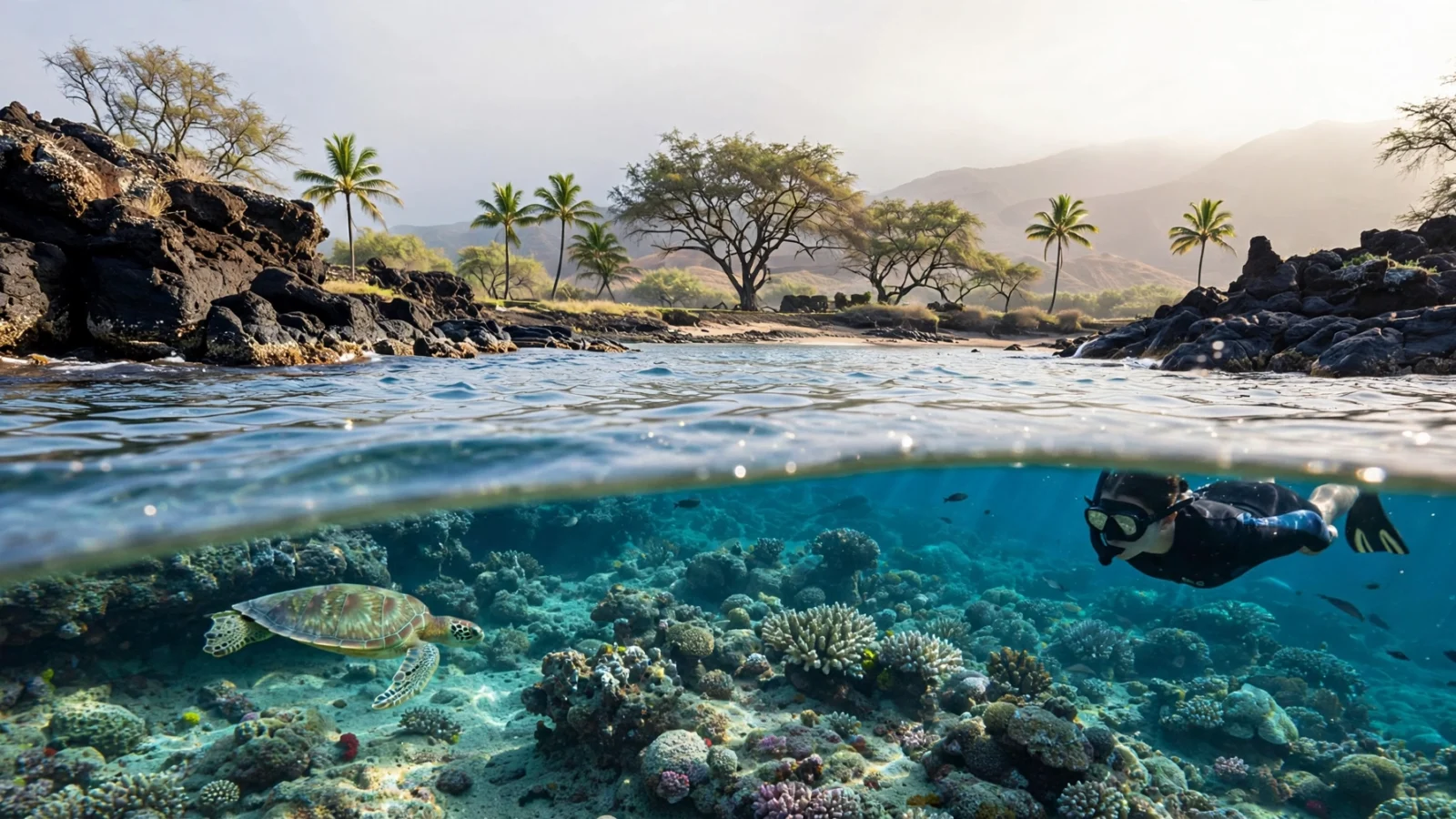
Makena Landing Snorkeling: The Five Graves Reef at the End of Makena Road
Is Makena Landing good for snorkeling? The short answer
Yes — if you are a confident swimmer, Makena Landing is one of the best shore snorkels on Maui’s south coast. The reef off the rocky point, known to divers as Five Graves and Five Caves, packs more structure into a single swim than any sandy entry nearby: coral-covered lava fingers, a turtle cleaning station, ledges and cave mouths, and fish life that starts the moment you clear the rocks. It is the snorkel for people who have already done the resort beaches and want the real reef.
The honest caveats, up front, because most guides bury them: there is no sand entry here. You get in over a lava shelf, and on any morning with a south swell pushing in, that entry is the whole game — mistime it and the surge will introduce you to the rocks. There is no lifeguard, and this is not a first-timer’s swim. If your entry skills are solid and the morning is calm, though, this is the Wailea–Makena coast’s most interesting snorkel that does not require a boat. Beginners will be happier starting at Turtle Town at Maluaka Beach, two minutes back up the road.
Makena Landing quick facts
| Location | Makena Landing Beach Park, at the end of Makena Road, Makena, South Maui — just south of Maluaka Beach (Turtle Town) |
| Best snorkeling | The Five Graves / Five Caves reef off the rocky point on the south side of the cove |
| Entry | Rocky — a worn lava shelf forms natural steps into the cove; calm mornings only, never in surge |
| Parking | Free lot at the beach park; small, and kayak tours fill much of it early; park hours are posted at the entrance |
| Lifeguard | None — confident swimmers only, and always with a buddy |
| Facilities | Restrooms and outdoor showers at the beach park; a small lawn and shade, but no real swimming beach |
| Best time | Early morning, before wind and chop — aim to be in the water by 8am |
| Good for beginners? | No — the rocky entry and surge risk make this an intermediate-plus swim |
| Watch out for | Surge at the entry, kayak and boat traffic in the cove, currents beyond the point |
Where is Makena Landing?
Drive south from Wailea on Wailea Alanui Drive, past the resort row and Maluaka Beach, and the road narrows into Makena Road — older, quieter, shaded by kiawe trees. Makena Landing Beach Park sits near the end of it, on the ocean side: a small county park with a parking lot, restrooms and a pocket cove. The landing was once this coast’s working boat landing, and it still earns its keep — kayak tours and dive boats launch here from first light, which tells you something about the water.
What you will not find is a beach in the Wailea sense. The shoreline is lava rock with one small gravel-and-sand pocket in the middle of the cove. Snorkelers base themselves on the lawn or the rocks, gear up, and go straight to the reef — this is a snorkel site that happens to have a park, not a beach park that happens to have snorkeling. For how it fits the whole coast, see our Maui snorkeling hub.
Five Graves, Five Caves: two names for one reef
The site’s two names describe two different things, and locals use both for the whole reef. Five Graves refers to five Hawaiian gravesites on the shore above the point — a reminder that this is a cultural landscape, not just a dive site. Treat them with respect: stay on the paths, do not climb around the rocks above the point, and never disturb anything on shore. Five Caves refers to what is underwater: a series of lava-tube caves and arches cut into the point, made famous by scuba divers.
For snorkelers, the distinction matters. The caves are to be looked at, not entered — from the surface you can peer into the shadowed mouths and watch fish pour in and out, but inside are surge, darkness and trapped air, and they belong to trained divers with lights. Everything in this guide happens on the open reef outside the caves, which is where the turtles are anyway.
The entry: rock steps, not a sandy beach
This is the section that decides whether Makena Landing is for you. From the park, a short path leads down to the cove. The usual entry is on the south side of the pocket, where the lava shelf has worn into a rough staircase to the water. On a calm morning it is genuinely easy: sit on the shelf, pull your fins on, slide in. On a morning with swell, the same shelf is a washing machine — and the correct decision is to drive two minutes north and snorkel Wailea Beach or Maluaka instead.
- Watch the water for a full set cycle before you gear up. If waves are breaking over the entry shelf, do not get in — the reef will still be there tomorrow.
- Wear booties or reef shoes to the waterline. The lava is sharp, and sea urchins live in the cracks.
- Sit to put your fins on, at the water’s edge or in waist-deep water — never walk down wet rock backwards in fins.
- Enter on the lull between sets and kick clear of the rocks immediately; do not linger in the surge zone.
- Plan the exit before you enter: same shelf, same patience. Come in on a lull, and take your fins off in waist-deep water.
One more entry note: local divers and kayak guides use this cove constantly and are generous with conditions advice. If someone who clearly works here suggests you skip it today, believe them.
The reef: three zones
The reef runs south and seaward from the entry in three natural zones. You can snorkel all three in a single 45-minute swim, working out along the fingers and drifting back through the shallows.
The inner reef
Inside the cove and along its south edge, coral heads and boulders sit in roughly 10 to 20 feet of water. This is the gentle introduction: goatfish working the sand, small tangs and butterflyfish over the coral, and very often the first turtle of the day grazing algae off the rocks. Treat it as your warm-up — get your mask settled and your breathing calm here before heading out.
The finger reefs
The main event. Lava fingers run seaward off the point, separated by sand channels, and nearly everything on this coast lives along them: schools of surgeonfish, raccoon and ornate butterflyfish, wrasses, moray eels in the ledges, and the site’s famous turtle traffic. Regulars describe a cleaning station on the fingers where honu hover while smaller fish pick them clean — park yourself a respectful distance away and watch the queue. Depths run roughly 15 to 40 feet, so there is plenty to see from the surface. Our guide to snorkeling with turtles in Hawaii covers the etiquette and the law.
The caves
Along the outer point, the finger reefs give way to the cave mouths and overhangs that made Five Caves famous. White-tip reef sharks are regularly reported resting under these ledges by day — divers see them often, and snorkelers occasionally spot one from above in clear water. Look from the surface and from outside the openings, never duck inside, and give any resting shark a wide, quiet berth.
What you will see
Regulars at Makena Landing report a consistent cast. The headliners:
- Green sea turtles (honu) — among the most reliable turtle encounters on the south shore, including the cleaning station on the finger reefs
- Humuhumunukunukuapua’a (rectangular triggerfish, Hawaii’s state fish) and other triggerfish patrolling the reef top
- Yellow tangs and mixed surgeonfish schools streaming along the lava fingers
- Butterflyfish — raccoon, ornate and milletseed — plus wrasses and Moorish idols
- Goatfish sifting the sand channels, sometimes trailed by opportunistic jacks
- Moray eels and octopus tucked into the ledges — scan slowly and you will find them
- White-tip reef sharks resting under cave ledges, and spotted eagle rays over the outer reef on calm mornings — bonuses, never promises
Set expectations honestly: this is a wild reef, not an aquarium, and a choppy or post-rain morning can cut visibility to a few feet. On a calm, dry morning, though, visibility here is often excellent by shore-snorkeling standards — the same clear south-coast water that fills the Molokini Crater photos, without the boat ride.
Makena Landing parking, hours and facilities
The beach park lot is free, and it is the only sensible place to park — Makena Road is narrow, and shoulder parking near the park is limited and signed in places. There are only a few dozen spaces, and the dawn kayak tours take a share of them, so by 8–9am in busy periods the lot is often full. If it is full, do not improvise on the roadside: take it as your sign to snorkel Maluaka or Wailea, where the lots are bigger.
- Parking: free county lot at the park; hours are posted at the entrance and the park is gated outside them — check the sign on arrival
- Restrooms: yes, at the beach park
- Outdoor showers: yes — essential for rinsing off after a rocky-entry swim
- Lifeguard: none
- Gear rental: none at the park — rent in Wailea or Kihei before you come; our Hawaii snorkeling gear checklist covers what to bring, and booties belong on it for this spot
A fees note, because Maui is mid-change: Maui County’s PARK MAUI programme has been expanding paid parking at county beach parks, starting on this coast. The landing’s lot has historically been free, but check the signage on the day and follow it — rules here are evolving faster than most guidebooks.
Best time to snorkel Makena Landing
Morning, full stop — and earlier than at the other south-shore spots, because your window is set by the entry, not just the visibility. The calmest water is usually from dawn to about 9am, before the trade winds ruffle the cove and the small shore break builds. Seasonally, the south shore’s swell season is summer: a run of south swell can close this entry for days at a time even when the sandy beaches nearby look fine. Winter is often the calmest season on this coast, though Kona storms can stir it up from the south. Our best time to snorkel in Hawaii guide explains the island-wide pattern. And the standing rule everywhere in Hawaii: after heavy rain, brown water means stay out until it clears.
Is Makena Landing good for beginners and kids?
Honestly — no, and this site will not pretend otherwise. The reef itself is no more demanding than Ulua’s, but the entry and exit are a skills test: timing sets, sitting on wet rock, keeping clear of the surge zone. A first-time snorkeler has enough to think about without adding that. Take beginners to sandy-entry Turtle Town or Ulua Beach first; our beginners’ guide to snorkeling in Hawaii ranks the easy options. Strong-swimming older kids who are already comfortable snorkelers can enjoy Makena Landing on a glassy morning with a parent within arm’s reach — but as a family beach day, Maluaka’s sand wins every time.
Safety at Makena Landing
- There is no lifeguard. Snorkel with a buddy, and tell someone on shore where you are going.
- The entry is the hazard. Most injuries at rocky entries happen in the surge zone — take your time, and never turn your back on the sets while getting in or out.
- Never enter the caves as a snorkeler. Surge, darkness and trapped air make them a trained-diver environment.
- Watch for traffic. Kayak tours and dive boats cross the cove — stay near the reef, stay visible, and listen before you surface.
- Do not round the point. Currents strengthen quickly in the open water beyond it.
- Watch your feet. Sea urchins (wana) live in the entry rocks, and standing on reef damages coral that takes decades to grow.
- Respect the gravesites on shore: stay on the paths and leave everything exactly as you found it.
More island-wide guidance is in our Hawaii snorkeling safety guide.
Makena Landing or Turtle Town — which should you snorkel?
They are two minutes apart and they solve different problems. Turtle Town at Maluaka Beach is the easy morning: sandy entry, a gentle reef, turtles on most days, and the trade-off of tour-boat company later in the day. Makena Landing is the connoisseur’s morning: a harder entry that buys you a better-structured reef, caves to peer into, turtles without the crowd, and nobody’s beach umbrella in your photos. Our verdict: snorkel Turtle Town on your first south-shore morning, then graduate to Makena Landing on the second, once you have read the entry section above and picked a calm day. Plenty of regulars do both in one morning — the landing at dawn, Maluaka for a second, sandier swim. Browse the full Maui snorkeling hub to plan the rest of the coast.
FAQ
Is Makena Landing good for snorkeling?
Yes — for confident swimmers it is one of the best shore snorkels in South Maui: a turtle-heavy reef of lava fingers and cave mouths at Five Graves / Five Caves. The catch is the rocky entry, which rules it out for beginners and on any day with surge at the shelf.
Why is it called Five Graves — and Five Caves?
Five Graves for the five Hawaiian gravesites on the shore above the point — treat the area with respect and stay on the paths. Five Caves for the lava-tube caves along the point underwater, famous with scuba divers. Both names refer to the same snorkel and dive site at Makena Landing.
Where do you park for Makena Landing, and is it free?
In the Makena Landing Beach Park lot at the end of Makena Road. It has historically been free, but it is small, kayak tours fill much of it early, and Maui County parking rules are changing — check the posted signs and park hours on arrival.
How do you get in the water at Makena Landing?
Over the lava shelf on the south side of the cove, where the rock forms natural steps. Sit to put your fins on, enter on the lull between sets, and kick clear of the rocks at once. If waves are breaking over the shelf, do not enter — snorkel a sandy beach instead.
Is there a lifeguard at Makena Landing?
No. There is no lifeguard at Makena Landing. Snorkel with a buddy, stay on the reef side of the cove, and keep out of the caves and the open water beyond the point.
What is the best time to snorkel Makena Landing?
Early morning — be in the water by about 8am, before the wind and shore break build. Seasonally, winter mornings are often calmest on the south shore; summer south swells frequently close the rocky entry for days at a time.
Can beginners snorkel at Makena Landing?
It is not recommended. The reef is manageable, but the rocky entry and exit demand timing and confidence. Beginners should start at Turtle Town (Maluaka Beach) or Ulua Beach, both sandy entries a few minutes north.
Are there turtles at Makena Landing?
Yes — green sea turtles (honu) are this site’s headline act, including a known cleaning station on the finger reefs where turtles hover while cleaner fish work. Watch from a respectful distance; turtles are protected and must never be touched or chased.